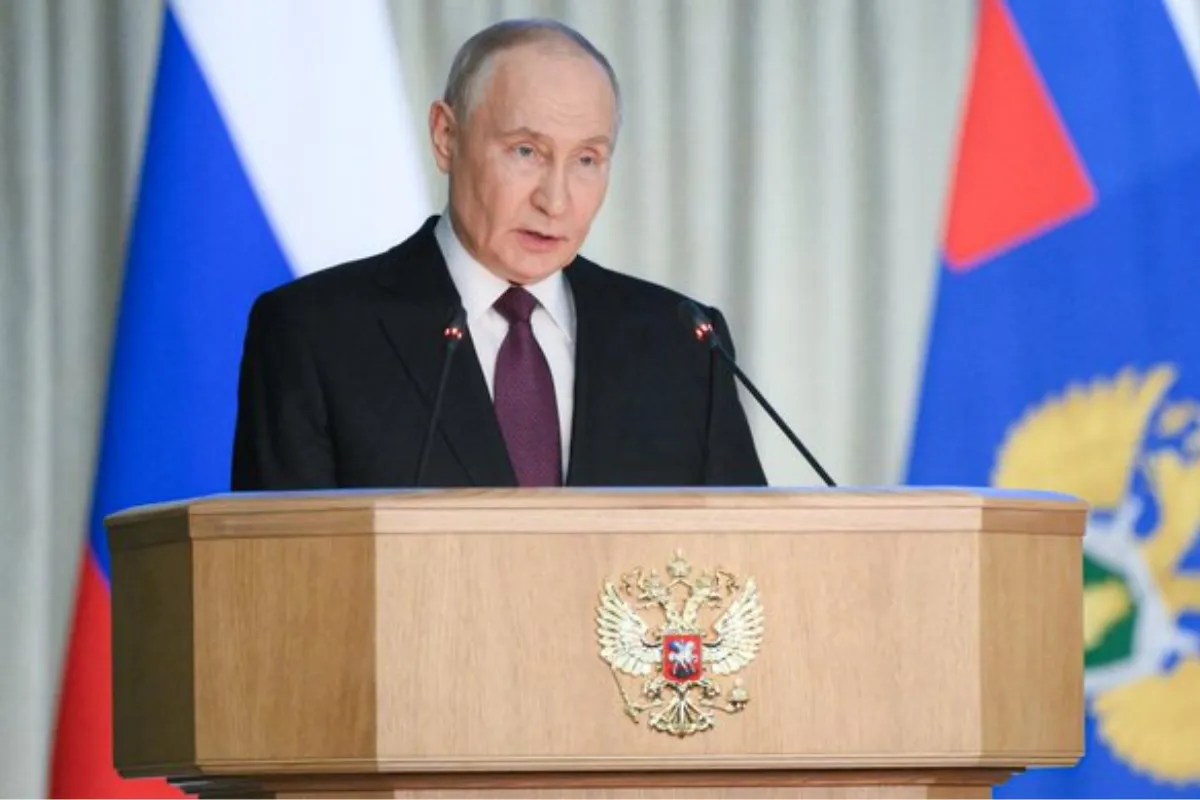
In the quiet, wood-paneled rooms of the Kremlin, the air doesn't smell like gunpowder. It smells like old paper, expensive tea, and the sterile hum of high-end servers. But outside those windows, the world is reshaping itself. When Vladimir Putin and Masoud Pezeshkian sat down to finalize a Comprehensive Strategic Partnership, they weren't just signing a document. They were welding two iron doors shut against a West that has tried for decades to keep them in the dark.
Consider a merchant in a small bazaar in Isfahan. He doesn't care about the high-altitude politics of Moscow. But he cares that his bank can no longer talk to the world. He cares that the shadow of an Israeli strike or a fresh wave of American sanctions hangs over his shop like a permanent storm cloud. For him, the news of a Russian alliance isn't about grand ideology. It is about a lifeline. It is about the hope that if the lights go out, someone in the North has the switch to turn them back on.
This is the reality of the new Russo-Iranian axis. It is a brotherhood born not of cultural affection, but of shared scars.
The Architecture of Defiance
Russia and Iran are currently the two most sanctioned nations on the planet. This shared status has created a strange, magnetic pull between them. In the past, Moscow played a delicate game, balancing its relationship with Tehran against its desire to be seen as a responsible global power by Washington and London. Those days are over. The bridges are burned. Now, there is only the path forward, and it is paved with Iranian drones and Russian satellite data.
The partnership is built on three pillars that go far beyond simple diplomacy.
First, there is the hardware of survival. Iran’s Shahed drones have become a household name in the conflict in Ukraine, providing a low-cost, high-impact way for Russia to pressure air defenses. In exchange, Iran is looking at the Su-35 fighter jets—predators of the sky that could fundamentally shift the balance of power in the Middle East. If Tehran gains the ability to defend its airspace with the same modern tech Russia uses, the calculus for any regional preemptive strike changes instantly.
Second, there is the digital underground. Both nations are working to bypass the SWIFT banking system, creating a private financial lane where the U.S. Treasury has no eyes. This is the "underground railroad" of 21st-century economics. It allows oil to flow and money to move without a single dollar ever being touched.
Third, and perhaps most vital, is the North-South Transport Corridor. This is a massive logistical undertaking—a network of ship, rail, and road routes connecting India to Russia through Iran. It bypasses the Suez Canal entirely. It is a physical manifestation of a world that no longer needs to ask for permission from the West to move its goods.
The Human Cost of the Great Game
We often talk about these alliances as if they are chess moves, but chess pieces don't bleed. The stakes for the Iranian people are visceral. For years, the "Maximum Pressure" campaign from the United States was designed to squeeze the Iranian economy until it popped. The goal was to force a change in behavior by making life unbearable for the average citizen.
But the Russian intervention provides a pressure valve.
When Putin declares that Russia stands "firmly" with Iran, he is telling the Iranian leadership that they don't have to fold. He is offering a security blanket made of Su-35s and S-400 missile systems. To the student in Tehran or the engineer in Tabriz, this means the status quo is likely to remain. The isolation might be deep, but it will not be total.
Russia’s motivations are equally pragmatic. Moscow is hungry for allies who aren't afraid of a fight. In Iran, they have found a partner that has been practicing the art of "sanction-busting" for forty years. Iran is the veteran in this particular war of attrition; Russia is the well-funded newcomer learning the ropes.
A Convergence of Shadows
The timing of this announcement was no accident. As tensions between Israel and Iran reached a fever pitch following missile exchanges and targeted assassinations, Moscow stepped into the frame. Putin isn't just offering words. He is signaling that any move against Tehran is now, by extension, a move against Russian interests.
This isn't a friendship. It's a mutual defense pact between two men who believe the current world order is a cage designed to hold them back. They are tired of the rules written in 1945. They are building a 2026 where the "international community" is a phrase that carries no weight.
Imagine a specialized technician in a Russian factory, working on a guidance system. He is using components that might have been smuggled through a port in the Caspian Sea. He is working on a weapon that might eventually find its way into the hands of a proxy group in Lebanon or Yemen. His work is the invisible thread connecting the frozen fields of the Donbas to the scorched hills of the Levant.
The Invisible Stakes
The real danger of this alliance isn't just the weapons. It’s the permanence.
Once these two economies are fully integrated—once the rail lines are laid and the banking codes are synced—it becomes nearly impossible to untangle them. Even if a more moderate government were to take power in either country tomorrow, the infrastructure of the "East-East" alliance is now part of the soil.
The West has long relied on the idea that isolation leads to collapse. But when the isolated join forces, they create a new center of gravity. They create a world where the "rest of the world" is actually quite small.
We are watching the birth of a parallel reality. In this reality, the dollar is irrelevant, the UN is a debating club with no teeth, and security is bought through the exchange of raw materials and military hardware. It is a gritty, transactional world. It is a world where a cold handshake across the Caspian Sea can make the entire planet shudder.
The ink on the partnership agreement is dry now. The declarations have been made. In the bazaars of Iran and the plazas of Moscow, the people wait to see if this new brotherhood will bring the prosperity they were promised, or if they have simply tied themselves together on a ship headed for a storm.
One thing is certain. The iron doors are shut. The lights in the Kremlin are staying on late tonight, and in Tehran, the radars are turning toward the horizon, watching for a future that looks nothing like the past.
The silence that follows a signed treaty is never truly silent. If you listen closely, you can hear the gears of a new machine grinding into life—a machine built of steel, oil, and a shared, burning resentment for a world that tried to leave them behind.