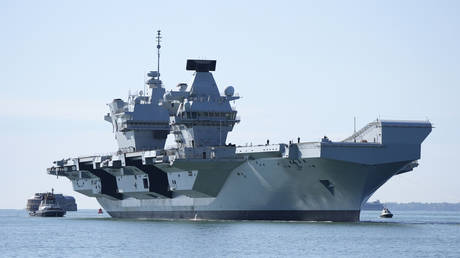
The metal smells of salt and old grease. If you stand on the deck of a Type 23 frigate in the mid-Atlantic, the wind doesn't just blow; it carves. It reminds you that underneath three inches of steel and a few thousand tons of buoyancy lies a silent, pressurized darkness that doesn't care about treaties or sovereign borders.
For decades, we looked at the ocean and saw a highway. We saw a surface to be crossed. But the game has changed, moving from the visible horizon to the crushing depths of the seabed. Britain is currently pivoting its entire naval philosophy to address a threat that most people will never see until their internet goes dark or their heating stops.
The UK government recently announced the formation of a specialized "anti-Russian" naval task force. It sounds like a headline from 1962. It isn't. This is about the vulnerability of the cables and pipes that keep the modern world breathing.
Consider a hypothetical officer named Elias. He sits in a darkened room illuminated by the glow of sonar displays. His job isn't to look for a fleet of battleships. He is looking for a ghost. He is looking for a Russian "research" vessel that has been hovering over a specific coordinate for three days—a coordinate where a fiber-optic cable the size of a garden hose carries the banking data for half of London.
The Invisible Achilles Heel
We live in a fragile web. Roughly 97% of global communications travel through undersea cables. These are not indestructible monoliths. They are bundles of glass and plastic resting on the silt of the ocean floor. If you wanted to cripple a nation, you wouldn't need to drop a bomb on its capital. You would just need to cut the cord.
Russia knows this. Their GUGI—the secretive Main Directorate of Deep-Sea Research—operates specialized submarines designed to manipulate or destroy infrastructure at depths that would crush a standard attack sub. They have been mapping our vulnerabilities with surgical precision.
The British response is a calculated admission of risk. By establishing a dedicated force to patrol the North Atlantic and the High North, the Royal Navy is signaling that the era of "peace dividends" is officially over. This isn't just about big ships with big guns. It is about a high-tech shell game played in the dark.
Steel and Silicon
The backbone of this new strategy involves the Multi-Role Ocean Surveillance (MROS) ships. These aren't the sleek, aggressive destroyers you see in recruitment posters. They look more like commercial oil-rig supply vessels. That is intentional. They are floating workshops for underwater drones and autonomous sensors.
The first of these, the RFA Proteus, acts as a mothership for a swarm of "remotely operated vehicles." These drones go where humans cannot. They crawl along the seabed, checking for "taps" or explosive charges left by unwanted visitors.
Imagine the sheer scale of the task. The North Sea is a graveyard of shipwrecks, discarded fishing gear, and shifting sands. Finding a small device attached to a pipe is like finding a specific needle in a field of needles. It requires a level of persistence that humans simply cannot maintain. This is why the Navy is leaning so heavily on automation.
But machines lack intuition. They can see a shape, but they can't always understand intent. That remains the burden of the sailors. They have to decide if a fishing trawler dragging its nets too close to a pipeline is an accident or a rehearsal for a blackout.
A Shift in the Winds
The geography of the threat is shifting toward the "GIUK Gap"—the stretch of water between Greenland, Iceland, and the United Kingdom. During the Cold War, this was the gateway Russian subs had to pass to reach the Atlantic. Today, it is the front line of a new kind of resource war.
As the Arctic ice melts, new shipping lanes open. New gas fields become accessible. The High North is no longer a frozen wasteland; it is a contested prize. Britain’s decision to spearhead this task force alongside JEF (Joint Expeditionary Force) partners—including Norway, the Netherlands, and the Baltic states—is a recognition that no single nation can guard the basement of the world alone.
Logistics tell the story. The UK is spending billions to refit its fleet because the math of modern warfare has shifted. A single sophisticated torpedo costs millions, but a well-placed disruption to an underwater power interconnector can cause billions in economic damage in a single afternoon.
The stakes are personal, even if they seem abstract. When the price of electricity spikes or your video call drops, you don't think about a Russian mini-sub five hundred miles away in the Norwegian Sea. But the Admiralty does.
The Human Cost of Constant Vigilance
Burnout is a quiet enemy. The crews tasked with these "shadow" patrols don't get the glory of a port visit in the Mediterranean. They spend weeks in the grey, churning waters of the North Atlantic, staring at screens, waiting for a blip that might never come.
It is a psychological grind. You are defending against a "maybe." You are guarding a "what if."
History teaches us that when empires feel their influence slipping, they look for soft spots. They look for the places where their rivals aren't looking. For a long time, we weren't looking down. We were looking at the sky, at cyber-attacks, and at traditional border skirmishes. We forgot that our entire digital existence is anchored to the mud of the sea.
The new task force is a massive, expensive, and necessary "Keep Out" sign. It is an attempt to make the cost of interference higher than the reward.
The Silence of the Deep
There is a specific kind of silence you find in the deep ocean. It isn't the absence of sound, but the presence of a weight so immense it feels like it’s pressing against your thoughts.
As the British fleet expands its footprint in the North, it enters that silence. It is searching for the faint hum of a propulsion system or the metallic click of a drone being deployed. This is the new reality of "defense." It is no longer about holding a line on a map. It is about holding the integrity of the invisible threads that allow us to live our modern lives.
The ships will sail. The drones will dive. And most of us will continue to scroll through our phones, unaware of the cold, dark chess match being played two miles beneath the surface to ensure the screen stays lit.
Somewhere in the North Atlantic, a sonar operator adjusts his headset. He hears a rhythmic pulsing. Is it a whale? Is it a tectonic shift? Or is it the sound of someone trying to turn off the world?
He waits. He watches. The shadow moves, and the hunt continues.