Neon bleeds across the asphalt of Causeway Bay, reflecting off the slick umbrellas of a Tuesday evening downpour. To the tourist with a camera swinging from their wrist, this is a cinematic fever dream of perpetual motion and high-octane wealth. Luxury storefronts glow like aquariums filled with gold and diamond scales. Ferraris idle against the curb, their low growls swallowed by the roar of double-decker buses.
Walk forty minutes uphill. Leave the neon behind.
Enter a subdivided flat in Sham Shui Po. Here, the air hangs heavy with the scent of damp concrete and cheap cooking oil. The apartment—if three hundred square feet partitioned into four metal cages can be called an apartment—is home to a family of four. A grandfather sleeps on a folding cot that doubles as a kitchen chair when the sun is up. His granddaughter does her homework balanced on her knees, the flickering light of a single bare bulb casting long, jagged shadows against walls stained with decades of humidity.
These two realities do not merely coexist. They occupy the exact same coordinate system, separated only by altitude and the invisible, unyielding architecture of modern capital.
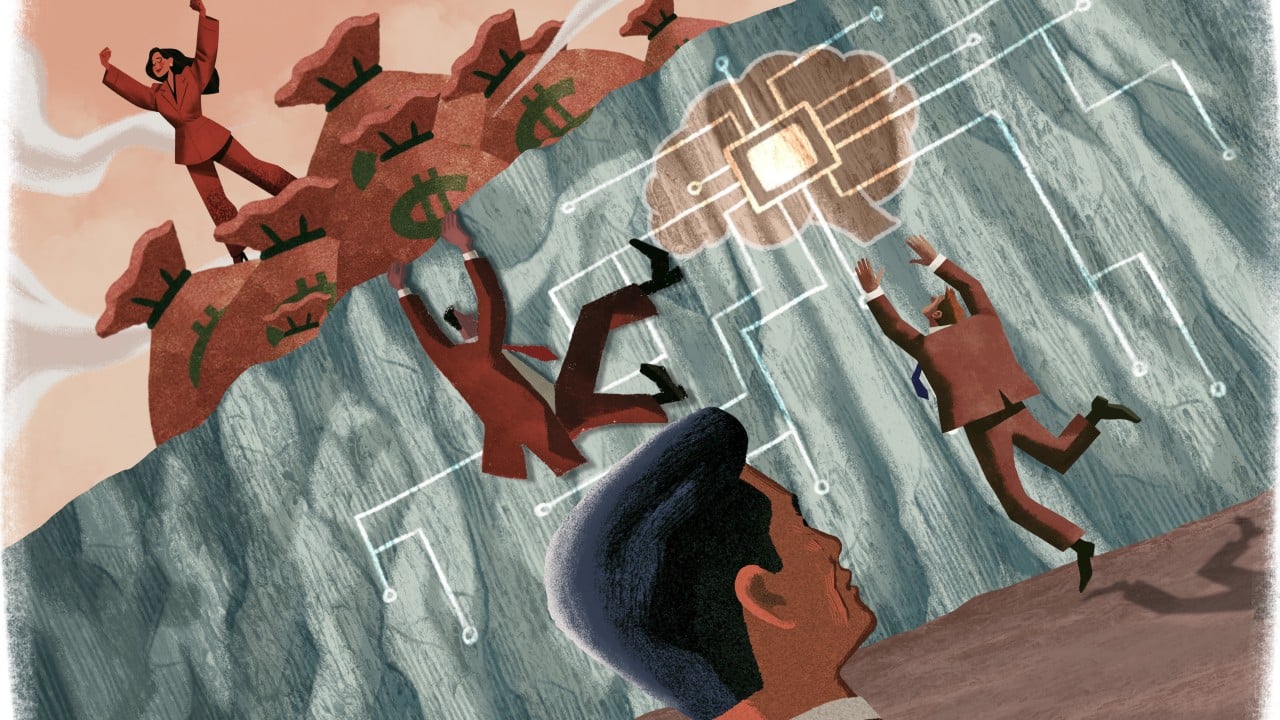
Hong Kong has long prided itself on being a machine for manufacturing miracles. It is a vertical sanctuary where fortunes are conjured from reclaimed land and financial arbitrage. Yet beneath the glittering skyline, a quiet fracture is widening. Economists debate the geometry of this split. Will the city morph into an M-shaped society, where the middle class is hollowed out entirely and citizens are violently hurled toward either extreme of ultra-wealth or entrenched poverty? Or will it follow the olive shape, bulging in the middle with a swollen, complacent bourgeoisie while the edges remain pinched and dry?
The models are sterile. The human cost is not.
Consider Wai-man. He is a fictional composite drawn from hundreds of real-life transport workers who navigate the city's veins every dawn. Wai-man wakes at four in the morning. His joints ache from twenty years of hauling cargo through the damp labyrinth of Western Wholesale Food Market. He makes enough to pay rent, eat rice, and occasionally buy a cartoon bun for his son. But when he looks up at the glass monoliths piercing the clouds above Central, he is not looking at architecture. He is looking at a fortress wall.
Property in Hong Kong is not merely shelter. It is the ultimate religion.
For decades, soaring land values fueled the engine of growth. But land has become a finite resource hoarded by a handful of corporate conglomerates, driving housing costs into the stratosphere. When the foundation of an economy is tied to the absurd valuation of dirt and concrete, shelter stops being a human right and transforms into a speculative lottery.
Look at the numbers. The Gini coefficient, that dry academic metric used to measure income inequality, paints a sobering portrait. Hong Kong consistently logs some of the highest inequality figures in the developed world. A staggering portion of the elderly population lives below the poverty line, pushing shopping carts loaded with discarded cardboard boxes through the financial district, their gnarled hands sorting through the refuse of the very people trading derivatives a few floors above.
We pretend this is normal. We call it the price of progress.
An M-shaped society is not an abstract theory. It is a daily practice. It is the widening chasm between the child who attends an international school with an annual tuition that could buy a modest sedan, and the child who shares a bunk bed with a sibling while studying under a dim hallway lamp because their room lacks a desk. When social mobility stalls, hope becomes a scarce commodity.
Economists talk about structural shifts. They speak of the decline in traditional manufacturing, the rise of a hyper-financialized service sector, and the squeeze on small businesses crushed by exorbitant commercial rents. All true. All cold.
The real engine of this inequality is simpler and more brutal. It is the compounding advantage of ownership. If you own property, the city bends to serve you. If you do not, the city squeezes you until every breath is accounted for in rent receipts and utility bills.
The middle class, once the proud backbone of this territory, feels the floor softening beneath its feet. They are the sandwich generation. They earn too much to qualify for public housing subsidies, yet earn too little to buy into the private market without chaining themselves to thirty-year mortgages that consume half their monthly take-home pay. They drink artisanal coffee on Sunday, but a single medical emergency or a sudden job loss could send them cascading down the slope into financial precarity.
Is the olive shape possible? Can the middle expand again?
Only if the fundamental rules of engagement are rewritten. Only if land supply ceases to be a sacred cow and becomes a public trust. Only if wages in the service and care economies reflect the dignity of human labor rather than the convenience of profit margins.
The rain stops over Victoria Harbour. The mist clears, revealing the jagged teeth of the skyline once more. Down below, in the alleyways, the cardboard collectors fold their wares for the night, waiting for tomorrow's dawn. The city hums on, beautiful and broken, keeping its secrets in the shadows of the skyscrapers.