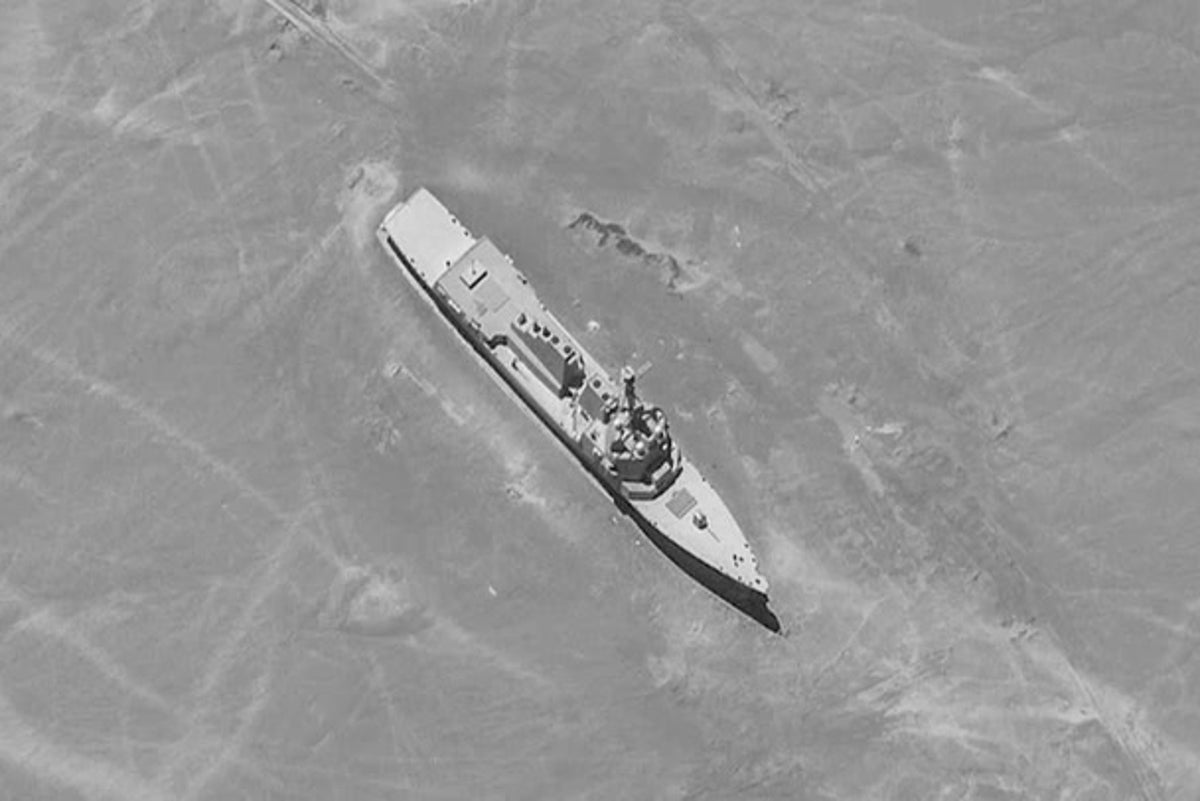
The wind in the Tarim Basin does not blow; it scours. If you stand in the expanse of the Taklamakan Desert, the silence is so absolute it feels heavy, pressing against your eardrums like deep water. For centuries, this wasteland swallowed silk traders, broken empires, and wandering monks. Today, it swallows satellites.
High above the dust storms, orbiting eyes peer down at a specific patch of nothingness. If you zoom in close enough through the digital haze, the desert floor shifts. The endless yellow clay gives way to something impossible.
A silhouette. A gray, jagged ghost etched into the dirt.
It is the unmistakable outline of an American aircraft carrier, rendered perfectly in full-scale concrete and steel, baking under a merciless sun.
We live in an era obsessed with digital warfare. We worry about code, algorithms, and invisible malware slipping through fiber-optic cables. Yet, out in the desolation of Xinjiang, the world’s rising superpower is spending millions of dollars to build massive, physical monuments to their greatest anxiety.
To understand why this concrete mirage exists, you have to look past the satellite imagery. You have to understand the human terror of being blind in the dark.
The Ghost Fleet of Ruoqiang
Imagine a young radar operator stationed in the command center of a Chinese missile unit. Let's call him Chen. He sits in a sterile, fluorescent-lit bunker thousands of miles away from the ocean. His entire universe is defined by glowing green monitors and data streams.
Chen’s job is simple but terrifying: if the unthinkable happens, he must guide a ballistic missile—traveling at five times the speed of sound—straight into the heart of a moving American carrier strike group.
But a missile is only as smart as the eyes that guide it.
Out in the open ocean, a warship is not just a hunk of metal. It is a shifting, radio-emitting, radar-reflecting city. It tricks the eye. It jams electronics. For a missile guidance system rushing down from the edge of space, the Pacific Ocean looks like a chaotic sheet of aluminum foil reflecting blinding sunlight.
That is why the replica in the desert exists.
Built near the town of Ruoqiang, the site is a masterclass in deception and preparation. It is not just a flat drawing on the ground. Recent intelligence reveals it is a sophisticated, three-dimensional mockup. The Chinese military did not just stop at the carrier, either. They built replicas of Arleigh Burke-class destroyers alongside it. They even mounted these massive structures on rails.
Think about the sheer engineering required. They are moving entire buildings across the desert floor to simulate a strike group maneuvering through the waves.
Why? Because Chen’s targeting algorithms cannot practice on the real thing. They need a proxy. They need a physical canvas where engineers can test how radar waves bounce off the specific angles of an American superstructure. The desert becomes a giant laboratory. The concrete is the control variable.
The Geometry of Fear
Every military strategy is born from a specific trauma. For the United States, it was Pearl Harbor. For China, a more recent humiliation shaped their modern doctrine.
In 1996, during the Third Taiwan Strait Crisis, the United States dispatched a massive naval armada to the waters off China’s coast. Two American aircraft carrier battle groups cruised through the straits with near-total impunity. China’s military could only watch. They lacked the technology to track them accurately, let alone threaten them.
The message was clear: whoever controls the waves controls the destiny of the region.
The response to that vulnerability took decades to mature, culminating in what analysts call Anti-Access/Area Denial. The crown jewels of this strategy are missiles like the DF-21D and the DF-26—weapons explicitly designed to be carrier killers.
But a weapon is useless if it swings wildly in the dark.
"Space is transparent, but the ocean is opaque," a naval historian once told me over coffee in a cramped Washington diner. "If you can't find it, you can't hit it. And if you think you found it, you better be damn sure it isn't a decoy."
This brings us back to the heat distortion of the Taklamakan. By building these replicas, Chinese engineers are solving the geometry of fear. They are training their satellites to recognize the exact thermal signature of an American flight deck under different atmospheric conditions. They are teaching their optical sensors how to differentiate between the real silhouette of a destroyer and a cleverly deployed smoke screen.
It is a high-stakes game of visual recognition. The desert targets are embedded with extensive instrumentation networks. When a dummy warhead or a simulated laser strike hits the concrete hull, thousands of sensors record the shockwaves, the heat distribution, and the fragmentation patterns.
Every test run refines the software. Every crater in the sand makes the hypothetical strike on the open ocean a fraction of a percent more lethal.
The View from the Bridge
Now shift your perspective across the ocean. Consider the view from the bridge of an American destroyer patrolling the South China Sea.
The crew is young. Most of the sailors monitoring the sonar and radar screens are barely old enough to rent a car. They rely on the assumption that their ship is an invisible fortress, protected by layers of Aegis combat systems and electronic countermeasures designed to confuse incoming threats.
But the knowledge of the desert replica changes the psychological calculus.
It tells the crew that the adversary is not guessing. They are studying the ship's specific blueprints. They are practicing the exact angles of attack. The concrete ship in Xinjiang is a silent message broadcast to every sailor in the Pacific: We see you, we know your dimensions, and we are practicing for the day we meet.
It turns a abstract technological standoff into something deeply visceral. The stakes are no longer measured in defense budgets or geopolitical rhetoric. They are measured in the thickness of a steel hull and the split-second response time of a point-defense weapon.
The Illusion of Certainty
There is a profound irony buried in the sands of the Tarim Basin. The more energy a nation spends trying to achieve absolute certainty in warfare, the more elusive that certainty becomes.
The concrete carrier cannot turn. It cannot launch real aircraft. It cannot jam an incoming frequency or fight back. It sits there, a compliant, helpless victim to every test cycle.
In the real world, chaos reigns. The moment a conflict begins, the ocean becomes a swirling mess of decoy barges, electronic noise, bad weather, and human panic. A target that looked perfectly clear against the stable, dry background of the desert suddenly disappears into the gray swells of a Pacific storm.
Yet, the construction continues. New tracks are laid. New mockups appear, mimicking different port facilities and naval bases across the Pacific chain.
It is a testament to the modern dilemma of deterrence. You build the weapon so you never have to use it. You build the replica so the enemy knows you can hit the real thing. Both sides watch each other through the digital keyhole of satellite imagery, locked in a dance where the props are made of concrete and the stage is a vast, empty wasteland.
The sun sets over the Taklamakan, casting long, distorted shadows across the fake flight deck. The metal rails hum quietly as the desert temperature plummets. From space, the shape looks perfectly real, a monument to a war that everyone is preparing for, and everyone hopes will remain trapped in the sand.


