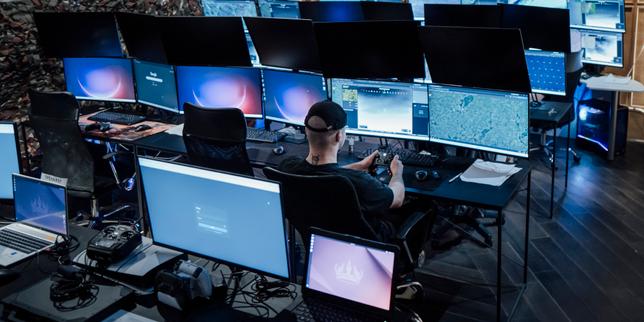
The air smells of stale coffee and damp drywall in the basement office at three in the morning. Outside, the curfew grips the streets of Kyiv in a heavy, suspicious silence. Inside, five men and women stare at a bank of glowing monitors, their eyes red-rimmed, tracking silent predators dancing across a digital sky.
They are not soldiers. They are not wearing camouflage adorned with state insignia. They wear fleece pullovers and running shoes. Their coffee cups are littered with candy wrappers. But they are holding the line for a mid-sized pharmaceutical packaging plant fifteen miles away.
Over the last three years, the corporate office in Ukraine has undergone a terrifying metamorphosis. Once defined by quarterly reports, supply chain logistics, and HR seminars, survival now hinges on a completely different metric.
Fitted with rotors. Packed with explosives. Flying low.
The New Guard
Oleksiy used to write software for a logistics firm. Today, he is a shift supervisor for a private security company that didn't exist before the invasion. His hands, once meant for mechanical keyboards, hover over a custom console running modified open-source radar software and video feeds stitched together from acoustic sensors bolted to factory rooftops.
Private enterprise in a war zone faces a cruel mathematical reality. State air defense protects critical infrastructure, government seats, and power grids. It cannot stretch to cover every grain elevator, pharmaceutical warehouse, or automotive component assembly line. When a factory costs twenty million dollars to build and employs three hundred people whose families depend on those paychecks, waiting for state intervention is a gamble with impossible odds.
Enter the specialized private security firms.
These are not the mall cops of yesterday, nor are they traditional armed guards built to deter a petty thief with a crowbar. They are civilian defense contractors operating in the gray space between corporate risk management and tactical warfare. (Note: When I speak of these operators, I am drawing from documented patterns observed across industrial hubs in central and eastern Ukraine where private capital has been forced to buy its own defense.)
They deploy acoustic tripwires. They operate portable electronic warfare domes. They launch counter-drone interceptors from the back of converted pickup trucks parked behind loading docks.
The Anatomy Of An Attack
Consider what happens next on a typical Tuesday night.
A tiny acoustic sensor—a ruggedized microphone wired to a microcomputer—picks up a distinctive high-pitched whine two miles away. It matches a signature. Shahed. Or a modified FPV drone repurposed for industrial sabotage. The sensor doesn't sleep. It doesn't drink coffee. It simply registers the frequency and sends a packet of data to Oleksiy’s screen.
A red pulse blinks on the digital map.
Time to impact: four minutes.
In that four-minute window, the corporate boardroom’s investment choices materialize in real-time. Do they have the right frequency jammers active? Are the mobile interceptor teams fueled and ready in the gravel lot behind warehouse building four?
Oleksiy doesn't panic. He has lived through this rhythm a hundred times. He taps his headset, speaking quietly to a two-person mobile crew stationed in a van near the perimeter.
"Bird inbound, sector four. Bearing one-two-zero. Moving fast."
Across town, inside the van, Viktor kills his cigarette. He and his partner don’t talk about quarterly profits. They talk about wind speed, battery voltage, and the line of sight between their directional antenna and the approaching threat. They lift a boxy, rifle-shaped electronic jammer. They step out into the cold night air.
This is the invisible economy of modern survival. Millions of dollars spent not on marketing or expansion, but on spectrum dominance and kinetic counter-measures.
The Corporate Balance Sheet Of War
We used to measure business risk in currency fluctuations, regulatory changes, and supply chain bottlenecks. Now, risk management includes ballistic glass thickness, backup diesel generators buried beneath concrete bunkers, and monthly retainers for anti-drone tactical units.
Chief executive officers in Kyiv, Dnipro, and Kharkiv have had to become amateur defense strategists. They balance insurance policies that explicitly exclude acts of war against the brutal cost of contracting private security outfits that specialize in anti-drone protection.
It is an expensive proposition. A single electronic warfare rig can cost tens of thousands of dollars. Trained crews demand hazard pay, specialized medical insurance, and continuous technical upgrades to counter the ever-evolving firmware updates pushed by enemy drone operators.
Yet, compared to the alternative—a smoking crater where a distribution center used to stand—the investment is trivial.
Businesses are discovering that keeping the lights on requires keeping the skies clear. When the state's protective umbrella proves too narrow for the sheer volume of territory under threat, the free market steps into the breach. Private security companies fill the vacuum, transforming corporate real estate into fortified islands of economic continuity.
The Human Core
Behind the hardware, behind the encrypted radio chatter and the flickering thermal scopes, lies the stubborn heartbeat of ordinary people refusing to stop working.
I spoke with a warehouse manager last winter who told me something I will never forget. We were standing in a cavernous, unheated shipping bay filled with pallets of baby formula. The windows were taped in complex X-patterns to minimize glass shatters.
He looked at the towering stacks of cardboard boxes and said, "If we stop packing, the store shelves in Lviv go empty. If the shelves go empty, people lose faith. And once people lose faith, the war is already over."
That is the hidden weight carried by these private security teams. They are not merely protecting corporate assets or shareholder value. They are protecting the fragile, stubborn normalcy of daily life. Every drone intercepted before it hits a factory roof is a quiet victory for the baker, the truck driver, the accountant, and the child waiting for breakfast.
The shift winds down. The sky outside turns a pale, bruised shade of gray as dawn bleeds over the Dnieper River.
In the basement office, Oleksiy stretches his arms, pulling his fleece tighter around his shoulders. The monitors remain steady. The alerts are clear. For another night, the private shield has held, and the quiet machinery of life prepares to wake up and start all over again.


