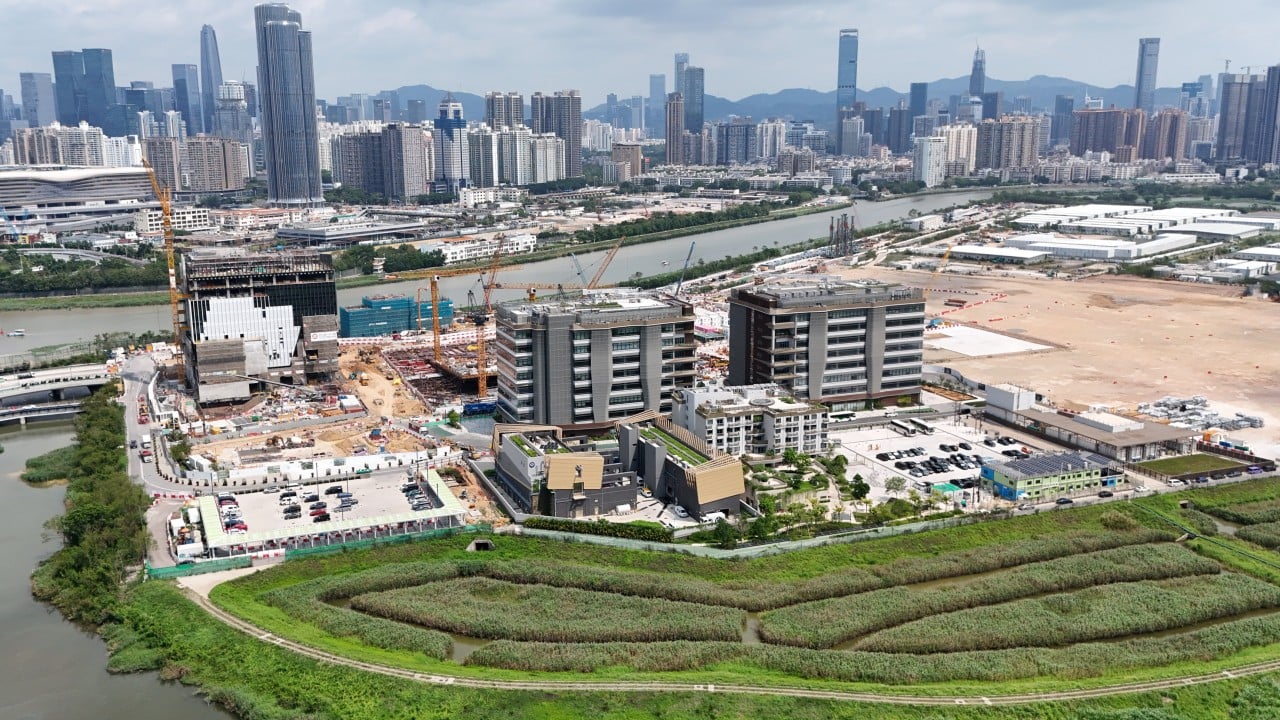
Hong Kong cannot simply copy paste the Hefei model to ensure the success of the 30,000-hectare Northern Metropolis. While policy pundits increasingly urge the city to adopt mainland China’s most celebrated state-backed venture capital framework, they overlook a structural reality. The mechanics of the Hefei model rely on a highly specialized bureaucratic apparatus and aggressive equity stakes that directly contradict Hong Kong’s institutional architecture, currency peg, and historical risk aversion. Merely importing the terminology of government guidance funds will not magically turn the San Tin Technopole into a thriving semiconductor or electric vehicle ecosystem.
The Northern Metropolis is envisioned as an economic counterweight to the traditional financial core around Victoria Harbour. It aims to house 2.5 million people and generate 650,000 jobs, shifting the economic gravity of the territory toward the Shenzhen border. However, the current strategy leans heavily on land resumption, infrastructure delivery, and tax incentives. This is a classic real estate approach to industrial policy.
To bridge the gap, critics point across the border to Hefei, a landlocked provincial capital in Anhui that transformed itself from an agricultural backwater into a tech juggernaut.
The Hefei model is a system where the municipal government acts as a top-down venture capitalist. Instead of handing out standard corporate subsidies, the state deploys trillions of yuan through state-owned guidance funds to take direct, early-stage equity stakes in high-risk industrial giants. They famously rescued the electric vehicle maker NIO from the brink of bankruptcy in 2020 with a 7 billion yuan injection. They anchored the display giant BOE and built entire semiconductor supply chains from scratch. Once these anchor tenants stabilize and attract private capital, the government exits its equity positions, pools the profits, and reinvests them into the next frontier technology.
It is an elegant, closed-loop system. But it is a system that Hong Kong is structurally ill-equipped to run.
The illusion of the investment banker government
The core engine of Hefei's success is not the capital itself. It is the highly specialized nature of its civil service. In Hefei, bureau officials operate like seasoned private equity partners. They utilize a strict decision-making framework known as the four-bench review and the three inquiry tests, which require officials to systematically interrogate scientists, private investors, and entrepreneurs before committing a single yuan.
Hong Kong’s administrative elite are trained under a completely different paradigm. The civil service is designed for regulatory compliance, fiscal conservatism, and administrative neutrality. A typical administrative officer rotates departments every few years, moving from highways to social welfare, then to environmental protection. They are master generalists. They are not trained to read semiconductor balance sheets, evaluate the commercial viability of a solid-state battery startup, or predict which quantum computing architecture will dominate the market in 2035.
If the Hong Kong government tries to pick winners under the guise of the Hefei model, it faces an existential dilemma.
Without the domain expertise to conduct deep, industrial-grade due diligence, bureaucrats will inevitably default to low-risk, politically safe investments or fall prey to smooth-talking asymmetric players. The Hong Kong Innovation and Technology Venture Fund and the HK$10 billion injection into the Hung Shui Kiu Industry Park indicate a willingness to spend. Yet, spending capital is not the same as managing venture risk.
The risk tolerance paradox
True venture capital requires an acceptance of failure. Hefei explicitly institutionalizes this through a formalized risk tolerance ratio built into its public asset management guidelines. If a government fund loses money on a highly complex, early-stage technology bet, the investment managers are legally protected from professional ruin, provided they followed the correct due diligence protocols.
Now consider the political reality of Hong Kong.
Every dollar of public money spent is subject to intense scrutiny by the Legislative Council, the Public Accounts Committee, and a highly critical public. Imagine the fallout if a Hong Kong government-backed vehicle took a 20% equity stake in a local biotech startup that subsequently went bust, wiping out HK$2 billion of taxpayer funds. The headlines would scream of incompetence, cronyism, and the squandering of public reserves.
Because the city lacks a political framework to normalize and absorb public investment losses, its current state-backed investment vehicles are structurally timid. They function more like cautious late-stage co-investors than bold market-makers. They wait for private institutional capital to lead the round, completely defeating the purpose of the Hefei model, which is designed to step in precisely when private markets refuse to take the risk.
Capital mobility and the anchor tenant problem
The physics of industrial clusters require a closed geographic ecosystem to function efficiently. When Hefei invests in an anchor tenant like NIO or BOE, it dictates explicit terms. The company must build its primary manufacturing facilities within the city limits, and it must source a specific percentage of its components from local upstream suppliers. This creates a captive ecosystem that locks wealth, employment, and intellectual property within the municipality.
Hong Kong operates on a completely different economic plane. It is a hyper-open economy with an entirely convertible currency pegged to the US dollar, no capital controls, and a legal system rooted in English common law. This openness is its greatest strength, but it makes the strict enforcement of localized supply chains nearly impossible.
[Traditional Real Estate Subsidies] -> Low Risk -> Weak Ecosystem
[Hefei Direct Equity Model]       -> High Risk -> Captive Local Ecosystem
[Hong Kong Hybrid Gap]            -> High Risk -> Capital Flight / Leakage
If the Hong Kong government anchors a multinational artificial intelligence or green tech firm in the San Tin Technopole using heavy equity financing, it cannot easily force that firm to build its heavy manufacturing or data center architecture inside the territory. High land costs, strict environmental regulations, and power constraints mean that the company will naturally want to perform high-value research and development in Hong Kong, structure its financing in Central, but push its actual supply chain operations across the border into Shenzhen, Dongguan, or Huizhou.
The capital loop breaks. Hong Kong taxpayers take the early-stage equity risk, but the tangible industrial clustering and blue-collar employment benefits flow directly out of the city.
A blueprint for a distinct Hong Kong model
Instead of mimicking a mainland municipal model designed for a completely different regulatory and political ecosystem, Hong Kong must design an asymmetric strategy that plays to its unique structural advantages. The city does not need to become a venture capitalist. It needs to become the ultimate global validator and clearinghouse for deep tech.
The regulatory sandbox as a premium asset
The most valuable asset Hong Kong can offer tech firms in the Northern Metropolis is not cheap land or direct equity injections. It is a distinct regulatory environment.
Because Hong Kong maintains a separate legal system and data governance framework under the One Country, Two Systems principle, it can act as a trusted regulatory sandbox for advanced technologies that face geopolitical or compliance bottlenecks elsewhere.
The government should focus on creating specialized, frictionless regulatory zones within the San Tin Technopole. For example, by establishing a dual-data governance zone, international genomics companies could legally analyze mainland biomedical data alongside global datasets within a secure, common-law protected environment. That is an advantage that Hefei, Shenzhen, or Shanghai can never replicate.
Rewiring the Hong Kong Investment Corporation
The Hong Kong Investment Corporation (HKIC), which manages various state-backed funds, must alter its mandate. Rather than trying to emulate the direct, state-directed industrial planning of mainland guidance funds, the HKIC should position itself as the premier global matchmaker for patient capital.
The focus should switch to co-investment models that leverage international venture capital expertise.
[HKIC Sovereign Capital] + [Global Tier-1 VC Firms] -> Rigorous Due Diligence -> Co-Investment
By partnering with top-tier international venture funds and requiring them to commit their own capital alongside public funds, Hong Kong can solve its bureaucratic expertise deficit. The private funds handle the cutthroat due diligence and commercial scaling, while the government provides institutional stability and long-horizon infrastructure commitments.
Exploiting the infrastructure ledger
The Northern Metropolis should not be treated as a collection of real estate plots to be sold to the highest-bidding property developers. It must be treated as a living laboratory for infrastructure deployment.
The territory possesses world-class public utilities, a highly efficient mass transit system, and an ultra-dense urban fabric. The government can catalyze industrial development by acting as the primary customer for the technologies it wants to cultivate.
If the city wants to build a world-class autonomous vehicle cluster in Hung Shui Kiu, it should not merely subsidize driverless car startups. It should rewrite the local transport ordinances, fully digitize the road infrastructure of the new development areas, and guarantee large-scale public procurement contracts for autonomous public transport. This creates immediate, real-world application scenarios.
Startups do not just want capital. They want customers, data, and a track record of deployment that they can sell to the rest of the world.
The urge to copy the Hefei model stems from a well-intentioned desire for speed and decisiveness in an era where Hong Kong urgently needs a new economic engine. But blind emulation of mainland industrial policy ignores the delicate institutional machinery that makes Hong Kong valuable to both China and the global economy in the first place. The success of the Northern Metropolis will not be measured by how closely it copies the strategies of landlocked mainland cities, but by how effectively it leverages its position as an international, common-law financial hub to build an entirely new species of tech ecosystem.