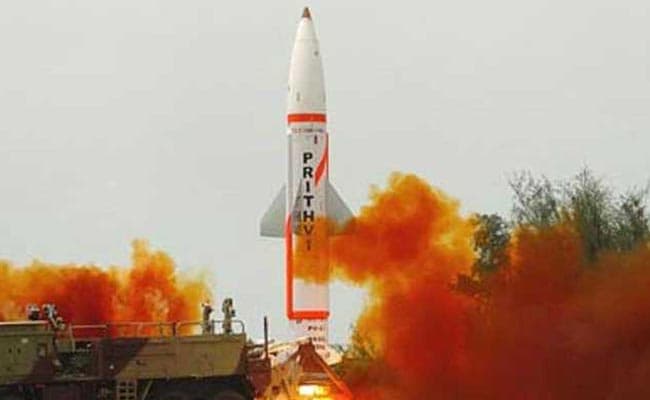
The media is collectively hyperventilating over a number: 190.
Following the release of the Stockholm International Peace Research Institute (SIPRI) Yearbook, mainstream defense journalism has defaulted to its laziest instinct. They are treating nuclear arsenals like a cricket scoreboard, breathlessly reporting that India has expanded its inventory to 190 warheads, edge-ing past Pakistan's 170 while still trailing China's 620.
This bean-counting exercise is not just shallow; it is strategically illiterate.
In nuclear deterrence, stockpiling un-mated warheads in a central warehouse does not equate to power. Having 190 nuclear weapons sitting in pieces under civilian lock-and-key is fundamentally the same as having zero if a decapitating first strike hits before you can assemble them.
The real story buried beneath the headlines is a profound, structural mutation in how South Asia approaches the brink of annihilation. For the first time, India has operationally deployed 12 nuclear warheads in peacetime, mating them directly to delivery systems.
Fixating on the absolute total of 190 warheads misses the entire mechanical shift of modern deterrence. The absolute size of a stockpile is a vanity metric. Survivability, delivery readiness, and response latency are the only variables that actually matter.
The Mirage of Stockpile Domination
I have watched defense analysts spend years treating nuclear parity as a simple mathematical equation. If Country A has 10 more warheads than Country B, Country A is winning. This logic is a relic of the early Cold War, and it falls apart when applied to contemporary Asian geopolitics.
Nuclear weapons are not conventional artillery shells. You do not win a nuclear exchange by having more left over at the end. You win—or rather, prevent the exchange entirely—by guaranteeing that a credible, devastating second-strike capability survives any imaginable surprise attack.
Under India's historical posture, the nation adhered strictly to a de-alerted, disassembled status. The civilian Department of Atomic Energy kept the cores, while the military controlled the delivery vehicles. This separation was designed to eliminate the risk of accidental launches or unauthorized use, providing a high degree of political safety.
However, this classic posture creates a massive operational vulnerability: time. If an adversary launches a hypersonic or low-flying cruise missile, the window to assemble, transport, mate, and launch a retaliatory strike shrinks to zero.
By shifting 12 warheads into active deployment—likely within canisterized, road-mobile Agni missiles and aboard the SSBN fleet like the INS Arihant—New Delhi is signaling an exit from this leisurely operational model. Canisterization seals the warhead inside the missile body, allowing it to be stored ready-for-launch for long periods.
This means India is trading a portion of its traditional safety buffer for immediate readiness. A stockpile of 190 inert weapons is a logistical headache during an active crisis; 12 canisterized, mated warheads hidden at sea or in underground silos are a functional deterrent.
Dismantling the De-Escalation Myth
When analysts look at the military crisis between India and Pakistan, the standard narrative claims that nuclear weapons successfully kept the peace. The "lazy consensus" argues that because neither side initiated a nuclear exchange, deterrence worked exactly as intended.
That view is dangerously optimistic. The reality of modern conflict proves that the line between conventional skirmishes and nuclear escalation is thinning rapidly.
Consider a scenario where conventional operations target dual-use command facilities. During intense border friction, conventional air or cyber strikes aimed at neutralizing an enemy's conventional radar assets could easily be misinterpreted as the opening salvo of a preemptive nuclear decapitation strike. If an adversary believes their nuclear retaliatory capability is being dismantled by conventional means, the pressure to "use them or lose them" becomes overwhelming.
Furthermore, the introduction of cyber operations into active military friction introduces extreme volatility. When tactical networks are compromised, commanders lose real-time visibility. In the fog of war, a sudden loss of communications with a missile base is not viewed as a routine network failure; it is interpreted as the prelude to a strike.
The assumption that states will always possess perfect information and act with clinical rationality during a crisis is a fantasy. Increasing the number of warheads to 190 does not solve the structural vulnerability of communication breakdowns. If anything, a larger, more distributed arsenal expands the surface area for technical miscalculation and cyber interference.
The Credibility Deficit of No First Use
To understand why India is shifting toward active, peacetime deployment, you have to look at the severe friction within its own declared doctrine. Officially, New Delhi maintains a strict No First Use (NFU) policy coupled with a promise of "massive retaliation."
On paper, this sounds clean. In practice, it presents a massive operational contradiction that the military establishment has had to quietly engineer its way around.
If an adversary uses a tactical, low-yield nuclear weapon against an advancing armored column on their own soil, a "massive" strategic response targeting major civilian centers invites a counter-response that ensures mutual destruction. The credibility of promising a total civilization-ending strike in response to a limited tactical provocation is incredibly low.
Because an adversary might gamble that India would hesitate to initiate a total exchange, New Delhi cannot rely purely on the abstract threat of its total stockpile. It requires immediate, survivability-focused technical upgrades.
This is the precise technical driver behind the development of Multiple Independently Targetable Re-entry Vehicles (MIRVs) and the operationalization of the sea-based leg of the triad.
- MIRV Technology: Allows a single ballistic missile to carry several distinct warheads, each capable of hitting a different target. This neutralizes regional missile defense networks without requiring a massive expansion in the number of physical rocket launchers.
- Canisterization: Provides the physical infrastructure needed to keep weapons ready for instantaneous launch, shifting the posture from a reactive bureaucratic process to an active operational reality.
- SSBN Deterrence Patrols: Submarines disappearing into the deep ocean ensure that even if land-based infrastructure is completely wiped out, the ability to strike back remains intact.
The true indicator of strategic weight is not the gross inventory listed in an international yearbook. It is the percentage of that inventory that can survive a first strike and successfully penetrate enemy airspace. A state with 50 highly survivable, MIRV-equipped, mated missiles possesses a far more potent deterrent than a state with 300 unassembled warheads sitting in a known, static storage facility.
Stop Asking Who Has the Most Warheads
The public obsession with ranking nuclear-armed states by head count distorts the actual reality of global stability. When media outlets publish graphics comparing the size of global arsenals, they are answering the wrong question entirely.
The relevant metric is not "Who has the most?" The only question that matters to a military planner is: "Can we guarantee a retaliatory strike that inflicts unacceptable damage under the worst possible conditions?"
Once a nation achieves that threshold—known as minimum credible deterrence—every additional warhead manufactured delivers diminishing strategic returns while adding significant maintenance, security, and storage liabilities. Managing a massive, static stockpile requires immense budgetary resources that could otherwise be spent on conventional precision-guided munitions, satellite reconnaissance, and hardened command-and-control networks.
The real transformation occurring in the region is qualitative, not quantitative. The transition from zero deployed warheads to an active, mated peacetime force signals that the era of the slow-moving, relaxed nuclear posture is ending.
The focus has shifted entirely to operational velocity, high-alert readiness, and technical survivability. Anyone still judging strategic capability by counting the total number of warheads in an inventory is analyzing a version of warfare that no longer exists.


:max_bytes(150000):strip_icc():focal(665x0:667x2)/gettyimages-50733149-2000-8b129a2475974982a915418ce92a73d8.jpg)