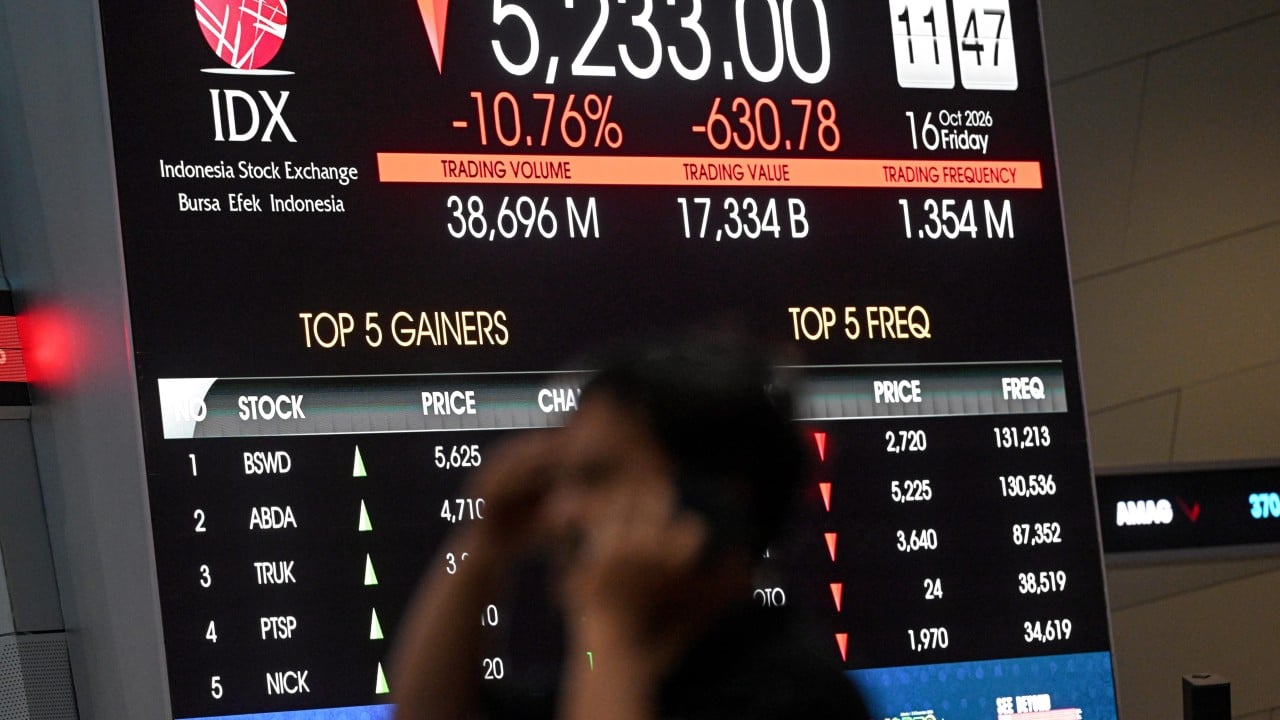
Financial panics rarely stay contained within national borders. When a regional exchange takes a violent plunge, politicians and market participants hunt for scapegoats before the trading floor even closes. Jakarta recently found itself staring at a brutal correction, and the political machinery did what it always does in moments of stress. It pointed outward. Whispers and official murmurs quickly targeted Singapore, accusing the neighboring financial hub of deliberately undermining Indonesian equities through predatory capital flows and speculative short-selling campaigns.
Singapore hit back. The Monetary Authority of Singapore does not take kindly to accusations of market manipulation, and the response was swift, measured, and characteristically sharp. But beneath the diplomatic friction lies a deeper, more uncomfortable truth about modern emerging market vulnerabilities. Capital is fast, anonymous, and entirely indifferent to national sovereignty. When foreign institutional money exits an economy en masse, local liquidity dries up instantly. Blaming a neighbor is politically convenient. Fixing structural deficits in domestic market oversight is much harder. For a more detailed analysis into similar topics, we suggest: this related article.
The Anatomy of a Capital Flight Crisis
To understand why the Indonesian stock market experienced such a severe downward spiral, you have to look past conspiracy theories about foreign trading desks working late into the night to break Jakarta's benchmark index. Emerging market corrections are almost always born of macroeconomic fundamentals. Interest rate differentials, currency depreciation pressures, and shifting global liquidity cycles dictate where portfolio managers park their capital.
When global yields rise, emerging market equities face immediate pressure. Institutional investors sitting in London, New York, or Singapore face risk-adjusted return hurdles that force them to reallocate capital away from riskier developing economies. This is not a conspiracy. It is arithmetic. Indonesia possesses a robust resource-driven economy, but its capital markets remain deeply sensitive to external liquidity shocks. For further context on this development, in-depth coverage can also be found at MarketWatch.
Singapore functions as the primary financial conduit for Southeast Asia. Billions of dollars in foreign direct investment and portfolio capital flow through its banking sector before landing in regional projects, including Indonesian equities and bonds. Naturally, when global funds pull back from the region, those transactions often clear through Singaporean accounts. This operational reality creates a persistent optical illusion. Because the money flows through Singapore, local observers frequently mistake the messenger for the architect.
The Politics of Blame in Regional Trade
Accusations of market sabotage serve a distinct domestic political function. When retail investors see their portfolios decimated by double-digit percentage drops in a single week, administrations face immense pressure to provide an explanation that preserves confidence in domestic institutions. Admitting that local corporate governance concerns, regulatory bottlenecks, or fiscal pressures drove foreign funds away is a difficult pill for any finance ministry to swallow.
It is far easier to frame a market crash as an external attack. By casting neighboring financial centers as aggressive adversaries, regulators can rally nationalist sentiment while buying time to implement emergency liquidity measures. Yet, this strategy carries a heavy long-term cost. Foreign institutional investors are notoriously risk-averse when it comes to regulatory predictability. If a government begins hurling unsubstantiated allegations of market rigging at regional financial hubs, international funds take note. They reprice the regulatory risk of doing business in that jurisdiction, often leading to a permanent reduction in foreign capital allocation.
Market regulators in Jakarta and Singapore understand this dynamic intimately. Behind closed doors, central bankers maintain close operational channels to share cross-border transaction data and ensure compliance with international anti-money laundering standards. Public rhetoric diverges sharply from private regulatory cooperation. The public posturing satisfies domestic political constituencies, while the backchannels prevent actual systemic decoupling.
Structural Realities Behind the Indonesian Correction
Stripping away the political theater reveals a market facing distinct structural hurdles. Indonesia’s stock market concentration remains remarkably high. A handful of massive banking and commodity conglomerates drive the lion's share of the index's movements. When foreign portfolio managers decide to trim risk across Southeast Asia, they do not sell hundreds of small-cap stocks individually. They liquidate positions in the most liquid large-cap names available.
This creates a disproportionate impact on the benchmark index. A few heavy sell orders from global funds can trigger automatic stop-loss thresholds, cascading into broader retail panic. Singaporean financial institutions executed many of these sell orders because they house the regional custody accounts for global pension funds and asset managers. To claim that these institutions engineered the crash is equivalent to blaming the highway for a multi-car collision.
Furthermore, local retail participation in Indonesia has surged dramatically over recent years, driven by mobile trading applications and social media stock-picking communities. This surge introduced a new wave of volatility. Retail investors often trade on momentum rather than deep balance-sheet analysis, amplifying both upward surges and downward spirals. When the market turns, retail panic selling exacerbates the outflow of foreign capital, creating a feedback loop that local regulators struggle to contain.
The Illusion of Regional Isolation
Modern capital markets cannot be walled off by national borders or protected by protectionist rhetoric. Attempts to restrict foreign capital movements or penalize regional financial conduits usually backfire, resulting in higher transaction costs and reduced market depth. If Jakarta wishes to insulate its financial system from external shocks, the solution lies in strengthening domestic institutional depth, improving corporate transparency, and expanding the domestic investor base so that the market relies less on fickle foreign portfolio flows.
The friction between Singapore and Indonesia over market stability underscores the fragility of regional financial integration. As long as capital moves freely across borders, disputes over market direction will persist. Blaming regional neighbors offers a temporary distraction, but it does nothing to alter the cold mechanics of global liquidity. Markets ultimately reward structural discipline and punish denial. Until policy discussions pivot from political posturing to genuine structural reform, emerging market corrections will continue to spark the same old fires, burning investors who mistake noise for analysis.


