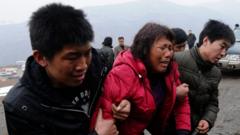
Industrial disasters in China’s coal sector are staging a quiet, lethal comeback driven by artificial price caps and systemic corporate deception. While official state metrics point toward long-term safety improvements, a dangerous undercurrent of unrecorded fatalities, hidden shafts, and unregistered migrant workforces is undermining Beijing's regulatory oversight. The reality on the ground contradicts official narratives. Independent industry audits and regional production data suggest that the push for domestic energy security has inadvertently resurrected the hazardous mining practices of the early 2000s.
The Mechanics of the Ghost Shaft
To understand how modern coal extraction bypasses state-of-the-art surveillance, one must look at the physical architecture of evasion.
National safety regulators require licensed mines to install extensive sensor networks. These systems monitor methane accumulation, ventilation velocity, and real-time personnel locations via RFID-tagged helmets. However, these systems only monitor registered layouts.
To maximize output beyond state-allocated quotas, operators frequently construct unmapped extraction faces. These are known colloquially as ghost shafts or blind tunnels. These voids branch off from legitimate tunnels, intentionally passing through thick brick bulkheads designed to mimic abandoned or depleted sections of the mine.
- Surveillance Blind Spots: Air quality sensors are conspicuously absent in these hidden corridors.
- Ventilation Redirects: Airflow is manually diverted away from legal faces using temporary canvas curtains, a tactic that lowers methane detection thresholds in the main shafts while allowing lethal gas levels to build up where the unregistered crews work.
- Production Discrepancy: The coal extracted from these illegal seams cannot be logged on standard company manifests. Instead, it is hauled to the surface during shift changes, loaded onto unmarked trucks, and sold directly to local industrial plants or independent blenders who operate outside the centralized state trading platform.
When a roof collapses or a sudden pocket of trapped gas ignites within these unmapped sectors, the standard emergency protocol is not activation of the rescue alarms. It is concealment.
The Economics of the Invisible Workforce
The human capital fueling this underground economy consists almost entirely of unregistered migrant laborers. Drawn from economically depressed provinces, these workers exist completely outside the state-mandated social credit and employment registry frameworks. They are ghosts within the machine.
Mine operators rely on a tiered subcontracting system to maintain plausible deniability. The primary mining license holder signs a contract with a secondary labor provider, who then subcontracts the actual extraction to a third-party foreman. This foreman recruits workers through informal village networks. Cash wages are paid daily, leaving no digital financial footprint or banking record.
This labor structure completely alters the financial calculus of operational safety. If a registered miner dies in an accident, the government-mandated insurance payouts and subsequent regulatory fines can easily exceed one million yuan, accompanied by an automatic, mandatory suspension of all mining operations for investigation.
For an unregistered worker killed in a ghost shaft, the resolution is entirely transactional.
Foremen and managers routinely negotiate private hush-money settlements directly with the victim’s family, frequently offering a lump sum that surpasses what the family could earn in a decade of farming. The agreement requires immediate cremation of the body and absolute silence. If the family refuses, they face the grim reality of challenging a powerful local corporate entity without an employment contract, medical records, or legal proof that their relative ever stepped foot inside the county. The mine keeps running. Profits flow uninterrupted.
Price Caps and the Quota Trap
The root cause of this systemic rot is not a simple lack of regulatory willpower. It is a direct structural conflict between China’s macroeconomic goals and its environmental mandates.
Beijing demands absolute energy self-sufficiency, particularly during peak summer cooling seasons and winter heating crunches. To protect heavy industry and consumer electricity rates from global energy volatility, the state imposes strict price bands on thermal coal.
| Metric | State-Regulated Market | Informal Spot Market |
|---|---|---|
| Price Stability | Capped by government mandate | Highly volatile, driven by local shortages |
| Regulatory Oversight | Constant sensor monitoring, strict quotas | Zero tracking, high-risk operational profiles |
| Labor Protections | Mandated insurance, formal contracts | Off-the-books cash pay, no legal recourse |
| Accident Consequence | Immediate mine closure, criminal charges | Private financial payouts, continuous operation |
When international fuel prices surge, domestic mines face immense pressure to boost production. Yet, they are legally forbidden from raising their prices above the official state cap to cover rising operational costs.
This dynamic squeezes the profit margins of private and mid-tier mining operations. To survive, managers must cut expenses. The easiest line items to reduce are those that do not directly generate coal: ventilation maintenance, structural roof bolting, and comprehensive safety training.
When a mine hits its official monthly production quota within the first two weeks, it faces a stark financial choice. It can either halt operations and lose out on highly lucrative black-market spot demand, or it can keep digging in secret. The economic incentive to choose the latter is overwhelming, especially when local municipal officials, whose career advancements depend on regional GDP growth and stable electricity generation, are inclined to look the other way.
The Limits of Digital Dictatorship
In recent years, the central government has deployed automated drones, satellite thermal imaging, and AI-driven power consumption analysis to detect illegal mining activity from above ground. Regulators track the electricity usage of individual ventilation fans and water pumps, looking for anomalies that indicate a mine is drawing more power than its declared production volume justifies.
Yet, operators have adapted with low-tech counter-measures.
To mask the extra power consumed by unauthorized equipment, engineering teams tap directly into high-voltage agricultural lines or install hidden diesel generators deep within rural valleys, away from the main mining compound. Satellite thermal signatures of illegal coal piles are obscured using specialized mesh netting that mimics natural ground cover or topsoil.
The battle between state surveillance and corporate evasion has turned into a highly sophisticated cat-and-mouse game where the regulators are constantly playing catch-up.
The institutional weakness of regional safety bureaus complicates the situation further. Local inspectors are frequently understaffed, underfunded, and socially embedded in the very communities they are tasked with policing. A provincial inspector earning a modest civil service salary is poorly positioned to challenge an influential mining executive who commands the largest tax-revenue-producing asset in the prefecture.
Even when inspections occur, they are frequently preceded by early warnings leaked from within the local bureaucracy, giving mine managers ample time to seal off illegal shafts with fresh concrete before the inspectors arrive.
The current strategy of relying on digital tracking and severe post-accident punishments has reached its structural limit. As long as the financial reward for extracting uncounted coal outweighs the statistical probability of getting caught, the underground infrastructure will remain operational. The hidden shafts will continue to expand, and the migrant workforce will continue to bear the ultimate human cost of keeping the lights on.