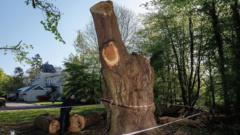
The Sound of 500 Years Falling
It takes mere minutes to destroy five hundred years of living history.
Imagine standing beneath a canopy that was already ancient when Queen Victoria took the throne. A tree that germinated when Henry VIII was a young man, stretching its great wooden limbs over the soil of Shirley, Solihull. For five centuries, that English oak stood as a silent witness to the changing world. It survived plagues, civil wars, world wars, and the relentless march of modern urbanization.
Then came the chainsaws.
In April 2023, the ancient oak, positioned on land near a Toby Carvery restaurant, was chopped down. It wasn't felled by a slow, agonizing disease or a sudden, violent act of nature. It was cut down by human hands. The loss was immediate. Irreparable. A towering monument of ecological heritage was reduced to a stump and a pile of sawdust in a matter of hours.
The community didn't just lose a tree. They lost an anchor. Neighbors walked past the empty space where the giant once stood, feeling a strange, hollow grief. How do you quantify the value of five hundred years of growth? How do you penalize the destruction of something that cannot be replaced in our lifetime, or the lifetimes of our grandchildren?
For over a year, a bitter legal battle raged in the background, pitting Solihull Council against the pub chain’s parent company, Mitchells & Butlers. It became a standoff about corporate responsibility, environmental heritage, and the true cost of administrative blunders.
Now, the dust has finally settled on the courtroom floor. But the resolution leaves a complicated legacy.
The Cost of a Mistake
When the oak was felled, the public outcry was deafening. Solihull Council acted swiftly, issuing a stop notice to halt any further work on the site. A criminal investigation was launched. The local authority alleged that the destruction of the tree was a breach of a Tree Preservation Order (TPO)—a legal shield meant to protect trees of significant value to the community.
The stakes were incredibly high. Under UK law, individuals or companies found guilty of breaching a TPO can face unlimited fines. The council was prepared to take the matter all the way to court, signaling to the wider corporate world that environmental heritage is not collateral damage for commercial convenience.
But as the legal machinery ground on, the narrative began to shift from intentional vandalism to a catastrophic failure of communication.
Mitchells & Butlers, the hospitality giant behind Toby Carvery, maintained that the felling was a tragic mistake rather than an act of malice. According to the company, the tree was cut down by a contractor due to a profound miscommunication regarding its safety and structural integrity. They expressed deep regret for the destruction of the oak, acknowledging the immense pain it caused the local community.
The legal battle became a game of high-stakes chess. On one side stood a local government determined to seek justice for an irreplaceable loss. On the other side was a major corporation eager to repair its fractured public image and avoid a devastating criminal conviction.
The Settlement in the Shadow of the Stump
The trial was set to take place at Birmingham Magistrates' Court. Lawyers had sharpened their arguments, witnesses were prepared to testify, and the local community waited for a verdict that would punish the wrongdoing.
Then, at the eleventh hour, the trial was called off.
A deal had been struck in the shadows. Solihull Council and Mitchells & Butlers reached an out-of-court settlement, bringing a sudden end to the criminal prosecution. The legal battle was over, replaced by an agreement aimed at restoration rather than retribution.
Under the terms of the settlement, Mitchells & Butlers agreed to pay a substantial financial sum. The company will hand over £32,500 to the council. This money is specifically earmarked for the planting of new trees and the funding of local environmental projects. Additionally, the corporate giant agreed to pay £50,000 to cover the council’s extensive legal costs.
In total, the mistake cost the company £82,500.
To a multinational hospitality group, that figure is a drop in the ocean. To the local council, it is a significant injection of funds to boost the borough's green canopy. The agreement also includes a commitment from Toby Carvery to plant a mature oak tree on the original site, accompanied by a commemorative plaque honoring the ancient giant that preceded it.
The Illusion of Replacement
The legal peace treaty has been signed. The politicians and corporate executives have released their statements, expressing satisfaction with the pragmatic outcome.
But look closer at the math.
You cannot buy five centuries of growth with eighty-two thousand pounds. You cannot replace a complex ecosystem that supported hundreds of species of insects, birds, and fungi with a newly planted sapling, no matter how "mature" it is when it goes into the ground.
Consider the sheer scale of time. A tree planted today will not reach the majesty of the felled Shirley oak until the year 2526. The humans who planted it, the children who watch it grow, and the society that negotiated its existence will be long gone before it ever matches the stature of the monument we lost.
This is the hidden tragedy of environmental enforcement. Our legal systems are built around financial compensation, but nature does not deal in currency. It deals in time.
The settlement is a victory for pragmatism. It avoids a lengthy, expensive trial funded by taxpayers. It guarantees funds for local green spaces. It forces a corporation to publicly check its processes and swallow a bitter financial pill.
Yet, the victory feels hollow when standing on the tarmac near the Toby Carvery, looking at the void where five hundred years of shade used to fall. The new sapling will eventually take root. Its leaves will unfurl in the spring, and a new generation of birds will find shelter in its branches.
The wound will heal, but the scar remains, a silent reminder of the day we traded half a millennium of living history for a handful of coins and a promise to do better next time.