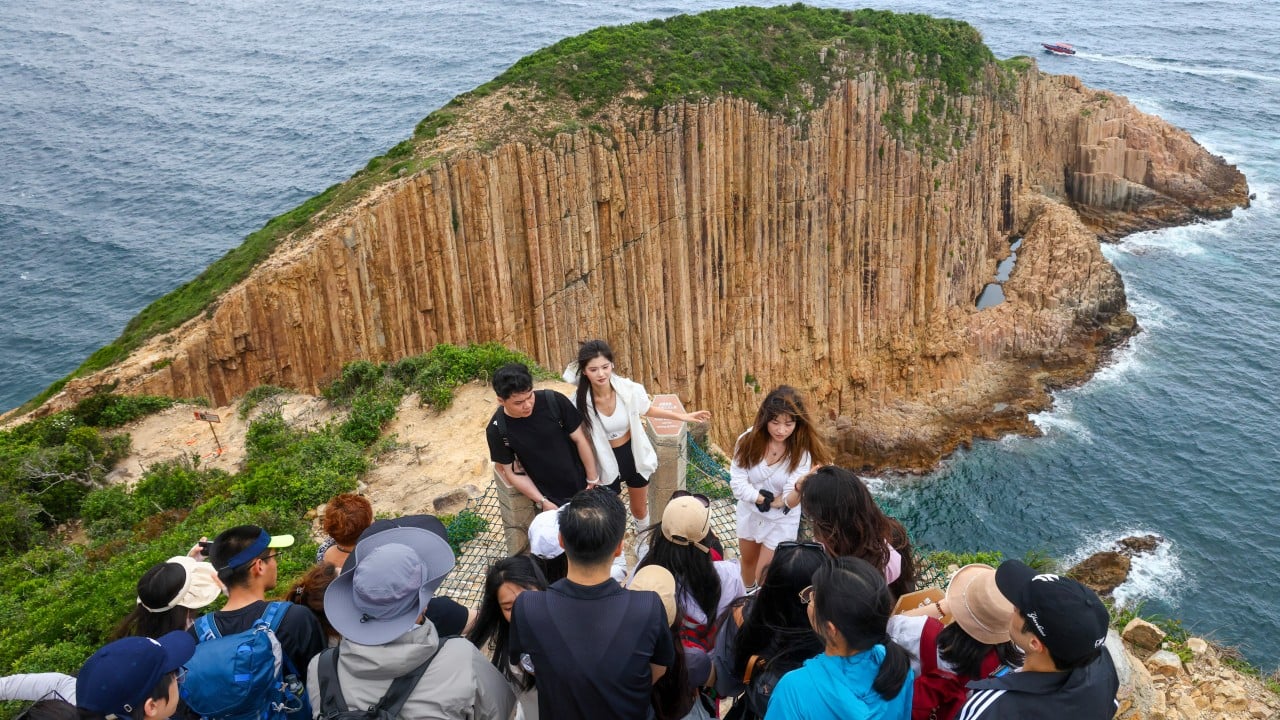
The mud on Dragon’s Back used to smell like wet granite and wild ferns. If you woke up early enough, before the humidity pinned the city down, the ridge line felt like the spine of some sleeping beast, rising out of the South China Sea. You could stand on the undulating crest, look to the left at the jagged cliffs of Shek O, look to the right at the dense, towering concrete of Tai Tam, and feel a rare, breathless solitude.
Not anymore.
On a typical Sunday afternoon now, the mountain does not breathe. It groans. The narrow dirt path is swallowed by a slow-moving, neon-clad snake of thousands of hikers. The quiet rustle of black-eared kites circling overhead is drowned out by the tinny screech of smartphone speakers playing pop music. The wild ferns have been trampled into concrete-hard dirt. Where the trail narrows, people queue in gridlock, stepping off the designated path to pass each other, their boots biting into the fragile topsoil. Every weekend, the mountain loses a few more inches of its soul.
Now, Hong Kong’s authorities are considering a move that would have seemed unthinkable a decade ago: putting a lock on the gate. A booking system is on the table. To walk among the trees, you may soon have to log onto an app, check a calendar, and secure a digital pass.
It is a clinical solution to an emotional tragedy. To understand why it has come to this, you have to look past the bureaucratic language of "crowd management" and see what happens when a city of seven million people collective runs out of room to breathe.
The Crushing Weight of Footsteps
Consider a hypothetical hiker named Michelle. She represents a generation of Hong Kongers who discovered the hills out of desperation. During the long, claustrophobic years of pandemic travel restrictions, the city’s vast country parks—which make up about 40 percent of Hong Kong’s landmass—became the only escape hatch. Michelle left her tiny 400-square-foot apartment in Kowloon every Saturday morning, seeking nothing more than a horizon line.
She was not alone. Millions had the exact same idea.
The math of conservation is brutal and unforgiving. A single pair of hiking boots does negligible damage. Ten thousand pairs of boots over a single weekend act like a slow-motion bulldozer. When hikers step off a deteriorating trail to avoid mud or oncoming traffic, they widen the path. This kills the root systems of the surrounding vegetation. Without roots to hold the earth together, the tropical rains of summer turn the hillside into a scar of sliding mud.
The Agriculture, Fisheries and Conservation Department (AFCD) has watched this degradation accelerate. Dragon’s Back, globally lauded by travel magazines as one of the world’s best urban hikes, has become a victim of its own marketing success. The very accessibility that makes it beautiful—the fact that you can take a subway and a double-decker bus from a skyscraper district and be on a ridge within forty minutes—is what is destroying it.
The proposed reservation system is not a sign of bureaucratic overreach. It is a confession of failure. It is an admission that we, as a collective public, do not know how to love a wild place without smothering it to death.
The Invisible Stakes of a Digital Turnstile
The resistance to a booking system is immediate, visceral, and understandable. Nature is supposed to be the antidote to the hyper-regulated, hyper-monitored reality of modern life. We live in a world of QR codes, facial recognition entry barriers, and pre-booked calendar slots. The mountains were the last place where spontaneity was legal.
If you have to plan your escape five days in advance, does it still feel like freedom?
But the alternative is worse, and we have already seen how the story ends elsewhere in the world. Look at Mount Fuji in Japan, where authorities had to install a physical gate and a fee system on the popular Yoshida trail to stop the dangerous, chaotic swarms of "bullet hikers." Look at the American West, where iconic landscapes like Zion National Park’s Angels Landing require a lottery ticket just to step onto the rock.
The problem lies in our perception of nature as an infinite resource. It isn't. The granite steps of Hong Kong's trails are as fragile as the glass facades of Central’s financial towers.
When a trail becomes too crowded, the human experience curdles. The hike stops being an exercise in mindfulness and becomes an exercise in frustration. You spend your time looking at the heels of the person in front of you, dodging selfie sticks, and stepping over discarded plastic hydration wrappers. The wilderness becomes an outdoor amusement park, complete with the queues.
The Art of the Invisible Trail
There is a quiet irony here. For years, volunteer groups and trail conservationists in Hong Kong have been advocating for a different kind of intervention. They practice sustainable trail design—using local rocks and timber to build steps that mimic nature, allowing water to flow naturally without causing erosion. It is backbreaking, unglamorous work. It requires carrying heavy stones up steep inclines by hand, because heavy machinery would destroy the very forest they are trying to save.
These hand-built trails can withstand a lot. But they cannot withstand an infinite number of people.
If the government implements a quota system for Dragon's Back, it will set a precedent for the rest of the territory’s parks. Lantau Peak, Sunset Peak, the sharp ridges of Sai Kung—all of them could eventually sit behind a digital turnstile. The city's geography would be fundamentally remapped, divided into zones of restricted access.
It feels dystopian because it is. It is the ultimate tax on urbanization. We built a city so dense, so intensely vertical, that we have forced our collective stress upward into the hills, fracturing the very landscape that keeps us sane.
The Cost of the Open Gate
We are faced with a choice between two uncomfortable realities.
On one side is the loss of spontaneity. The casual Sunday whim to catch a sunset over Big Wave Bay would be replaced by a bureaucratic ritual. If you miss your digital window, you stay on the asphalt. The hills become exclusive, curated, and parsed out by an algorithm.
On the other side is the literal dissolution of the landscape. Without intervention, Dragon's Back will continue to widen and flatten. The topsoil will wash down into the sea. The trees will lose their footing. The trail will eventually have to be paved over with concrete and fitted with steel railings just to keep the earth from collapsing under the weight of the crowds. It will become a sidewalk with a view.
The debate over the booking system is not really about logistics, apps, or park rangers checking permits at the trailhead. It is a mirror held up to the city's face. It asks us to decide what we value more: our unrestricted right to consume a landscape, or the landscape itself.
The next time you stand at the base of a trail, looking up at the ridge line where the green meets the blue, look closely at the dirt beneath your feet. It is shifting. Every step we take carries a weight that the mountain can no longer bear alone. The digital gate is closing, not because someone wants to keep us out, but because we forgot how to be guests in the only home we have left.