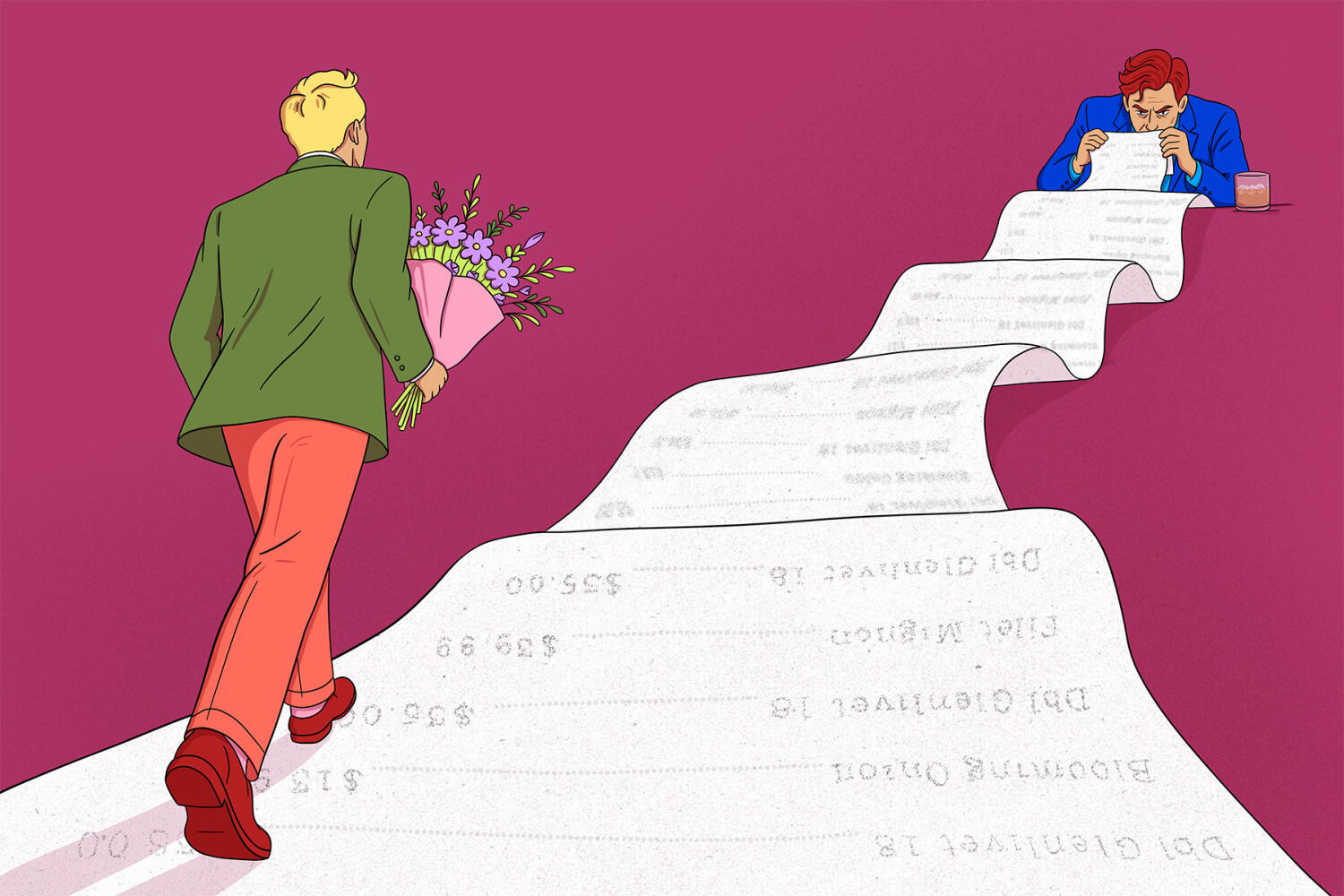
What a Deep-Fried Onion Revealed About Love and Money
Grease. That is the first thing I remember about the evening that changed how I read a menu. Not expensive olive oil or herb butter, just the heavy, unmistakable scent of a chain restaurant fryer cooling down after the dinner rush. A golden monument of battered petals sat between us on a laminate table, oozing a creamy dipping sauce into a paper ramekin. It was absurdly large. Built for four people, maybe six if nobody cared about their cholesterol.
I reached for a petal. Across the table, my date did not reach for his own. He just stared at my fork like I had picked up his wallet.
"You know," he said, his voice tight enough to hum, "taking half of something I ordered without asking is basically financial theft."
Silence.
I held the fried onion suspended in mid-air while the fluorescent lights above us hummed a low, flat note and a server hurried past with a tray of iced teas. Somewhere in the back of the kitchen, a bell rang. I waited for the punchline. I looked at his face for the crinkled eyes of a joke, the smirk that says gotcha, the tiny lift of a chin that means we are both in on the absurdity of dating in a big city where everyone is slightly broke and slightly guarded.
Nothing. His jaw was set. His posture had stiffened into the rigid geometry of a man defending a border.
In my own dating life, I have sat across from people who counted pennies like rosary beads and people who spent like trust funds were bottomless. I have felt that cold, hollow drop in the stomach when a casual dinner turns into a forensic audit. I know what it feels like to suddenly be cast as a villain in a story you thought was just a Tuesday night out.
To be completely honest, money in romance still confuses me. One week, splitting a twelve-dollar appetizer feels like basic fairness; the next week, someone acts as though sharing a plate is a breach of treaty. Even after years of watching friends pair off, break up, and argue over Venmo requests for six-dollar coffees, I cannot always tell where generosity ends and anxiety begins.
But the real problem lies elsewhere. A four-thousand-calorie appetizer is never just an onion. When someone calls sharing a plate "theft," they are rarely talking about the eight or ten dollars on the receipt. They are sounding an alarm about control, scarcity, safety, or an old wound that never quite closed.
The Anatomy of a Shared Plate
To understand why a blooming onion can detonate a first or second date, it helps to strip away the comedy of the dish itself. A blooming onion is an exercise in excess. A whole sweet onion is scored into dozens of petals, dipped in seasoned batter, deep-fried until crisp, and set upright like a floral centerpiece. By design, it is communal. Almost nobody eats an entire one alone without regretting every decision that led them to the booth.
So when one person treats a communal plate as strictly private property, friction is almost guaranteed.
Consider what happens when two people sit down with completely different internal rulebooks. To make this concrete, let us look at a hypothetical scenario—a composite of conversations I have heard over drinks and coffee with friends who date in major cities.
Imagine Clara and Ben on a second date. Clara grew up in a household where food was abundant and shared freely; if someone made fries or ordered nachos, reaching over was a gesture of closeness. Ben grew up watching his parents fight over utility bills after layoffs, where every dollar had a job and every unplanned expense felt like a threat to the floor beneath their feet. When Clara pulls a piece of food off Ben's shared plate without asking, Clara experiences warmth and ease. Ben experiences a sudden loss of predictability.
Neither of them is a monster. Clara is not a thief. Ben is not necessarily a cartoon miser. Yet in the space of three seconds, they are speaking two incompatible languages.
The red flag in calling a shared appetizer "financial theft" is not frugality. Being careful with money can actually be a sign of self-awareness, discipline, or realism—especially in an era when rent, groceries, and everyday costs squeeze people harder than they used to. Plenty of thoughtful, generous partners check prices before ordering. They budget. They notice when things add up.
The red flag is the language of accusation.
Calling normal, low-stakes sharing "theft" frames an ordinary human moment as a crime. It turns a partner or potential partner into a predator. Once that frame is set, the dynamic shifts from us figuring out how to navigate life together to me guarding myself against you. And once a relationship starts running on courtroom logic, affection has very little room to breathe.
Scarcity and the Invisible Ledger
Why does money trigger such extreme language in places as small as a restaurant booth?
Part of the answer sits in history and habit. For centuries, marriage and long-term partnerships were explicitly economic arrangements—contracts around land, survival, dowries, labor, and household solvency. Even as modern romance shifted toward emotional intimacy, compatibility, and personal fulfillment, money never stopped carrying weight. It simply went underground. Instead of negotiating property in front of a notary, modern daters negotiate fairness over tapas, drinks, and rideshares.
Modern dating apps have only made that invisible ledger more visible. When you meet someone through a screen, you often know their job title, neighborhood, and aesthetic before you know how they handle stress or disappointment. Money becomes a stand-in for character. If someone splits things down to the cent, people wonder if they are stingy. If someone always pays without hesitation, people wonder if they are trying to buy leverage or ignoring their own limits.
Psychologists and relationship researchers often point out that money conflicts in couples are rarely just about math. Money is tangled up with autonomy, status, childhood security, and fear of abandonment. When a person feels anxious about losing control—over their finances, their time, or their emotional footing—small boundary crossings can feel disproportionately large.
Still, there is a big difference between saying, "Hey, I budgeted specifically for this tonight, can we stick to our own plates?" and accusing someone of financial theft over a fried onion.
The first statement is vulnerable. It admits a limit without attacking the other person's character. It invites cooperation.
The second statement is defensive and punitive. It plants a stake in the ground and dares the other person to step over it. Even if the person saying it is half-joking or speaking out of raw insecurity, the words leave a mark. You sit there wondering: If a ten-dollar onion is theft, what happens when we share a lease, a car, a medical bill, or a rough year?
When a Red Flag Means Something Bigger
Not every awkward moment on a date is a permanent indictment of someone's soul. First dates are weird. People get nervous, talk too fast, bring baggage from their last breakup, or say clunky things they regret on the drive home.
Context matters. If a date makes a weird remark about money once, then later shows warmth, accountability, and generosity of spirit, you might be looking at a momentary flinch rather than a lifelong pattern.
A true red flag usually shows up in clusters. Watch for what happens when a small financial quirk collides with other behaviors:
- Scorekeeping instead of partnership: Every favor, meal, or chore is logged mentally—or on a spreadsheet—waiting to be cashed in during an argument.
- Hostile framing: Everyday misunderstandings are described in extreme, bad-faith terms (stealing, using, taking advantage) rather than curious ones ("Did you realize we were splitting that?").
- Resistance to normal conversation: Bringing up budgets, fairness, or comfort levels triggers defensiveness, mockery, or stonewalling instead of calm problem-solving.
- Control disguised as practicality: One person insists on managing every choice and every dollar while treating the other person's preferences as reckless or naive.
When those patterns stack up, money stops being a practical topic and becomes an instrument of power. And power imbalances corrode intimacy quietly, long before a bank account is ever joint.
Let me use a metaphor here to make the stakes easier to picture. Think of a relationship like a small wooden boat out on open water. Money is not the water—life is the water. Money is the ballast. Too little ballast, and the boat tips with every gust of wind. Too much heavy iron bolted to one side, and the boat lists permanently, forcing the other person to spend all their energy just keeping it upright.
A healthy financial dynamic is adjustable ballast. Sometimes one person carries a little more; sometimes the other does; sometimes you trim weight together because the weather ahead looks rough. Calling a shared appetizer "theft" is like bolting a cannonball to the floorboards and calling it safety.
What Healthy Money Talk Actually Looks Like
If extreme accusations are the warning sign, what does healthy behavior around money look like in the early stages of dating—and later on?
It is remarkably unglamorous. It sounds like plain English.
Healthy daters treat money as information, not a moral verdict. If someone says they are trying to save aggressively this year, a grounded partner does not take it as a rejection or a sign of cheapness; they take it as useful context when planning where to go. Maybe instead of a pricey restaurant, you get tacos and walk through a park, or cook at home and actually hear each other talk without loud music in the background.
Fairness in early dating does not require a calculator at the table. Some people prefer splitting down the middle; some alternate who treats; some split proportionally when incomes differ wildly and both people want to do things together without resentment. What matters is not the formula itself, but whether both people feel respected and unpressured.
Most of all, healthy money habits leave room for grace. People misread signals. Someone might assume an appetizer is communal because it came in a giant basket for the table; someone else might have ordered it thinking of it as their main meal because they had a late lunch. If the first instinct is curiosity rather than accusation, the moment passes. A quick laugh, a small adjustment, and the night stays intact.
When I think back to that booth and the cooling grease and the giant pile of fried onion rings, what strikes me most now is how small the actual object was and how enormous the reaction felt. Nobody's livelihood was ruined by a bite of battered onion. Nobody's savings account was drained.
Yet the moment laid bare something essential about trust. Trust isn't built in grand romantic gestures alone. It is built in how we interpret small, ambiguous moments when nobody is keeping score—whether we assume the best of the person across from us, or treat them like a threat before they've even done anything wrong.
I eventually finished my dinner that night, said goodnight politely on the sidewalk, and walked to my car knowing I wouldn't be ordering another blooming onion with him—or taking a second date. The grease had already soaked through the paper napkin by the time I left the lot, dark and translucent against the table, a quiet reminder that sometimes a snack tells you the whole story before the check even arrives.