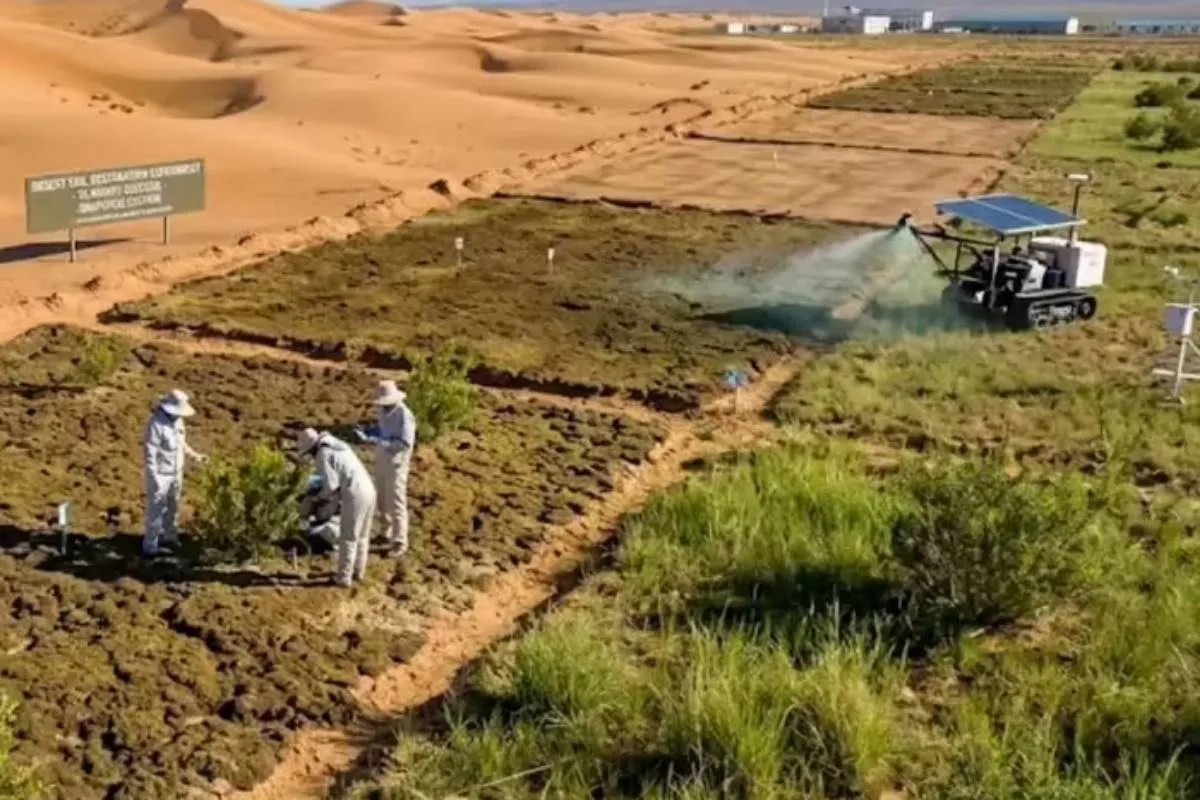
The transformation of barren desert sand into productive soil in under a year is not a biological miracle but a triumph of interfacial engineering. Traditional desert reclamation relies on irrigation and organic matter accumulation over decades; however, the "soilization" method pioneered by researchers at Chongqing Jiaotong University bypasses these biological timelines by focusing on the physical-mechanical properties of the medium. By modifying the rheological behavior of sand through the introduction of a water-soluble cellulose-based paste, the project aims to replicate the "visco-elastic" state found in natural soil. This transition allows for the retention of water, nutrients, and air—the three non-negotiables for plant life.
The Mechanical Deficiency of Desert Sand
To understand why desert reclamation usually fails, one must define the structural difference between sand and soil. Sand is a collection of discrete particles with negligible cohesion. In a dry state, it functions as a fluid; when wet, it gains temporary capillary cohesion that vanishes upon evaporation.
Natural soil possesses a property known as "soil structure," where particles are bound into aggregates by organic glues (polysaccharides and humic acids). These aggregates create a dual-porosity system:
- Macro-pores allow for aeration and root penetration.
- Micro-pores within the aggregates hold water against the force of gravity.
Desert sand lacks this aggregate structure. Water poured onto sand either drains immediately through the large interstitial spaces or evaporates rapidly because there is no internal matrix to trap it. The Chinese "soilization" strategy addresses this by applying a modified Sodium Carboxymethyl Cellulose (CMC) binder. When mixed with dry sand and hydrated, this binder creates a bridge between particles, simulating the mechanical behavior of natural soil aggregates.
The Two Pillars of the Soilization Framework
The success reported in regions like the Ulan Buh Desert rests on two distinct technological interventions: the Rheological Shift and the Nutrient Retention Loop.
The Rheological Shift
The introduction of the cellulose binder changes the sand's state from a granular solid to a visco-elastic body. In engineering terms, the "yield stress" of the material is altered. Natural soil can hold its shape under a certain amount of pressure but flows when that pressure is exceeded. By applying the CMC-based solution, scientists give sand a "memory." When it rains or is irrigated, the binder swells, creating a network that holds the water in place.
Unlike chemical stabilizers used in construction to harden sand into a "crust," this binder remains flexible. It allows the sand to breathe and roots to push through without fracturing the medium. The transition occurs almost instantly upon application, shortening the traditional "weathering" period from centuries to hours.
The Nutrient Retention Loop
The primary bottleneck in desert agriculture is leaching. Fertilizers applied to sand are washed away into the deep substrate before plants can utilize them. The cellulose matrix acts as a chemical sponge. Because the binder is hydrophilic and contains functional groups that can form weak bonds with minerals, it creates a "storage-and-release" mechanism.
- Initial Phase: The binder captures water-soluble N-P-K (Nitrogen, Phosphorus, Potassium).
- Active Phase: As roots grow, they draw from this concentrated reservoir.
- Feedback Phase: The death and decay of the first generation of crops (often drought-resistant species like sorghum or corn) add natural organic matter to the mix.
This creates a virtuous cycle where the synthetic binder provides the "scaffolding" for the first 10 months, after which the increasing volume of natural biomass begins to take over the role of the structural adhesive.
Quantitative Constraints and Resource Allocation
While the 10-month timeline is technically feasible, the strategy faces significant constraints regarding material volume and water sourcing. The conversion of one hectare of desert requires a specific ratio of binder to sand.
$$V_b = A \times d \times \rho_s \times C$$
Where:
- $V_b$ is the volume of binder required.
- $A$ is the surface area.
- $d$ is the depth of the "soilized" layer (typically 20-30 cm).
- $\rho_s$ is the bulk density of the sand.
- $C$ is the concentration of the cellulose additive.
Even at low concentrations, the logistics of transporting thousands of tons of binder to remote desert locations present a formidable cost function. Furthermore, the "soilization" process does not create water; it only manages it. The system still requires an initial input of water to activate the binder and sustain the first crop cycle. If the local aquifer is depleted or if the evaporation rate exceeds the irrigation capacity, the visco-elastic matrix will eventually collapse into a dry, brittle state, though it can be "reactivated" by subsequent moisture.
Ecological Risks and Material Stability
A rigorous analysis must account for the long-term degradation of the synthetic binder. Sodium CMC is biodegradable, which is an advantage for environmental safety but a liability for structural permanence.
The primary risks include:
- Microbial Breakdown: Soil microbes may consume the cellulose binder faster than the plants can produce natural replacements, leading to a loss of soil structure mid-season.
- Salt Accumulation: In many desert basins, high evaporation rates lead to the upward movement of salts (salinization). The binder must be engineered to resist "ion interference," where high salt concentrations might cause the polymer chains to collapse, destroying the water-retention capacity.
- Wind Erosion: Until a full canopy of vegetation is established, the "soilized" topsoil is still vulnerable. The binder increases the threshold friction velocity required to move the particles, but it does not eliminate the need for traditional windbreaks or "sand fences."
Strategic Deployment Patterns
The application of this technology should not be viewed as a blanket solution for all arid land, but as a targeted surgical strike for specific geographies.
The most effective deployment follows a "Nexus Strategy":
- Proximity to Water Infrastructure: Target edges of existing oases or regions with accessible (but underutilized) brackish groundwater that can be filtered or used directly by salt-tolerant crops.
- High-Value Crop Rotation: To offset the cost of the binder, the initial 10-month cycle should focus on crops with high biomass or commercial value, such as alfalfa for livestock or specific oilseeds.
- Micro-Climate Modification: Large-scale soilization changes the albedo (reflectivity) of the ground and increases local humidity through transpiration. This can, in theory, create a localized "cooling effect" that reduces the water demand for neighboring plots.
The transition of sand to soil in 10 months is a proof of concept for "mechanical soil science." The bottleneck is no longer the biological capability of the land, but the industrial throughput of the cellulose complexing agents and the energy cost of water delivery. For investors and governments, the focus must shift from "can we grow things in the sand?" to "at what price point does the synthetic soil matrix become self-sustaining?"
The next phase of this technology requires moving beyond simple binder application toward "Smart Matrices"—binders that are embedded with time-release nutrients and fungal spores (mycorrhizae) to accelerate the biological takeover of the synthetic structure. If the degradation rate of the binder can be synchronized perfectly with the accumulation rate of natural humus, the "10-month miracle" becomes a repeatable industrial process rather than a localized experiment.
Priority should be given to establishing "green corridors" that protect existing infrastructure—roads and railways—from sand encroachment, as the economic value of infrastructure protection provides a faster ROI than open-field desert agriculture.