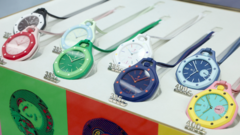
The global watch market just witnessed a weekend of absolute chaos that modern retail crowd control was entirely unprepared to handle. On Saturday, May 16, 2026, Swatch rolled out its highly anticipated "Royal Pop" collection, an unprecedented partnership with Audemars Piguet, one of the most elite, high-end names in luxury horology. The result was immediate pandemonium. In Manhattan, London, Dubai, and Mumbai, thousands of desperate buyers swarmed retail boutiques. Police deployed pepper spray at the Roosevelt Field Mall on Long Island, a dozen stores were forced into emergency shutdowns due to safety risks, and scheduled launches in Dubai and India were canceled outright.
Yet, beneath the surface of the hype lies a glaring irony. The Royal Pop is not the accessible, bioceramic version of the iconic Royal Oak wristwatch that millions of enthusiasts expected. It is a pocket watch.
By refusing to put the collaborative design on a traditional wrist strap, Swatch and Audemars Piguet delivered a jarring subversion of consumer expectations. Purists are furious, calling the colorful gadgets a cheap gimmick that threatens to tarnish the legacy of Audemars Piguet. Why, then, did the launch trigger global riots? The answer has very little to do with the intrinsic utility of a pocket watch, and everything to do with a desperate corporate rescue mission, the mechanics of modern resale markets, and a shifting cultural appetite for high-low luxury collectibles.
The Corporate Calculus and Swatch's Invisible Crisis
To understand why the Royal Pop exists, one must look at the grim financial realities of the Swatch Group rather than the artistic vision of its designers. The conglomerate entered 2026 reeling from a bruising fiscal cycle. Financial reports from late 2025 painted a bleak picture: net revenue dropped nearly 6% to 6.28 billion Swiss francs, heavily impacted by tanking demand in China and an overly aggressive Swiss franc.
More alarming was the collapse of the group's operating profit, which plummeted from over one billion Swiss francs down to a razor-thin 135 million francs. The consolidated operating margin contracted to a terrifying 2.1%.
While the actual retail watch sales division remained relatively stable, the bleeding was driven by Swatch’s manufacturing division. In an honorable but financially crippling move, management refused to cut jobs or reduce production capacity at its Swiss factories despite falling wholesale orders. This resulted in staggering fixed overhead costs.
The Royal Pop was engineered to solve this exact capacity crisis. Swatch factories possessed the idle infrastructure to stamp out millions of units of a mass-market hit at virtually zero incremental cost. By convincing Audemars Piguet to lend its sacred "Royal Oak" design language—the octagonal bezel, the signature hexagonal screws, and the "Petite Tapisserie" dial texture—Swatch created an instantaneous cash machine to absorb its industrial surplus.
Subverting the Wrist to Save the Brand
When news of the partnership leaked, investors sent Swatch shares climbing locally to 213 francs on the assumption that a bioceramic Royal Oak wristwatch would replicate the massive financial windfall of the 2022 MoonSwatch. A direct 40mm wristwatch replica would have sold tens of millions of units overnight.
However, Audemars Piguet faced a profound existential threat. For an ultra-luxury brand whose entry-level sports watches command over $30,000, allowing a $400 plastic copy to sit on millions of wrists worldwide could permanently erode its elite status.
The compromise was a calculated act of friction: the pocket watch format.
By moving the timepiece off the wrist and hanging it from a calfskin lanyard, the collaboration deliberately broke wrist-worn functionality. The Royal Pop collection is split into two historical formats:
- The Lépine: Featuring the winding crown at 12 o'clock and a clean, two-hand layout.
- The Savonnette: Positioning the crown at 3 o'clock and integrating a small seconds subdial at 6 o'clock.
Both iterations measure 40mm in diameter, 8.4mm in thickness, and feature sapphire crystals on both the front and back to showcase a hand-wound version of Swatch’s automated SISTEM51 movement. It is a fascinating industrial feat boasting 15 active patents and a 90-hour power reserve, wrapped inside a colorful, pop-art bioceramic shell. Yet, for all its technical merit, a pocket watch remains an archaic, highly impractical object for the average consumer.
The Toyification of Luxury
If the product is intentionally impractical, what explains the dangerous surges at shopping malls? The reality is that the luxury and streetwear sectors have undergone a profound transformation. Consumers are no longer buying items exclusively for utility; they are collecting them like high-stakes vinyl toys.
In recent years, the market has been dominated by a phenomenon known as "toyification," where consumer frenzy is driven by blind-box culture, limited drops, and hype-fueled collectibles like Pop Mart figurines. The Royal Pop taps directly into this psychology. Swatch intentionally treated the release like a streetwear drop rather than a traditional horological event, capping purchases at one watch per person, per day, in highly restricted physical locations.
This artificially engineered scarcity acts as an immediate beacon for algorithmic flipping and secondary market arbitrage. Scalpers and professional queue-standers quickly realized that the gap between the $400 retail price and the immediate, internet-driven desire of those locked out of stores created a guaranteed profit margin. Minutes after the first stores closed on Saturday, Royal Pop units began appearing on online marketplaces at massive markups. The riots weren't driven by an sudden, widespread cultural yearning for 19th-century pocket watches. They were driven by the raw scent of profit.
The Long-Term Cost of False Scarcity
The strategy is not without severe long-term risks. For Swatch, the immediate influx of revenue will successfully offset its fixed factory costs and temporarily appease shareholders. For Audemars Piguet, the 100% allocation of its proceeds to a foundation preserving watchmaking skills offers a convenient philanthropic shield against accusations of selling out.
But the damage to consumer trust is palpable. The chaotic scenes at physical retail boutiques have alienated genuine enthusiasts. True watch collectors who spent hours shoved in rowdy lines only to face sudden store cancellations are walking away empty-handed and deeply disillusioned.
Worse still, the blatant reliance on the hype cycle creates an addictive, volatile corporate loop. Once a brand relies on structural chaos and artificial scarcity to hit its quarterly numbers, returning to the slow, steady business of selling traditional timepieces becomes incredibly difficult. The Royal Pop proves that you can still cause a riot by selling a luxury-branded contradiction. Whether that riot can sustain an entire corporate empire remains to be seen.