The Atmosphere Strikes Back
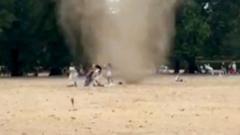
A freak weather anomaly tore through a London green space last Tuesday, sending deckchairs flying, tourists scattering, and smartphones recording frantically.
Social media feeds flooded with vertical videos of a rotating column of dust and debris spinning aggressively across the grass. Most spectators labeled it a tornado. Meteorologists corrected the public quickly. It was a classic dust devil, a meteorological phenomenon born from intense surface heating and localized atmospheric instability.
Londoners are accustomed to rain, wind, and the occasional heatwave that buckles transit infrastructure. They are decidedly not prepared for miniature ground-up vortexes whipping through urban parks. This rare event serves as an urgent wake-up call regarding how extreme weather manifests in densely populated urban environments.
Anatomy of an Urban Vortex
Understanding why a dust devil materialized in the middle of a British park requires looking closely at urban thermodynamics.
Unlike tornadoes, which drop out of supercell thunderstorms from the troposphere down, dust devils form from the ground up. On hot days, asphalt, concrete, and dry park soil absorb intense solar radiation. This energy superheats a thin layer of air sitting directly above the surface.
When this superheated air pocket suddenly breaks through a cooler layer of air above it, it rises rapidly. If a horizontal breeze or conflicting wind patterns shear across the rising column, it begins to spin. Conservation of angular momentum takes over, tightening the rotation and accelerating the wind speeds inside the vortex.
The Urban Heat Island Amplifier
London operates as a massive heat engine. Millions of buildings, exhaust systems, paved surfaces, and vehicles trap thermal energy effectively.
When an unseasonably warm afternoon hits the capital, green spaces like Hyde Park, Regent's Park, or smaller neighborhood squares act as thermal contrast zones. The boundary where dry, sun-baked turf meets shaded pathways creates localized pressure differentials. These micro-climates provide the exact ingredients necessary to spin up dust devils that would typically only find life across arid deserts or plowed agricultural fields.
Infrastructure Under Pressure
City planners have long designed public parks for leisure, drainage, and carbon sequestration. They have rarely engineered them to withstand sudden, localized wind shear.
When a spinning column of wind picks up heavy park benches, unsecured umbrellas, and heavy litter bins, the risk to human safety escalates immediately. While most urban dust devils dissipate within seconds of moving over damp ground or shaded tree canopies, the modern metropolis offers plenty of hard surfaces to sustain them.
The Surveillance Loop
Every freak weather event now arrives packaged with digital amplification.
Witnesses capture the spectacle instantly, uploading shaky footage to global platforms within minutes. This hyper-connectivity alters public perception of risk. A minor weather quirk that would have gone unnoticed fifty years ago now triggers widespread anxiety about climate instability.
Yet, this panic is not entirely unfounded.
As global temperatures continue to rise, the frequency of extreme ground-level thermal anomalies will increase. Cities must adapt their open spaces to account for sudden micro-weather hazards. Planting more continuous tree canopies breaks up the large, flat expanses of sun-baked grass that allow thermal plumes to organize and rotate freely.
The dust devil that startled Londoners last week was a fleeting anomaly. It was also a visible reminder that the atmosphere surrounding our concrete jungles is growing increasingly volatile, demanding a complete rethink of how we secure public spaces against the invisible forces gathering right beneath our feet.
:max_bytes(150000):strip_icc()/ar-American-Cheese-taste-test-horizon-4x3-54cc339550cd44b9a818c17bdfd5428d.jpg)