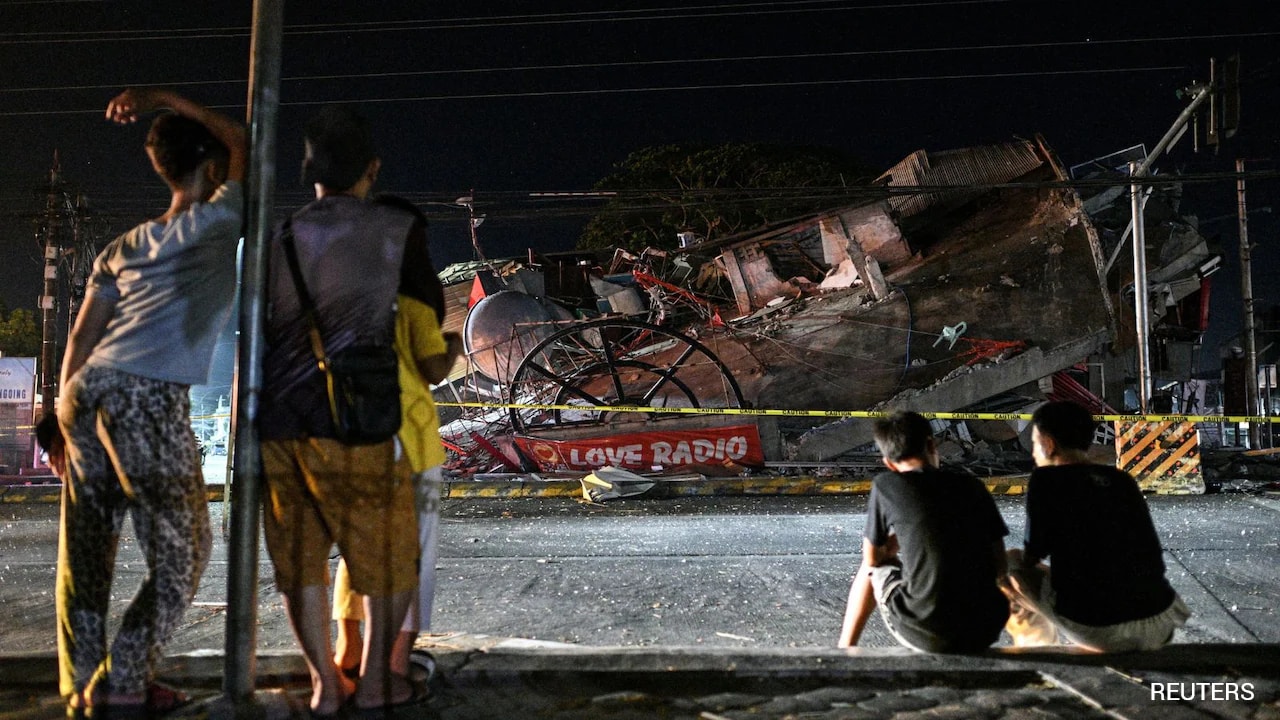
The headlines covering the recent disaster in the Philippines follow a predictable, lazy script. "32,000 Displaced As Buildings Reduced To Rubble." Media outlets rush to blame the shifting tectonic plates of the Philippine Fault Zone for the immediate humanitarian crisis. They parade images of flattened concrete and tent cities, implying a direct line of causation between a magnitude 7.0 tremor and human misery.
It is a comfortable lie. It frees local governments, urban planners, and real estate cartels from blame.
The hard truth is that earthquakes do not displace tens of thousands of people. Corrupt zoning laws, toothless engineering enforcement, and systemic poverty do. A seismic event is merely an audit of a city's infrastructure. In the Philippines, that audit has been failing for decades, and treating the resulting displacement as an unavoidable natural disaster ensures it will happen again.
The Myth of the Unavoidable Catastrophe
Mainstream reporting treats seismic energy as an unstoppable force that naturally results in rubble. This is mathematically and structurally illiterate.
Consider the structural mechanics of a standard seismic event. Earthquakes generate ground acceleration. Buildings fail because they are designed to handle vertical loads—gravity—but are completely unprepared for lateral forces, the horizontal shaking. When a poorly mixed concrete pillar lacks the proper rebar reinforcement, it undergoes shear failure.
Imagine a scenario where two identical magnitude 7.0 earthquakes hit two different cities. City A enforces the strict use of ductile detailing, where steel reinforcement allows structures to bend without snapping. City B relies on substandard aggregates, unwashed marine sand that corrodes internal steel, and bribes to bypass inspection.
When the ground shakes, City A experiences minor cracks and localized disruption. City B suffers total structural collapse, forcing 32,000 people into the streets.
The disaster is not the earthquake. The disaster is the building.
I have spent fifteen years auditing structural failures across Southeast Asia. I have stood in the ruins of collapsed commercial hubs while local officials blamed "an act of God." It is never an act of God. It is almost always a compromised concrete mix or a column that was deliberately narrowed to save a few thousand pesos in materials.
The False Economy of Cheap Housing
The knee-jerk reaction from international aid organizations is to demand massive funding for emergency shelters and temporary relocation camps. This focus is entirely backward.
The global aid apparatus treats displacement as a temporary logistical problem to be solved with canvas tents and water purification tablets. They miss the macro-economic cycle entirely. By subsidizing the aftermath of a predictable collapse, they relieve the pressure on local municipalities to enforce the National Building Code of the Philippines (PD 1096).
Let us break down the brutal economics of this cycle:
- Substandard Construction: Developers build high-density, low-cost residential structures using substandard hollow blocks.
- Regulatory Blindness: Local government units turn a blind eye during the permitting phase due to bureaucratic inertia or outright graft.
- The Audit: A long-overdue fault line slips. The structures pancake.
- The Bailout: International NGOs arrive with millions in aid, housing the displaced at no cost to the developers or the politicians who approved the buildings.
- The Reset: The land is cleared, and the exact same vulnerable structures are built on the exact same fault lines.
This is a loop of manufactured vulnerability. If you want to stop mass displacement, you must stop subsidizing the entities that permit dangerous housing.
The Delusion of "Rebuilding Better"
Every post-disaster press conference features a politician promising to "rebuild better and stronger." This phrase is entirely hollow.
True seismic resilience is expensive. Retrofitting an existing multi-story concrete structure to withstand severe lateral displacement requires carbon-fiber jackets, steel bracing, or base isolation systems. These technologies require significant capital and engineering expertise.
When an earthquake displaces 32,000 people in a developing economy, there is no capital for base isolation. "Rebuilding better" in reality means slapping a fresh coat of plaster over damaged foundations and replacing collapsed cinder blocks with slightly newer cinder blocks.
The harsh reality of the contrarian approach is recognizing the downside: enforcing strict compliance with modern seismic codes means housing prices will skyrocket. It means a massive portion of existing urban housing would need to be condemned immediately, displacing people before the earthquake happens.
No politician has the stomach to evict 30,000 people from unsafe buildings during an election year. They prefer to wait for the earthquake to do it for them, then blame nature.
Dismantling the Victim Narrative
The public wants a clear villain, and a fault line is an easy target. It cannot defend itself in court.
When people ask, "How can we better prepare for the next big earthquake?" they are asking the wrong question. They are looking for better early-warning apps or faster search-and-rescue drones.
The only question that matters is: Who signed the occupancy permit for the buildings that collapsed?
If a structure collapses during an earthquake that falls within the expected seismic parameters of that region, it is a structural crime scene. The engineering specifications required to withstand the peak ground acceleration of the Philippine Fault Zone are well-documented. The math is not a secret.
When a building fails completely, it is because someone intentionally chose to ignore the math.
Stop looking at the seismographs. Stop treating the 32,000 displaced citizens as victims of an unpredictable earth. They are the victims of a predictable, systemic calculation that valued cheap square footage over human life. Until the executives who manufacture substandard cement and the inspectors who sign off on structural death traps are prosecuted for manslaughter, the ground will keep shaking, and the tents will keep going up.



:max_bytes(150000):strip_icc():focal(665x0:667x2)/gettyimages-50733149-2000-8b129a2475974982a915418ce92a73d8.jpg)