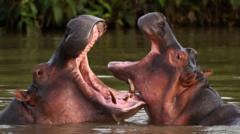
The proposed translocation of approximately 70 hippopotamuses from the Magdalena River basin in Colombia to the Greens Zoological Rescue and Rehabilitation Kingdom in Gujarat, India, represents more than a philanthropic gesture; it is a complex logistical intervention in a failed ecological system. This operation addresses a biological legacy of the late Pablo Escobar, whose private zoo introduced four hippos (one male, three females) to a non-native habitat in 1981. Without natural predators or the seasonal droughts that regulate populations in Sub-Saharan Africa, the herd has expanded at a compound annual growth rate that threatens the structural integrity of the Colombian riparian ecosystem.
The Biotic Resistance Gap and Population Scaling
The Colombian hippo crisis is a textbook illustration of the Enemy Release Hypothesis. In their native African range, hippo populations are moderated by competition for water during dry seasons, predation of calves by crocodiles and lions, and endemic diseases. In the Magdalena River, these limiting factors are absent.
The current population, estimated between 130 and 160 individuals, functions as a biological "tipping point." Research suggests that if the population exceeds a critical threshold—estimated at approximately 235 individuals—the growth curve shifts from linear to exponential. This creates a closing window for non-lethal intervention. The "repatriation" to India is a strategic attempt to bypass the high political and ethical costs of culling while offloading the long-term maintenance liabilities to a private entity capable of absorbing the capital expenditure.
The Ecological Displacement Mechanism
Hippos are "ecosystem engineers." Their impact on the Magdalena River is quantified through three primary vectors:
- Nutrient Loading: A single hippo excretes roughly 6 to 9 kilograms of dry-weight fecal matter daily. In the slow-moving waters of Colombia, this influx of nitrogen and phosphorus triggers massive eutrophication, leading to toxic algal blooms and subsequent hypoxic zones that suffocate native fish species like the manatee and various siluriforms.
- Geomorphological Alteration: The physical displacement of sediment caused by 1,500-kilogram mammals creates new channels and erodes riverbanks, destroying the nesting sites of native turtles and caimans.
- Interspecific Competition: Hippos are highly aggressive and territorial. Their presence physically excludes native megafauna from primary grazing and hydration sites, effectively shrinking the usable habitat for endemic species.
The Operational Cost Function of Translocation
Executing the transfer of 70 hippos across 15,000 kilometers involves a logistical framework that exceeds standard wildlife transport. The Vantara project, backed by Reliance Industries, must account for several high-friction variables that dictate the feasibility of the operation.
Sedation and Capture Constraints
Standard tranquilization of hippos is notoriously high-risk. Due to their thick subcutaneous fat layers and unique circulatory response to anesthesia, hippos frequently succumb to respiratory failure or drown if they retreat into water after being darted. The capture protocol requires a "lure-and-trap" system:
- Paddock Habituation: Constructing massive steel-reinforced enclosures and baiting them with food over several months to desensitize the animals to human presence.
- Mechanical Restraint: Utilizing specialized hydraulic crates designed to withstand the bite force of a hippo, which can exceed $12,000 \text{ kPa}$.
The Airlift Logistics
The cost of chartering heavy-lift cargo aircraft (such as the Ilyushin Il-76 or Boeing 747-400F) represents the largest line item in the budget. Each hippo, including its specialized crate and water-misting equipment, requires roughly 3 to 4 tons of lift capacity. For 70 animals, this necessitates multiple sorties or a massive fleet coordination. The environmental conditions inside the cargo hold must be maintained at specific humidity levels to prevent the hippos' skin from cracking, a physiological vulnerability resulting from their lack of sebaceous glands.
The India-Mexico Distribution Strategy
The plan involves bifurcating the population, with 60 individuals destined for the Gujarat facility and 10 sent to the Ostok Sanctuary in Mexico. This distribution serves as a risk-mitigation strategy. By splitting the herd, the project reduces the impact of a single-point failure (such as a disease outbreak in one facility) and leverages different climates to assess long-term acclimation.
The Greens Zoological Rescue and Rehabilitation Kingdom (Vantara) functions as a high-capacity "ecological sink." Unlike public zoos, which prioritize display and education, this facility is designed for large-scale animal recovery. The integration of 60 hippos into a 3,000-acre enclosure allows for a controlled environment where the population can be managed through surgical sterilization—an intervention that has proven nearly impossible in the wild Magdalena River due to the difficulty of tracking and post-operative care in a tropical jungle.
Jurisdictional and Ethical Friction Points
While the Indian offer provides a solution to the "cull vs. conserve" deadlock, it operates within a fragmented regulatory environment. The Colombian Ministry of Environment declared hippos an invasive species in 2022, a legal designation that simplifies the export process but complicates the liability framework.
The Sovereignty of Invasive Species
A primary bottleneck is the CITES (Convention on International Trade in Endangered Species of Wild Fauna and Flora) classification. Hippos are listed under Appendix II, which regulates trade to ensure it does not threaten the survival of the species in the wild. However, the Colombian hippos are not "wild" in the traditional sense; they are a feral population of a non-native species. This creates a legal gray area: Does the export of an invasive population require the same rigorous documentation as the export of a native endangered population?
The second limitation involves the long-term genetic viability of the relocated herd. If the goal is pure "rescue," genetic bottlenecks are a secondary concern. However, if these animals are ever intended to bolster African populations (true repatriation), the lack of genetic diversity from a four-individual founder effect makes them poor candidates for reintroduction into the African wild.
The Financial Architecture of Private Conservation
The Reliance-backed initiative signals a shift in megafauna management from state-funded mandates to corporate-driven ecological restructuring. The capital required for this move is estimated in the tens of millions of dollars. This model of "Corporate Social Responsibility" (CSR) acts as a form of "Soft Power," where a private entity solves a geopolitical and environmental headache for a foreign government.
The cost-benefit analysis for the Colombian government is clear:
- Avoided Cost: The expense of a state-led culling program, including specialized paramilitary or professional hunters and the subsequent public relations fallout.
- Risk Transfer: Shifting the biological liability of 70 aggressive animals to a foreign jurisdiction.
- Ecosystem Recovery: Reversing the $pH$ imbalances and sedimentation issues in the Magdalena River, which supports local fishing economies.
Strategic Priority: Sterilization over Relocation
While the translocation of 70 hippos is a high-profile victory for conservation optics, it only addresses roughly 50% of the current population. The remaining hippos will continue to breed at a rate of 10-15% annually.
The primary strategic move must be a dual-track approach. Translocation serves as the immediate pressure release valve, but it must be coupled with an aggressive, localized sterilization program for the remaining herd in Colombia. Chemical sterilization (using vaccines like GonaCon) has shown limited success in large mammals; therefore, surgical castration of males remains the only definitive method. The Colombian government must utilize the breathing room provided by the Indian translocation to perfect the "dart-and-operate" field surgery model, which requires specialized amphibious platforms and heavy-duty cranes.
The long-term forecast for the Magdalena River depends on the total removal of the breeding population. Leaving even twenty hippos in the wild will result in a return to current population levels within a decade. The Indian offer is not the final solution, but rather the initial phase of a total extraction strategy. The success of this operation will define the future of invasive species management, proving that private capital can execute complex biological extractions that are beyond the logistical or political reach of sovereign states.