The mass mortality of freshwater turtles in the Lowbidgee wetlands represents a failure of operational logistics rather than a lack of biological data. When Water NSW manages environmental flows, it operates under a multi-variable optimization problem: balancing agricultural irrigation, urban demand, and ecological preservation. The recent "appalling" outcome—hundreds of turtles dying in receding floodwaters—stems from a disconnect between hydrological delivery and the lifecycle requirements of the Chelodina expansa (Broad-shelled Turtle) and Emydura macquarii (Murray River Turtle). The primary bottleneck is not a lack of water, but the absence of a "recession management" protocol that accounts for the mobility limitations of local fauna.
The Three Pillars of Wetland Desiccation
To analyze why these mass mortality events occur, the event must be broken down into three distinct operational drivers. These factors dictate the survival rate of aquatic species during the transition from high-flow to low-flow states.
1. The Rate of Recession Variable
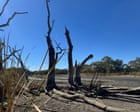
Hydrological systems in the Murray-Darling Basin are largely regulated by dams and weirs. When environmental flows are "turned off," the water level drops at a velocity that often exceeds the natural drainage patterns of a floodplain. For a slow-moving reptile, the rate of water recession creates a biological trap. If the water retreats faster than the turtle can navigate through dense vegetation or silt toward permanent water bodies, the animal becomes stranded in isolated, shallow pools. These pools then undergo rapid thermal spikes and oxygen depletion, leading to systemic physiological failure.
2. Connectivity Infrastructure Gaps
The Lowbidgee wetlands are a fragmented landscape. Effective water management requires the maintenance of "connectivity corridors"—deeper channels that remain wet long after the broader floodplain dries out. When these channels are blocked by sediment or poorly designed levees, the wetland loses its functional drainage. The turtles are effectively corralled into "death traps" because the infrastructure lacks the topographical nuance to provide a safe exit path to the river.
3. Thermal Stress and Predation Risk
Once a turtle is stranded, its survival is a function of time versus environmental exposure. In the semi-arid climate of New South Wales, a shallow pool can reach lethal temperatures within hours. Furthermore, a stranded turtle is a high-visibility target for invasive predators, primarily feral pigs and foxes. The mortality is rarely caused by a single factor but is the result of a compounding "cost function" where dehydration, overheating, and predation intersect simultaneously.
Quantifying the Policy Failure
The criticism leveled against Water NSW hinges on the predictability of this outcome. In ecological management, a "sudden" event is often a mislabeled planned action. The decision to cease water delivery to specific wetland cells is a binary choice made by human operators. The failure resides in the lack of a "tapering" strategy.
The Delta of Death: Flow vs. Survival
In a natural, unregulated system, the recession of floodwaters follows a bell curve. Regulation transforms this curve into a sharp cliff.
- Natural Decay: A gradual decline allows animals to sense the changing depth and migrate toward the river.
- Regulated Decay: A sharp cutoff leaves the ecosystem unable to adjust.
The ecological deficit is calculated by the difference between the number of individuals that would have survived a natural recession versus the number that survived the managed shut-off. In the case of the Lowbidgee wetlands, this delta is massive. Reports of hundreds of carcasses indicate that the survival rate dropped toward zero in specific management cells. This suggests that the "managed" recession was functionally indistinguishable from a catastrophic drought event, despite being an intentional operational choice.
The Mechanics of Bureaucratic Inertia
Why does a state agency ignore the obvious risk of mass mortality? The answer lies in the hierarchy of mandates. Water NSW is primarily a delivery agency. Their Key Performance Indicators (KPIs) are often centered on volume delivery and cost-to-delivery ratios. Ecological outcomes are frequently viewed as "externalities" rather than core operational requirements.
This creates a perverse incentive structure:
- Volume Efficiency: Shutting off water quickly saves volume for later use or sale, improving the efficiency metric of the water bank.
- Labor Minimization: Monitoring the "end of flow" requires ground-level ecological assessment, which is labor-intensive. It is cheaper to manage via remote sensors and timed gate closures.
- Responsibility Diffusion: When turtles die, the agency can point to "unforeseen environmental conditions" or "natural drying cycles," effectively shifting the blame from operational decisions to the inherent harshness of the Australian climate.
The False Dichotomy of Water Use
The narrative surrounding these events often pits "farmers versus turtles." This is a fundamental misunderstanding of the resource management problem. The water used for these wetlands was already designated as "environmental water." The failure was not a lack of supply, but a failure of application.
Think of it as a medical failure: the patient was given the correct medication, but it was administered at such a high pressure that it ruptured the veins. Water NSW delivered the environmental flow (the medication) but failed to manage the withdrawal (the recovery phase), leading to a system-wide collapse in the targeted wetland cells.
The Problem with "Wetland Flushing"
Environmental flows are often used to "flush" a system to remove salts or trigger breeding events. However, if the "flush" is not followed by a "stabilization phase," the breeding event becomes a sink. For turtles, a flush might trigger movement into the wetland, but the sudden withdrawal prevents them from leaving. This turns a conservation effort into a population trap, effectively accelerating the decline of the very species the flow was intended to support.
Implementing a Dynamic Recession Protocol
To prevent future mass mortality events, the operational framework of Water NSW must shift from "Volume Delivery" to "Ecosystem Transition." This requires three specific technical upgrades to their management strategy.
1. Recession Rate Capping
Agencies must establish a maximum allowable rate of water level decline (e.g., no more than X centimeters per day). This cap would be based on the locomotive capabilities of the slowest-moving keystone species in the area, such as the Broad-shelled Turtle. If the water level must drop, it must do so at a pace that allows for biological retreat.
2. Topographical Mapping and "Refuge" Excavation
The use of LiDAR and high-resolution drone mapping can identify "low spots" where water will naturally pool. Management plans should include the manual deepening of these areas or the clearing of channels to ensure they remain connected to the main river channel. This creates a "ladder" system for aquatic life, ensuring there is always a deeper path available as the floodplain dries.
3. Real-Time Biological Feedback Loops
The decision to close a regulator gate should not be made from an office in Sydney based on a spreadsheet. It must be contingent on field reports from local rangers or ecologists. If a "stranding event" is detected early, the recession must be paused or a "rescue flow" initiated.
The Economic Reality of Ecological Neglect
The death of hundreds of turtles is not just a moral or aesthetic loss; it is a significant hit to the long-term economic health of the river system. Turtles are "ecosystem engineers" and scavengers. They play a critical role in nutrient cycling and maintaining water quality by consuming decaying organic matter.
When the turtle population collapses:
- Water Quality Degrades: Without scavengers, carcasses of fish and other organisms rot, leading to bacterial blooms and potential outbreaks of botulism or blue-green algae.
- Filtration Costs Rise: Lower water quality in the river system increases the filtration and treatment costs for downstream agricultural and urban users.
- Biodiversity Debt: Replacing a mature turtle population takes decades. Chelodina expansa can live for over 50 years and takes a long time to reach sexual maturity. The loss of hundreds of adults represents the destruction of decades of "biological capital."
The Strategic Shift Required
The current management model is broken because it treats water as a static commodity rather than a dynamic biological necessity. Water NSW must move beyond the "Appalling Decision" phase by integrating "Recession Management" into their legal and operational charters.
The immediate tactical move is the implementation of a "Floodplain Exit Strategy" for every environmental flow event. This strategy must be pre-funded and pre-planned, with the same level of engineering precision currently reserved for dam safety and irrigation schedules. If an agency cannot guarantee a safe exit for the species it is supposedly supporting with environmental water, it has failed its primary mission. The focus must shift from how much water is delivered to how that water leaves the landscape. Only by managing the end of the flow with the same rigor as the beginning can the Murray-Darling Basin avoid becoming a series of managed graveyards.