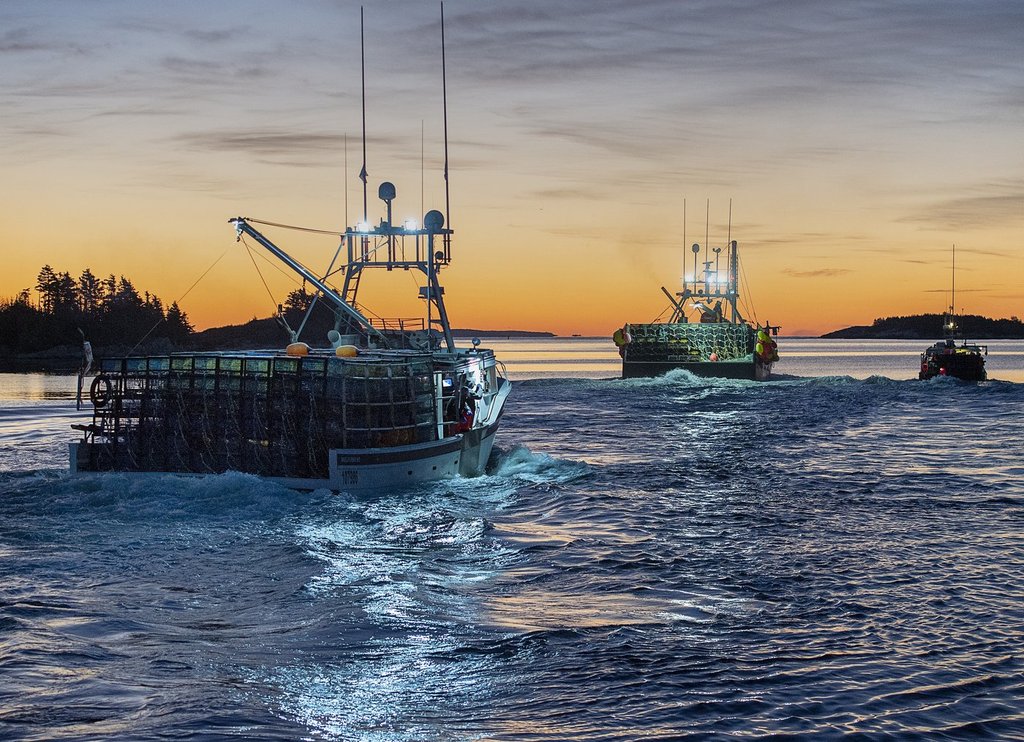
The financial viability of the North Atlantic lobster industry currently rests on a fragile equilibrium between inelastic operating costs and highly elastic global demand. Harvesters are trapped in a classic margin squeeze: the "input floor" is rising due to systemic inflation in energy and labor, while the "price ceiling" is constrained by consumer sensitivity to luxury protein surcharges. To navigate this, stakeholders must move beyond mere hope for higher prices and instead master the three variables that dictate the bottom line: fuel-to-landings ratios, bait supply chain volatility, and the pricing power of downstream wholesalers.
The Cost Function of Modern Lobstering
A lobster vessel functions as a mobile extraction unit with a high fixed-to-variable cost ratio. When expenses "soar," the break-even point shifts rightward on the volume axis, forcing harvesters to stay at sea longer to cover the basic day-rate of the operation. If you found value in this article, you should check out: this related article.
Energy Intensity and the Fuel-Price Trap
Diesel is not merely an expense; it is the primary engine of liquidity. Most harvesters utilize internal combustion engines that lack the efficiency of modern automotive equivalents. When marine gas oil (MGO) prices spike, the "search cost" for lobster clusters becomes the deciding factor in profitability. A captain who burns 100 gallons to find 500 pounds of lobster faces a vastly different margin profile than one who burns the same amount for 300 pounds. This creates a trap: as fuel prices rise, the risk of "exploratory hauling" (checking traps in unproven areas) becomes financially ruinous, leading to over-competition in known, high-density zones.The Bait Supply Bottleneck
Bait represents a significant, often overlooked variable cost that is decoupled from fuel trends. Recent regulatory shifts in the management of Atlantic herring and mackerel—traditional bait sources—have created an artificial scarcity. This forces harvesters to turn to more expensive alternatives, such as frozen imports or synthetic baits. This creates a secondary squeeze: as biomass regulations tighten for forage fish, the cost per trap-haul increases regardless of the market price of lobster. For another angle on this development, refer to the recent coverage from Business Insider.Capital Depreciation and Debt Service
Modern lobstering is capital-intensive. The cost of a new 40-foot fiberglass hull, equipped with state-of-the-art sonar and hydraulic haulers, can exceed $500,000. Many operators carry significant debt loads. When operational costs (fuel/bait) rise, the ability to service this fixed debt is compromised. This forces a transition from "growth mindset" to "asset preservation," where harvesters delay critical maintenance, inadvertently increasing the risk of mechanical failure and long-term capital loss.
Price Elasticity and the Luxury Protein Barrier
While harvesters "hope" for high prices, the reality is dictated by the global seafood market's elasticity. Lobster is a discretionary luxury good. Unlike staple proteins, demand for lobster drops precipitously once a certain price-per-pound threshold is breached at the retail and restaurant levels.
The pricing mechanism is a multi-step descent. The "boat price" (what the harvester receives) is a derivative of the "wholesale price," which is itself a derivative of "consumer willingness to pay" (WTP). If inflation erodes the purchasing power of middle-class consumers in the US or China—the two largest markets—wholesalers cannot pass on the increased costs from the harvesters. This results in a price ceiling that is often lower than the harvester’s required margin.
The lack of vertical integration in the industry compounds this. Because most harvesters are independent contractors selling to a few large processors or distributors, they lack the "pricing power" to dictate terms. They are price-takers in a market where the takers are also feeling the pinch of high cold-storage costs and shipping rates.
The Mechanism of Seasonal Volatility
The timing of the harvest is the most significant tactical variable within the control of the fleet. The industry observes a clear inverse relationship between supply volume and unit price, yet the necessity of cash flow often forces a "race to fish."
- The Oversupply Paradox: When the season opens and landings are high, the surge in supply often crashes the boat price. Harvesters are then forced to catch even more to meet their fixed costs, further depressing the price.
- The Molting Cycle: Soft-shell lobsters (newly molted) yield less meat and are more fragile for transport, leading to lower prices. Hard-shell lobsters command a premium due to their durability in the export market. The shift in fuel costs makes the "low-value" soft-shell season increasingly difficult to justify, potentially shifting the industry's focus toward a smaller, high-value hard-shell window.
Biological and Regulatory Constraints as Non-Negotiable Overheads
Beyond the immediate financial inputs, the industry faces structural pressures from environmental and regulatory spheres that act as a "hidden tax" on operations.
The North Atlantic Right Whale (NARW) regulations represent a massive shift in the operational cost structure. Requirements for "weak rope," gear marking, and seasonal closures are not just bureaucratic hurdles; they are operational bottlenecks. The time spent re-rigging gear or navigating around closed areas directly increases the fuel-per-pound ratio. Furthermore, the threat of potential gear mandates—such as "ropeless" fishing technology—represents a looming capital expenditure that many small-scale operators cannot absorb without significant subsidies.
Climate-driven migration of lobster populations adds another layer of uncertainty. As the Gulf of Maine warms, the biomass is shifting further north and into deeper waters. For the harvester, this means longer steam times and the need for larger, more seaworthy vessels, once again escalating the fuel and capital requirements of the business.
Measuring Efficiency: The Net-Pound Metric
The traditional metric of success in the industry has been "total pounds landed." In a high-cost environment, this metric is functionally obsolete. The only metric that matters for long-term survival is the Net-Margin per Trap Haul.
$$M = \frac{(P \times L) - (F + B + W + D)}{T}$$
Where:
- $M$ = Margin per Trap
- $P$ = Price per pound
- $L$ = Pounds landed
- $F$ = Fuel cost per trip
- $B$ = Bait cost per trip
- $W$ = Labor/Wages
- $D$ = Daily Depreciation/Debt
- $T$ = Number of traps hauled
If $M$ is near zero or negative, the harvester is essentially paying to work. This calculation reveals that a "good" price is meaningless if the fuel and bait components ($F + B$) grow faster than the revenue component ($P \times L$).
Strategic Reorientation for Harvesters
The industry cannot rely on the volatility of global markets to solve a structural cost problem. Survival requires a shift from a volume-based strategy to a margin-optimization strategy.
The first step is a radical focus on fuel efficiency. This includes retrofitting existing hulls with fuel-flow meters to identify the "sweet spot" in RPMs, reducing transit speeds, and utilizing data-driven scouting to minimize search time. The goal is to maximize $L$ while minimizing $F$.
The second step involves diversifying the bait supply chain. Dependence on a single species (herring) creates a single point of failure. Harvesters who can secure long-term contracts for alternative proteins or participate in bait-buying cooperatives will insulate themselves from the price shocks seen in the traditional bait market.
The third and most difficult step is increasing pricing power through traceability. Consumers are increasingly willing to pay a premium for "verifiable" sustainability and local origin. By utilizing blockchain or simple QR-code tracking that links a lobster to a specific boat and captain, harvesters can attempt to bypass the "commodity trap" and capture a portion of the specialty-market premium.
The lobster industry is entering a period of Darwinian consolidation. Those who continue to operate on the "high volume, high burn" model of the previous decade will likely be phased out by the sheer physics of the margin squeeze. The survivors will be those who treat their vessel not as a fishing boat, but as a precision-tuned extraction business where every gallon of diesel and every pound of bait is an investment that must yield a calculated return. Strategic success now depends entirely on the ability to decouple revenue from the erratic fluctuations of the global energy market. Focus on the internal cost function; the market price is a variable you cannot control, but the efficiency of the extraction is a variable you can master.