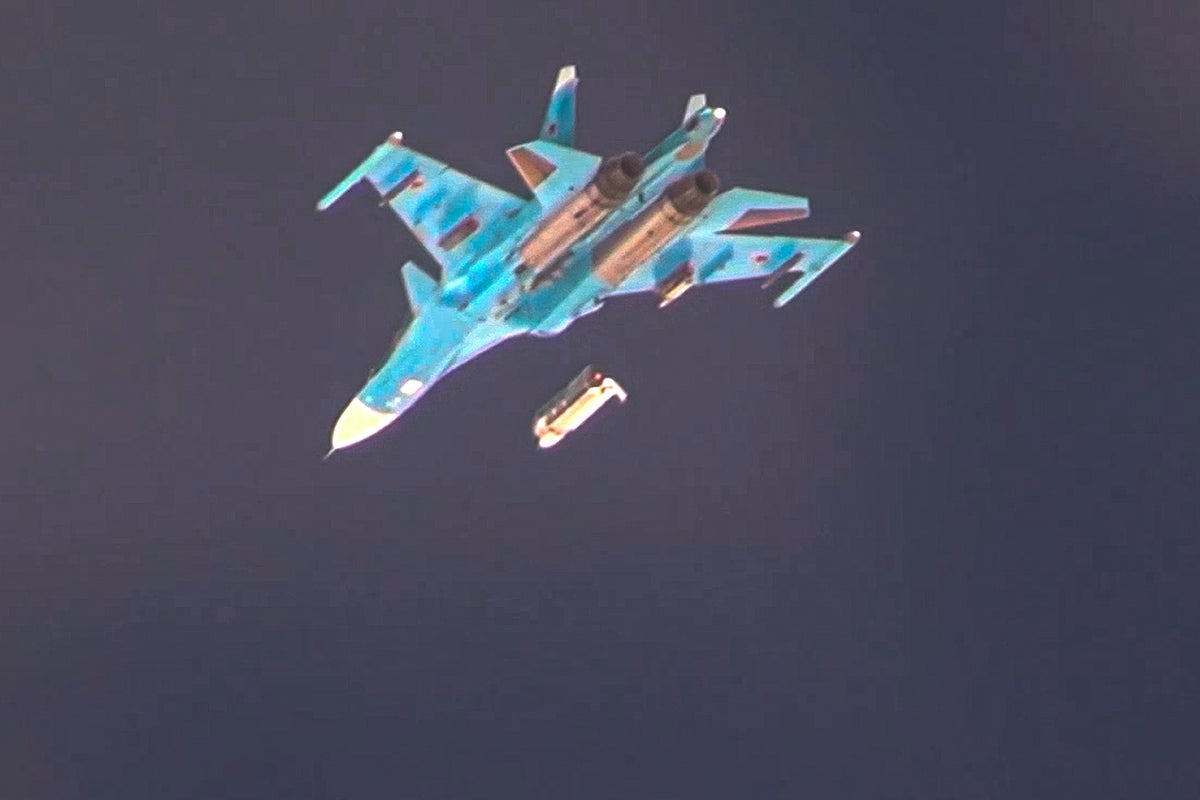
The operational reality of modern attrition warfare is dictated by the cost-exchange ratio of precision munitions against defensive architectures. In the ongoing conflict in Ukraine, the deployment of Soviet-era unguided bombs retrofitted with low-cost guidance and flight-extension kits—commonly known as Universal Modules for Planning and Correction (UMPK)—has fundamentally altered tactical dynamics. This shift is not driven by technological breakthrough, but rather by the optimization of existing industrial mass against finite, expensive air defense interceptors. Understanding this weapon system requires breaking down its kinematic mechanics, its economic asymmetry, and the structural limitations of current counter-mechanisms.
The Kinematic Mechanics of Stand-Off Conversions
The primary utility of a glide bomb lies in its ability to convert potential and kinetic energy from a launch aircraft into horizontal range, removing the necessity for expensive internal propulsion systems. Traditional air-to-ground missiles require solid-fuel rocket motors or turbojets, which increase unit cost, production complexity, and logistical footprint.
A standard unguided explosive, such as the FAB-500 (a 500-kilogram general-purpose bomb), undergoes a structural transformation when attached to a UMPK kit. The assembly consists of three primary subsystems:
- Deployable Wing Assembly: Folded beneath or above the bomb casing during transport, these wings deploy immediately post-release to generate lift, transforming a ballistic drop trajectory into an extended glide path.
- Satellite and Inertial Navigation Units: A combination of inertial measurement units (IMU) and satellite navigation receivers (compatible with GLONASS and GPS networks) tracks deviations from predetermined coordinates.
- Actuator Control Surfaces: Small tail fins manipulate aerodynamic airflow to continuously correct the bomb’s flight path toward the designated grid point.
The maximum effective range of these munitions fluctuates between 40 and 70 kilometers, heavily dependent on the launch platform’s velocity and altitude at the point of release. To maximize stand-off distance, launch platforms (typically Su-34 and Su-35 fighter-bombers) execute high-altitude, high-speed release maneuvers. Launching at altitudes exceeding 10,000 meters and speeds approaching Mach 1 allows the munition to exploit thinner air layers, reducing drag coefficients during the initial phase of flight.
This operational profile creates an acute tactical dilemma. The launch aircraft remains outside the effective engagement envelope of short- and medium-range tactical air defense systems, such as mobile MANPADS or point-defense missile batteries. The aircraft only exposes itself briefly to long-range strategic surface-to-air missile (SAM) systems, creating a narrow window for interception before the platform retreats into protected airspace.
The Cost-Exchange Ratio Bottleneck
Wars of attrition are ultimately decided by industrial production capacity and economic sustainability. The deployment of glide bombs demonstrates an extreme asymmetry in cost-per-engagement metrics, favoring the offensive actor.
The financial equation can be structured as a comparison between the cost of the offensive payload and the cost of the defensive interceptor required to neutralize either the payload or the delivery platform:
$$\text{Cost Ratio} = \frac{\text{Unit Cost of Air Defense Interceptor}}{\text{Unit Cost of Conversion Kit} + \text{Depreciation of Iron Bomb}}$$
An unguided FAB-500 shell drawn from deep Cold War-era stockpiles carries a negligible marginal asset value, effectively reducing the raw material cost to zero. The UMPK kit itself relies on commercial off-the-shelf electronics, basic fiberglass or aluminum wing structures, and simple electric actuators. Estimates place the production cost of a single conversion kit between $20,000 and $30,000.
Conversely, the defensive systems capable of intercepting these small, low-radar-cross-section targets at extended ranges rely on highly sophisticated interceptor missiles:
- Patriot MIM-104 Interceptors: Individual missiles cost between $2 million and $4 million depending on the variant (PAC-2 vs. PAC-3).
- NASAMS (AMRAAM Interceptors): Each missile costs approximately $1 million to $1.2 million.
- SAMP/T (Aster 30 Interceptors): Unit costs approximate $2 million or more.
Attempting to intercept individual glide bombs using advanced SAM systems results in rapid economic exhaustion for the defending force. A single day of heavy bombardment involving 100 glide bombs represents roughly $2.5 million in offensive hardware deployment. Defending against this volume with high-tier interceptors would require an expenditure exceeding $100 million per day, an unsustainable burn rate for any contemporary military-industrial logistics network.
Furthermore, the physical characteristics of glide bombs make terminal interception difficult. They possess no thermal signature from a rocket motor, rendering infrared-guided point defenses useless. Their radar cross-section is remarkably low compared to an aircraft, and their descent angle in the final phase approaches a steep vertical drop, striking targets with high kinetic velocity that traditional point-defense systems are poorly optimized to track and defeat.
Failure Modes and Countermeasure Limitations
Despite their operational efficiency, glide bombs are bound by specific engineering constraints and failure modes. These vulnerabilities offer the only viable pathways for neutralizing the threat.
Satellite Signal Degradation and Electronic Warfare
The accuracy of a UMPK-equipped bomb is heavily reliant on continuous coordinate updates via satellite positioning. In environments characterized by dense electronic warfare (EW), high-powered GPS and GLONASS jamming systems can sever this link. When denied satellite connectivity, the bomb reverts to its internal Inertial Navigation System (INS).
The structural limitation here is drift rate. Cheap IMUs experience cumulative errors over time; for every minute of uncorrected flight, the target deviation increases exponentially. If jammed immediately after release, a glide bomb's circular error probable (CEP) can degrade from under 10 meters to over 100 meters, rendering it ineffective against localized, hardened tactical positions, though still destructive against broad civilian or industrial infrastructure. To mitigate this, newer variants incorporate CRPA (Controlled Reception Pattern Antennas) which isolate valid satellite signals by electronically steering nulls toward the direction of ground-based jamming signals.
Airframe and Assembly Structural Failures
The rapid, ad-hoc adaptation of old munitions introduces systemic mechanical failure rates. Cold War-era bomb casings often suffer from internal corrosion, altering center-of-mass calculations. Furthermore, the mechanical attachment points securing the UMPK kit to the bomb body are subjected to violent aerodynamic forces during high-speed deployment. Structural failures—such as wings failing to deploy symmetrically or separating from the fuselage entirely—result in immediate ballistic failure, causing the munition to fall short of its intended target corridor.
Strategic Realignment of Defensive Architecture
Because intercepting the glide bomb itself is economically and logistically unviable, defensive strategies must shift from terminal interception to platform denial. The target of kinetic action must be the delivery system—the fighter-bomber—rather than the payload.
This strategic shift demands a reallocation of defensive resources along three primary axes:
- Extended Forward Air Defense Presence: Moving long-range SAM assets closer to the forward line of troops (FLOT) introduces significant risk, exposing high-value radars and launchers to drone spotters and loitering munitions. However, this risk is mandatory to create an interception envelope that reaches 50 kilometers behind enemy lines, forcing launch aircraft to release their payloads from lower altitudes or further back, drastically reducing the effective range of the glide bombs.
- Long-Range Asymmetric Base Interdiction: Rather than engaging aircraft in flight, defensive strategy must target the logistical infrastructure that supports them. This involves utilizing long-range one-way attack drones and tactical ballistic missiles to strike airbases hosting Su-34 fleets. Destroying unhardened aircraft on the tarmac, obliterating forward fuel storage depots, and detonating unguided bomb stockpiles yields a higher return on investment than tactical air defense engagements.
- Active Air-to-Air Denial: Deploying fourth-generation fighter aircraft equipped with long-range air-to-air missiles (such as the AIM-120D AMRAAM) allows for active patrolling of airspace. By exploiting the radar capabilities of look-down/shoot-down systems, these platforms can threaten launch aircraft before they reach their optimal release points, breaking the continuity of the bombardment cycle.
The emergence of glide bomb warfare highlights a fundamental truth of modern state-on-state conflict: high-technology solutions are easily undermined by brute-force industrial scaling of low-technology adaptations. The future of defensive doctrine will not be defined by building increasingly complex missiles to shoot down cheap flying explosives, but by the rapid automation of electronic warfare countermeasures and the structural destruction of the adversary's long-range logistical chain. Strategic equilibrium can only be restored when the cost of delivering the munition exceeds the economic threshold of the territory it destroys.