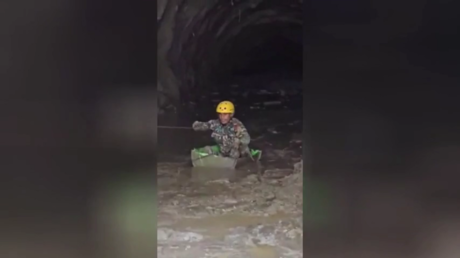
Every time a tunnel collapse or major infrastructure failure makes international headlines in South Asia, the media machine spins up an identical, lazy narrative. The script never changes. We get weeping families outside portal entries, breathless updates on machinery shortages, and stern editorials demanding tighter safety regulations. Then, the news cycle moves on, leaving behind a scarred mountain pass and a population waiting for the next catastrophe.
This knee-jerk framing misses the entire structural reality of how civil engineering works in volatile, high-altitude terrain.
Standard journalism looks at a disaster site like a crime scene where a specific villain left fingerprints. It treats every collapsed bore as an isolated failure of contractor greed, geological bad luck, or institutional neglect. That view feels morally satisfying, but it is completely useless for saving lives or building better infrastructure. When a thousand people are trapped or killed in a catastrophic construction or transit failure, pointing fingers at individual project managers is a comfortable substitute for confronting systemic engineering hubris.
Let us look past the standard outcry and examine the mechanics of what actually happens when modern tunneling collides with the Himalayas.
The Myth of Predictive Geotech in Moving Mountains
The lazy consensus relies on a comforting fiction. Project backers love to claim that with enough seismic sensors, core drills, and high-powered computer modeling, we can map every fault line and subterranean void before a single dynamite charge goes off.
Reality laughs at soil mechanics.
The Himalayan range is not a stable chunk of rock you can slice through like cheese. It is a live tectonic collision zone. The Indian plate is continuously driving underneath the Eurasian plate at a rate of roughly two centimeters per year. This means the entire mountain belt is under immense, restless compressive stress. Storing energy in rock strata that are actively shifting is like trying to build a fortress on top of a hydraulic press.
When engineers apply western tunneling methods—such as the New Austrian Tunneling Method or heavy mechanized boring shields—they often assume a baseline homogeneity in the surrounding geology. They drill a few exploratory boreholes, run sonar profiles, and calculate rock mass ratings. But in young, highly fractured orogenic belts, a core sample taken fifty meters to the left might show stable granite, while the actual bore path cuts directly through a hidden hydro-thermal shear zone filled with saturated silt and gravel under high hydrostatic pressure.
The failure is rarely a lack of safety gear or a skipped inspection. The failure is an epistemological arrogance. We are trying to impose rigid Euclidean geometries onto a chaotic, dynamic geological system that refuses to stay still.
The Logistics Trap of High-Altitude Rescue
When a collapse occurs, the immediate public demand is simple: send more heavy machinery, deploy specialized rescue teams, and clear the blockage faster.
This expectation ignores the brutal physics of logistics in remote mountain corridors.
Imagine a scenario where a five-hundred-meter section of a primary access tunnel collapses under three hundred meters of overburden, crushing heavy excavation equipment and cutting off ventilation. The portal is accessed via a single-lane mountain switchback road prone to secondary rockfalls and landslides.
In this environment, bringing in a massive hydraulic crawler crane or an automated muck-removal system is not a matter of writing a check. It is a multi-day logistical nightmare. Every ton of heavy equipment has to crawl up narrow, winding infrastructure that may have just been compromised by the same seismic jolt or heavy monsoon rains that triggered the tunnel failure in the first place.
Rescuers do not face a lack of willpower; they face the tyranny of mass and momentum. You cannot airlift a hundred-ton excavator into a deep narrow gorge when the winds are gusting at forty knots and the visibility is zero. While politicians hold press conferences promising round-the-clock extraction efforts, the crews on the ground are fighting against basic Newtonian physics with hand tools and unstable rubble piles that shift every time a diesel engine vibrates nearby.
Why More Regulation Is Making Projects Less Safe
The policy prescription from international development agencies is invariably the same: add more oversight, mandate stricter compliance checklists, and increase bureaucratic sign-offs.
This response produces the exact opposite of its intended effect.
In high-risk engineering environments, hyper-bureaucratic compliance often breeds a culture of defensive box-checking rather than active hazard mitigation. When every decision requires five layers of regulatory approval from officials sitting in a distant capital who have never stepped foot inside an active heading, the timeline stretches out. Pressure mounts to make up for lost time. Contractors facing severe financial penalties for project delays begin cutting corners quietly, knowing that official audits are focused on paperwork compliance rather than physical reality.
True safety in difficult terrain comes from operational flexibility, not rigid bureaucracy. Field engineers need the authority to halt work immediately based on real-time acoustic emissions from the rock face, water inflow spikes, or subtle deformation measurements in the steel rib supports. When compliance is reduced to a stack of signed forms, the incentive shifts from listening to the mountain to protecting legal liability.
The Economic Blackmail of Mountain Infrastructure
We cannot talk about these disasters without confronting the economic coercion driving them. Remote communities need all-weather connectivity for trade, medical access, and education. National governments need strategic transport corridors to secure borders and integrate peripheral regions.
This creates a desperate race to bore through mountains that do not want to be pierced.
The bidding process for these megaprojects frequently rewards the lowest bidder, creating an invisible race to the bottom in cost estimation. Contractors underbid because they know that once a project is fifty percent complete, the government cannot afford to pull the plug. Change orders for unforeseen geological surprises become the real profit engine.
As a result, projects start with compromised budgets and compressed timelines. Safety margins are treated as negotiable line items rather than absolute constraints. When the mountain pushes back, the human cost is paid by migrant laborers at the excavation face, while the financial risk is cushioned by state-backed guarantees and insurance pools.
Rethinking the Borehole
If we want to stop writing identical obituaries every few years, we have to abandon the illusion that we can conquer Himalayan geology with brute force and better PR.
This requires three fundamental shifts in how we approach difficult infrastructure:
- Embrace Surface Alternatives: Stop treating tunnels as the default solution for every mountain crossing. Surface roads, funiculars, cable-crane systems, and aerial ropeways often have higher initial capital costs or lower throughput capacities, but they do not concentrate catastrophic risk into a single enclosed death trap when the earth moves.
- Decentralize Authority: Give shift foremen and geologists absolute, unchallengeable veto power over project timelines. If the rock starts talking, work stops. No committee meetings, no ministerial sign-offs required.
- Internalize Geological Risk: Tie the financial compensation of project planners and executives directly to the long-term structural integrity of the bore over a ten-year horizon, rather than completion milestones.
The mountains are not failing us. Our engineering philosophy is failing the mountains. Until we stop treating tectonic plates like passive construction materials, the rescue operations will continue, and the tunnels will keep collapsing.

