The warehouse smells of cooling oil and ozone. It is a sharp, chemical scent that catches the back of your throat, sticking to your tongue long after you leave the floor. I stood there three years ago, watching a logistics officer run a gray-gloved hand down the stencil-painted side of a Patriot missile canister. He didn't look proud. He looked tired.
"Every one of these is a million-dollar insurance policy," he told me, his voice flattening against the corrugated metal walls. "The problem is, we are cashing them out faster than the bank can print them."
At the time, numbers on a defense budget sheet felt abstract. They were columns of ink, symbols of national security that lived in sterile briefing rooms thousands of miles from any battlefield. We talked about inventory levels the way accountants talk about quarterly adjustments. We assumed the supply chains were bottomless. We believed the industrial might that won the twentieth century could simply flick a switch and churn out infinite silver cylinders whenever the sky darkened.
We were wrong.
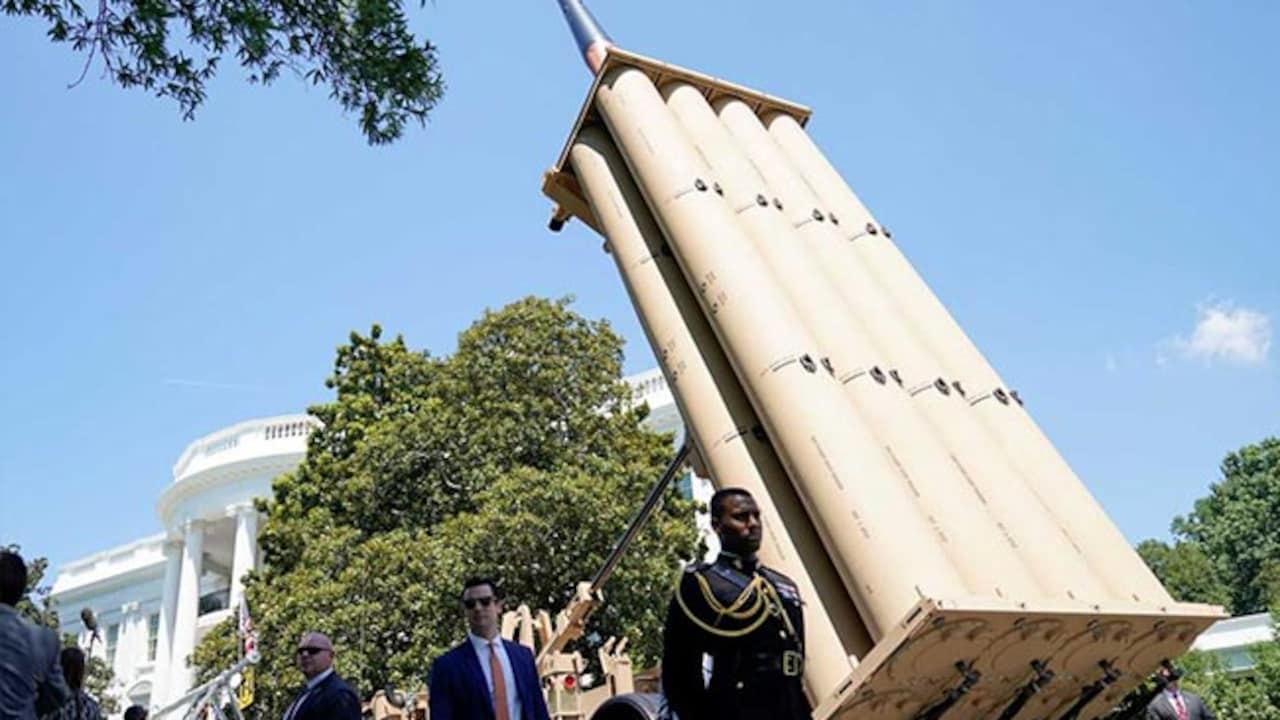
Consider what happens next when a conflict stretches past the horizon of patience. The math catches up. According to recent assessments regarding the heavy strain on American defense stockpiles, the rapid expenditure of high-end interceptors—ranging from the Terminal High Altitude Area Defense systems to the Patriot batteries scattered across foreign installations—has depleted critical reserves to near-empty thresholds. We have spent years firing multi-million-dollar interceptors at low-cost drones and ballistic arcs, trading economic advantage for momentary survival.
The strategy worked, technically. The targets fell out of the sky. But the cost was never just financial.
To understand this crisis, you have to look past the hardware and into the geometry of a launch. Imagine a single battery crew stationed in a dusty, wind-scoured compound. It is three in the morning. The radar screens flare with sudden, violent orange rings. Incoming. The soldiers do not have the luxury of hesitation. They check the tracking data, calculate the closing speed, and authorize a launch. The roar of the booster rocket is not something you merely hear; it vibrates in your chest cavity, shaking the loose dirt from your boots.
In seconds, the missile is gone, tearing upward at hypersonic speeds to intercept a threat that cost a fraction of its own manufacturing price.
Multiply that single moment across months of sustained regional conflict. Multiply it across multiple theaters, from Eastern Europe to the Middle East. The inventory drains. The supply lines strain under the weight of raw material shortages, specialized microchip bottlenecks, and a defense manufacturing base that was optimized for lean, twenty-first-century efficiency rather than protracted industrial-scale attrition. You cannot build a complex guidance system overnight just because you need it today. The specialized gyroscopes, the heat-resistant composites, the proprietary software calibrations—each component demands time, precision, and an unbroken chain of global suppliers.
When the interceptors run low, the psychological weight shifts entirely.
For decades, the American military posture rested on an unspoken promise of absolute overhead dominance. The implicit guarantee was simple: nothing gets through. If a threat rises, a shield intercepts it. But when the shield becomes a scarce commodity, commanders are forced into agonizing triage. Do you protect the port facility or the civilian population center? Do you spend the last remaining battery on a high-altitude ballistic missile or conserve it for a swarm of cheaper loitering munitions?
This is the hidden vulnerability of modern high-tech warfare. We built weapons systems of astonishing, breathtaking sophistication, yet we tied them to a fragile, sluggish replenishment rate. It is like driving a high-performance sports car across a desert with a leaking fuel tank; the speed is exhilarating until the engine stutters and dies miles away from any pump.
The transition from abundance to scarcity is rarely announced with a trumpet blast. It happens quietly, in the quiet adjustments of operational posture, in the cautious memos circulating through the Pentagon, in the sudden reluctance to engage secondary targets because the primary bin is looking bare.
Industry leaders speak of scaling up production lines, of second and third shifts, of expanding factory footprints. Yet the physical reality of manufacturing advanced rocketry resists quick fixes. You cannot rush the curing time of composite rocket motor casings. You cannot shortcut the rigorous quality assurance testing required for a system designed to operate at Mach numbers in the stratosphere. Every shortcut introduces a failure point, and in this arena, a single failure point carries catastrophic consequences.
We are left staring at a stark, unvarnished truth. The era of limitless military stockpiles has collided with the reality of protracted, multi-front geopolitical friction.
The warehouses do not smell of ozone forever. Eventually, the floor clears. The crates empty out. And the silence that follows is heavier than any rocket's roar.