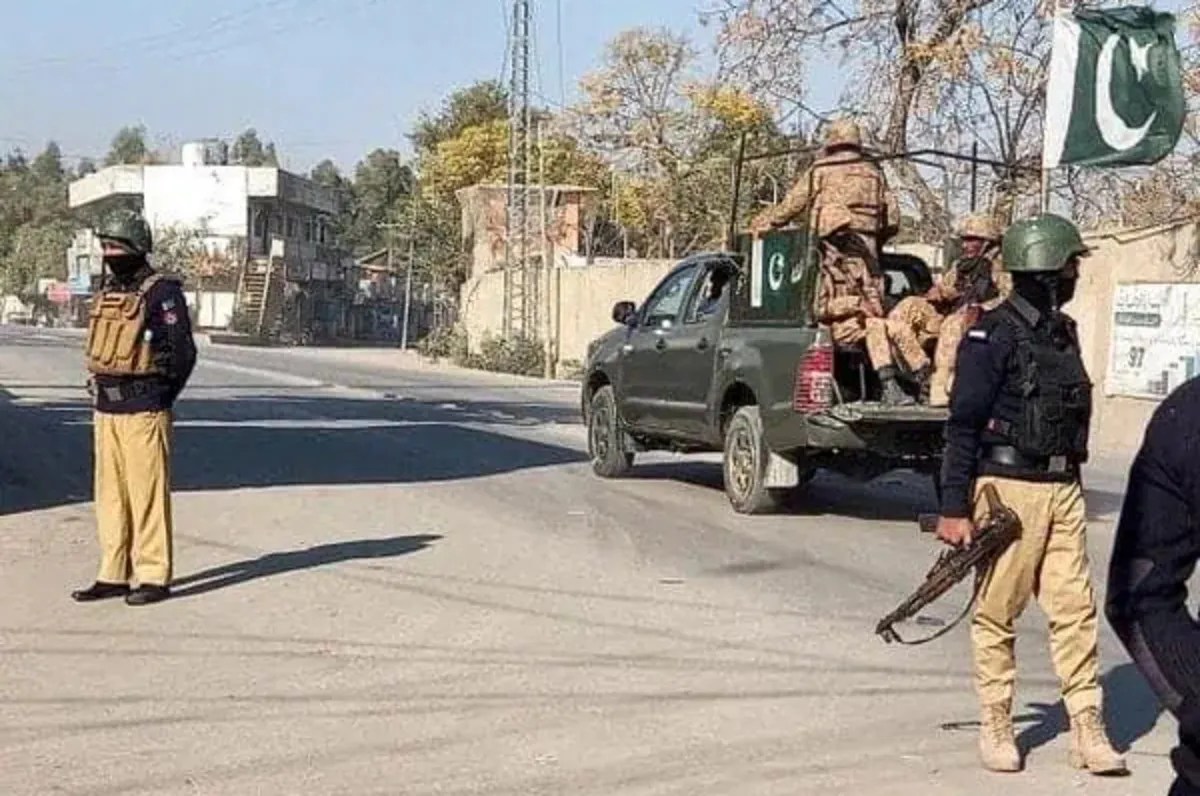
Dawn in the rugged frontierlands does not arrive with a gentle brush of gold. It hits like a hammer. The slate-gray mountains jagged against the horizon slowly bleed into a harsh, blinding white as the sun claws its way over the ridgelines. For the young infantryman huddled behind a stack of sandbags, the cold wind carries the smell of dust, cheap tobacco, and a quiet, relentless exhaustion.
He checks his radio. Again.
It is a small, mundane gesture, repeated millions of times across a sprawling network of checkpoints, forward operating bases, and high-altitude outposts. But multiply that single gesture by tens of thousands, and you begin to grasp the sheer, crushing weight of modern military mobilization.
Statistics rarely bleed. They sit neatly on spreadsheets, sterile and flat. When reports filter out that the Pakistani military has executed over forty thousand operations in a single year, the numbers wash over the public consciousness as white noise. Another milestone. Another bureaucratic metric of state security.
Stop. Look closer.
Behind that staggering tally of forty thousand separate missions lies a human story of perpetual motion. It is the story of soldiers missing their children's first steps, of boots wearing down to paper-thin soles on shale rock, of intelligence officers staring at flickering blue screens until their eyes burn, searching for the needle of a threat in a vast, indifferent haystack of desert and mountain.
To understand what forty thousand operations actually mean, one must strip away the high-altitude politics and look at the geometry of endurance.
Consider the sheer operational tempo. Three hundred and sixty-five days a year. Divide that mathematically, and you arrive at a staggering frequency. Over a hundred missions every single day. Dawn patrols breaking through morning fog. Night raids slipping through jagged ravines under a moonless sky. Logistics convoys grinding up treacherous switchbacks, hauling fuel, water, and ammunition to outposts perched so high the air itself feels like thin glass.
This is not a peacetime army rattling sabers for cameras. This is a force locked in a grinding, generational state of hyper-vigilance.
Commanders in the General Headquarters in Rawalpindi look at maps colored by risk gradients. Every valley has a history. Every crossroad has a graveyard of past mistakes. When intelligence feeds indicate a shift in militant positioning, the response cannot wait. The machinery jerks awake. Helicopters thump against the thin air. Diesel engines roar to life in hidden motor pools.
I remember the biting chill of a forward command post years ago, the smell of kerosene heaters mixing with the metallic tang of oiled weapons. The officers there do not talk in the grand abstractions of geopolitics. They talk in coordinates, battery percentages, and weather windows. They talk about morale.
"If you drop the guard for a single second," a veteran battalion commander once told me, his face weathered deep by sun and wind, "the mountain remembers."
That is the invisible stake governing every single one of those forty thousand operations. The margin for error is razor-thin. A missed intel report, a sluggish response time, a fatigued patrol losing focus in the dead of night—the consequences are immediate and catastrophic.
Yet, the sheer volume of operations tells a dual story. On one hand, it highlights an unprecedented level of activity, a military apparatus stretched to its absolute limits, constantly reacting, preempting, and fortifying. On the other hand, it exposes a grim reality about the environment itself. A state does not launch forty thousand operations in a vacuum. It does so because the pressure from within and without never truly ceases.
The threats have evolved. They no longer march in uniform across open fields. They slip across porous borders, hide in crowded urban neighborhoods, and weaponize ideology through encrypted messaging apps. To counter this, the military machine had to transform. It had to become faster, more decentralized, and infinitely more intrusive into the daily fabric of regions that have known little else but conflict for decades.
Down in the valleys, ordinary citizens live in the shadow of this perpetual mobilization. They wake up to the rumble of armored personnel carriers idling at checkpoints. They feel the tension in the air when a curfew is lowered or a major sweep is announced. For them, the forty thousand operations are not a headline on a morning news broadcast. They are roadblocks that delay a harvest, checkpoints that separate families, and the low, constant hum of surveillance overhead.
Security and normalcy are locked in a permanent tug-of-war. The soldier wants safety. The citizen wants peace. But in the crucible of the frontier, safety often requires an overwhelming display of force that makes true peace feel perpetually out of reach.
As the sun dips back below the western ridges, plunging the jagged peaks into sudden, freezing darkness, the watch does not end. The night shift takes over at the outposts. The thermal scopes power on, casting an eerie, monochromatic green glow over the rocky terrain. Somewhere in a dim command tent, a phone rings with a fresh update.
The counter ticks upward. Another operation begins. The machine never sleeps, because in this landscape, sleep is a luxury no one can afford.