Paleontologists love a neat, linear narrative. The latest academic scramble over fossil DNA claims to have mapped a perfect, tidy highway for horse evolution: originated in North America, trotted across the Bering Land Bridge, cruised through China, and finally conquered Europe. It is a beautiful story. It is also a fundamentally flawed interpretation of evolutionary mechanics.
By hyper-focusing on geographic checkboxes—treating ancient equids like tourists collecting passport stamps—the mainstream scientific narrative misses the entire point of evolutionary pressure. The obsession with pinning down a precise geopolitical "birthplace" for a migratory species based on fragmented, degraded genetic samples is a textbook case of missing the forest for the trees.
Evolutionary adaptation does not happen because a species decides to move to Europe via China. It happens because of brutal, localized environmental filters. The real story of the horse isn't a travelogue. It is a story of systemic, climate-driven survival that occurred simultaneously across vast, interconnected landmasses.
The Flawed Premise of the Genetic Homeland
Mainstream evolutionary biology suffers from a geographic bias. When a researcher finds an older fossil line in North America, the immediate conclusion is a rigid, unidirectional arrow pointing outward. But fossilization is a lottery, not a census.
To assume we can map the definitive global migration network of Equus using highly localized, pristine DNA samples from specific permafrost regions is scientifically reckless. Genomic mapping tells us who was related to whom, and roughly when. It does not tell us that North America held the exclusive monopoly on the adaptive traits that made the modern horse.
Imagine a scenario where ancient equids existed in continuous, fluctuating populations across the entire Northern Hemisphere. The genetic markers we trace today are not evidence of a deliberate, cross-continental march. They are the remnants of massive, undulating genetic waves. Genetic bottlenecks, localized extinctions, and rapid repopulations occurred over millennia. When you look at the DNA of a fossil from ancient China, you are looking at a snapshot of a dynamic, open-ended biological network, not a transit stop on a one-way highway.
The peer-reviewed obsession with identifying a single point of origin ignores the reality of reticulate evolution—where lineages split, diverge, and then fuse back together through interbreeding. The horse did not just evolve in America and migrate to Europe. The horse evolved everywhere it went, shaped by the brutal demands of changing vegetation and predator pressures.
The Arid Grassland Engine
The physical transformation of the horse—from a small, multi-toed forest dweller to a large, single-toed sprinter—was driven entirely by the global spread of open, arid grasslands during the Miocene and Pliocene epochs. This was not a localized phenomenon unique to the Americas.
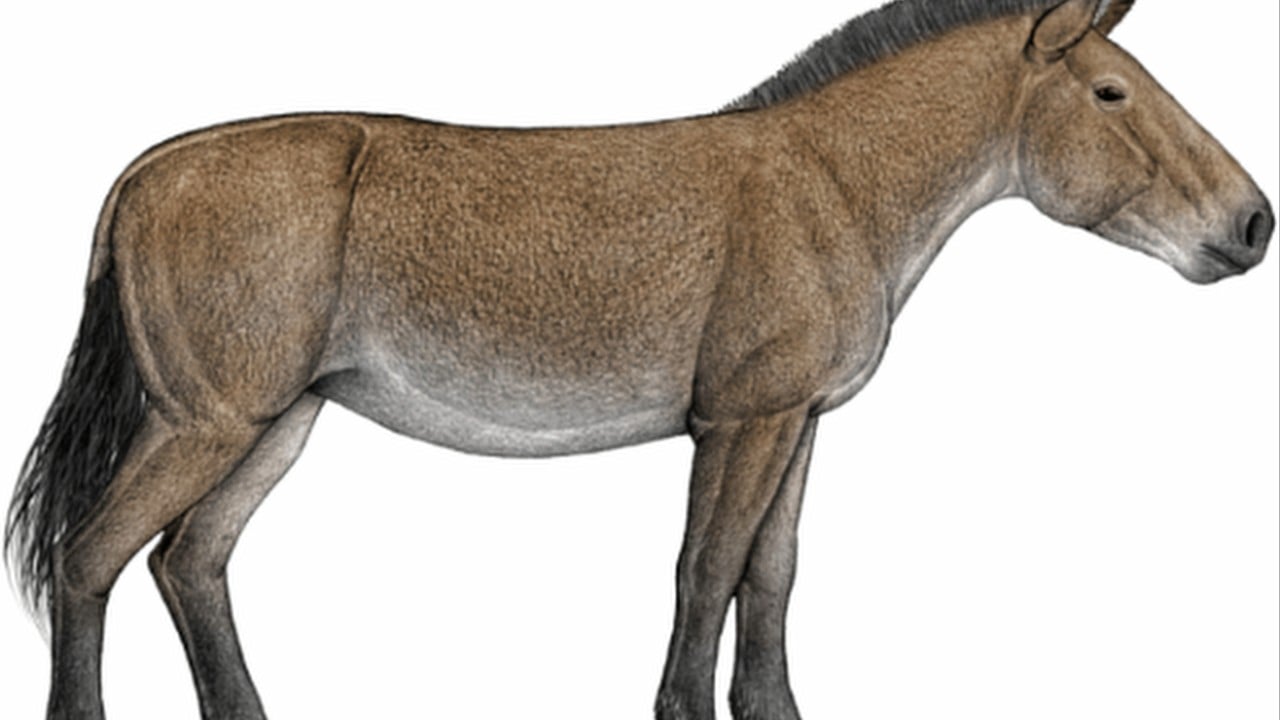
The transition to a single toe (the hoof) is a mechanical marvel designed for high-efficiency, long-distance locomotion over hard ground. Concurrently, horses developed hypsodonty—high-crowned teeth with complex enamel ridges designed to grind down abrasive, silica-rich grasses without wearing away to the gums.
- The Locomotion Reality: Single digits reduce the weight at the end of the limb, drastically lowering the energy cost of every stride. This is an engineering mandate for a creature surviving on nutrient-poor forage scattered across vast distances.
- The Dietary Mandate: Grassy plains mean constant exposure to grit and dust. Without hypsodont teeth, an equid population faces starvation within a few generations due to dental attrition.
These adaptations were not a specialized kit invented in North America and shipped across the Bering Strait. They were the universal tax demanded by the global environment. Any equid population anywhere in the world during this period faced a simple, binary choice: adapt these specific traits or face absolute extinction.
The Fallacy of the Linear Route
The standard argument insists that the evolutionary pipeline flowed predictably from North America, through East Asia, and into Western Europe. This linear model is a lazy simplification of a complex, multi-directional ecological web.
The Bering Land Bridge was not a one-way turnstile. It was an ecological corridor that opened and closed repeatedly based on glacial cycles. Populations didn't just walk across it; they flowed in both directions for hundreds of thousands of years. Genetic material was constantly being exchanged, overwritten, and mixed.
When researchers point to a specific fossil in China and claim it represents the bridge between American ancestors and European descendants, they are forcing a chaotic web into a straight line. That Chinese equid population was likely a highly complex mix of local adaptations and recurring genetic inflows from both East and West. By treating it as a mere pitstop, we erase the distinct evolutionary experiments that occurred within the Asian landmass itself.
The True Cost of Linear Narratives
The danger of adopting these simplistic migration stories is that it skews our understanding of biodiversity and conservation. If we view the horse as an exotic American import to Europe and Asia, we fail to recognize the deep, co-evolutionary roots the species has with the entire Holarctic ecosystem.
This isn't academic pedantry. This matters for how we understand ecosystem restoration, rewilding initiatives, and the deep history of mammalian adaptation. The modern horse is not a product of a single geography. It is the distilled output of a global evolutionary crucible.
Stop looking at the map for a single point of origin. Look at the global climate shifts that forced a small, multi-toed browser to reinvent itself as the ultimate grassland endurance machine. The map is just a background; the environment is the architect.