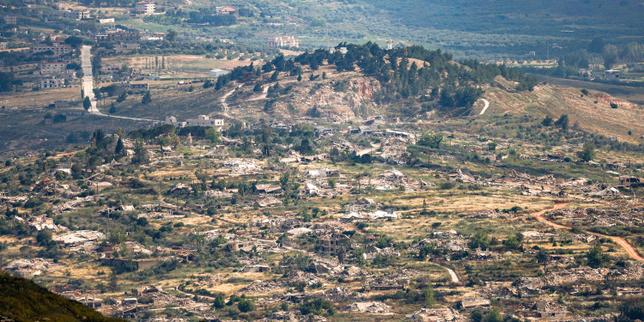
The dust in southern Lebanon does not smell like ordinary earth. It smells of crushed limestone, wild thyme, and pulverized history. When an ancient wall collapses under the impact of modern high explosives, it does not merely leave a crater. It releases a scent—a dry, chalky gasp of air trapped for two thousand years inside Roman masonry and Phoenician foundations.
To watch this happen from a distance is to witness a strange kind of magic trick. A village stands on a hillside, its stone arches framing the Mediterranean just as they did when Tyrian merchants traded purple dye along the coast. A flash occurs. A sound like tearing canvas rips through the valley. When the smoke clears, the hillside is still there, but the memory is gone. The stones that held the shape of a community's soul have been reduced to gray powder.
This is the invisible front line of the war in the Middle East. It is a conflict fought not just over borders, positions, or cross-border rocket fire, but over the right to have existed in the first place.
Lebanese Prime Minister Najib Mikati recently captured this quiet tragedy in a statement that went largely unnoticed beneath the screaming headlines of geopolitical chess. What is happening, he warned, is not merely a violation of Lebanese sovereignty. It is a systematic enterprise to erase history itself. He was not talking about politics. He was talking about the deliberate, irreversible dismantling of human heritage.
The Stones That Anchor the Living
Consider a hypothetical woman named Farah. She is seventy-two years old, and her family has lived in a small, stone-fronted house in Tyre for generations. To Farah, the Roman ruins down the street are not a tourist attraction. They are not a line item in a cultural ministry budget. They are the background of her life. Her grandfather sat on those fallen columns to smoke his pipe. Her children played hide-and-seek among the crumbling porticoes.
When a missile strikes near an archaeological site, the damage is measured by experts in seismic fractures and structural integrity. But Farah measures it in the sudden, terrifying realization that her past can be deleted.
If you take away a person's house, they are a refugee. If you take away their history, they become a ghost.
The Levant is a dense, layered cake of civilizations. Scratch the surface of any hill in Lebanon and you find Rome. Dig deeper, you find Greece. Deeper still, Persia, Phoenicia, and Canaan. These civilizations did not replace one another; they melted into one another. The local mosques often incorporate Byzantine pillars. The churches are built over Roman temples. This is not a museum. It is a living, breathing landscape where the dead and the living share the same narrow streets.
When these places are targeted or treated as collateral damage, the loss is total. You cannot rebuild a 2,000-year-old archway. You can only build a replica. And a replica is a lie that tells you what used to be there before the world broke.
The Strategy of Permanent Dislocation
War has always been destructive, but the nature of modern warfare in historic landscapes carries a specific, terrifying finality. When heavy artillery and precision-guided munitions are deployed in areas dense with ancient architecture, the concussive force alone is enough to shatter fragile structures that survived the Crusades, the Ottomans, and two world wars.
But the real problem lies elsewhere. It lies in the casual disregard for the permanence of cultural destruction.
In international law, the targeting of cultural heritage is a war crime, protected under the 1954 Hague Convention. Yet, in the fog of modern conflict, heritage is easily reclassified as a hiding place, an obstacle, or simply an unfortunate casualty of proximity. When a strike hits the vicinity of Baalbek—home to some of the grandest, most intact Roman temples on Earth—the shockwaves do not just rattle the stones. They shake the collective identity of a nation.
Imagine walking through a forest where the trees are thousands of years old, and watching someone cut them down for firewood. It warms them for an hour, but the forest will not return in their lifetime, or their children’s lifetime.
The destruction of history is a form of temporal cleansing. It cuts the cord that connects a people to their ancestors, leaving them adrift in a traumatized present. It tells the population that their endurance on that land means nothing to the machinery of war.
The Sound of Shattering Identity
We often talk about war in terms of numbers. We count the casualties, the displaced, the rockets fired, the targets hit. These are concrete metrics that can be placed on a map or debated in a boardroom. They provide a illusion of understanding.
But how do you quantify the loss of a language written in stone?
Listen to the way people speak in the old quarters of Sidon or Byblos. Their dialect is peppered with words that are not quite Arabic, remnants of Aramaic and Syriac that lingered in the valleys because the mountains protected them. Their daily rhythms are tied to the structures around them. The shade of an ancient wall dictates where the old men gather to play backgammon. The architecture shapes the community.
When those walls are broken, the social fabric dissolves. The backgammon players scatter. The children move to concrete apartments in Beirut or tented settlements in the north. The stories that were attached to specific corners, specific stones, and specific views lose their anchors. Within a generation, those stories fade into vague myths. Then, they disappear entirely.
This is what an enterprise of effacement looks like in practice. It is not always a dramatic, cinematic destruction like the blowing up of Palmyra by extremists. More often, it is a steady, grinding erosion. It is the accumulation of near-misses that crack foundations, the dust that blankets ancient mosaics, and the evacuation of the people who knew how to care for them.
The Vulnerability of the Past
It is easy to feel cynical about old stones when human lives are being lost by the thousands. A critic might ask: why weep for a Roman column when children are dying?
It is a fair question. It is a necessary question.
The answer is that the destruction of the stones and the destruction of the people are parts of the selfsame act. You do not destroy a people's history because you hate the architecture; you destroy it to break their spirit. You do not flatten a historic quarter by accident; you do it because treating the entire landscape as a combat zone requires you to pretend that nothing of permanent value exists there.
To admit that a place has history is to admit that its people have deep, undeniable roots. It is to acknowledge their legitimacy. Conversely, to reduce their history to rubble is to make them look like temporary occupants, wanderers who can be easily moved, managed, or forgotten.
The subject is terrifying because it reveals how fragile our grip on the past truly is. We think of history as something solid, preserved in books and stone. But history is actually as fragile as glass. It requires a continuous chain of living memory to protect it. Once that chain is broken by exile, death, and demolition, the past becomes malleable. It can be rewritten by the victors, or forgotten by the world.
The Empty Hillside
The sun sets over the hills of southern Lebanon, casting long shadows across a landscape that has seen the armies of Alexander the Great, the legions of Rome, and the cavalry of the early Caliphates pass through. Most of those armies left the stones standing. They wanted to rule the history, not delete it.
Today, the hills look different. The scars are fresher, deeper, and whiter against the gray rock.
A family sits in a temporary shelter miles away from their ancestral village. The grandmother tries to describe to her grandson the shape of the old church door, the way the iron ring felt cold in her hand when she walked inside to escape the midday heat. The boy listens, but he has no reference point. To him, the world is made of cinder blocks, plastic tarps, and the distant, rhythmic thud of artillery.
The church is gone now. The hill where it stood is bare, covered in a fine, white powder that used to be a wall. The wind blows from the sea, lifting the dust and carrying it away over the water, scattering the centuries into the empty air until there is nothing left to show that anyone was ever there.