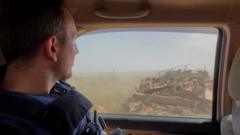
You can see the smoke columns from miles away, but it's the silence afterward that hits you. Since Israeli forces crossed the border in mid-March, a pattern of systematic leveling has rewritten the geography of southern Lebanon. What's happening isn't just standard urban warfare or the chaotic byproduct of crossfire. It's a deliberate campaign of controlled demolitions that has turned dozens of ancient border communities into gray zones of pulverized concrete.
Recent field investigations and verified satellite imagery show that the Israeli military has blown up more than 1,400 buildings using manually placed explosives. This isn't long-range artillery hitting moving targets. These are engineering units walking into empty villages, rigging entire blocks with wires, and filming the detonations from a safe distance. The scale of the destruction has displaced over 820,000 people from the south alone, pushing the country into a massive humanitarian crisis while a fragile interim ceasefire constantly threatens to collapse.
The Strategy of Forced Emptiness
When Israeli Defense Minister Israel Katz announced that the military would accelerate the destruction of border villages, he openly referenced a specific precedent. He called it the "Gaza model." The stated military goal is to wipe out Hezbollah infrastructure—tunnels, weapon caches, and lookout posts—to secure northern Israel. But when you look at the actual data, the flattening of entire towns suggests a different long-term intent: making the region completely uninhabitable.
Human rights monitors and independent satellite analyses have focused on towns like Taybeh, Naqoura, and Deir Seryan. In some of these border municipalities, upwards of 70% of all standing structures have been completely wiped out. This includes homes, local schools, olive groves, and town squares. The UN and groups like Amnesty International have pointed out that these demolitions are happening after Israeli forces have already established full operational control over the areas. In short, the combat had moved on, but the bulldozers and explosives teams stayed behind.
The legal definition of this tactic is "domicide"—the systematic destruction of housing to prevent a population from ever returning. By clearing a massive strip of land up to the Litani River, Israel is carving out a buffer zone that represents roughly 10% of Lebanon's total territory. Prime Minister Benjamin Netanyahu confirmed this direction, stating that forces will remain in the southern security buffer zone for as long as necessary.
What Displaced Families Face Right Now
For the people who lived there, these villages weren't just real estate. They were family anchors. Southern Lebanon has a massive diaspora network stretching across Africa, Australia, and Europe. For decades, those border towns would double or triple in population during the summer when families returned to harvest olives, host weddings, and maintain ancestral stone homes.
Ahmad Abu Taam, a local business owner from Taybeh, watched his life's work disappear on a social media video posted by an Israeli soldier. "The first thing we saw was the town square being blown up," he shared. "A person's whole life is in that place—their work, their memories, everything. Suddenly you see it exploding in front of you."
Right now, those survivors are crammed into public schools, half-finished apartment blocks, and makeshift shelters in cities further north like Sidon and Beirut. The economic hit is staggering. Southern Lebanon relies heavily on tobacco and olive farming. The military campaign hasn't just hit houses; it has burned fields and contaminated soil with white phosphorus and unexploded ordnance. Millions of dollars in agricultural wealth, built up over generations, vanished in a matter of weeks.
The High Cost of the Security Zone
The human toll keeps climbing despite international talks. According to the Lebanese Health Ministry, the death toll has passed 4,000 since the wider conflict erupted following the outbreak of the US-Israel war with Iran in late February. On the other side, Israeli authorities report that Hezbollah rocket attacks have killed dozens of soldiers and civilians in northern communities.
The IDF maintains that its actions comply with international law, stating it only destroys property when there is an absolute military necessity. They argue that Hezbollah has spent decades embedding its military apparatus into civilian living rooms and underground bunkers beneath local mosques.
But the physical evidence on the ground tells a messy story. Arms experts who reviewed the video footage of the detonations noted that the clean, vertical collapse of these structures requires hours of uninterrupted prep work. It takes time to drill into load-bearing walls and wire a neighborhood for a synchronized blast. That level of access only happens when active combat has ceased, raising serious questions among international legal experts about potential war crimes.
Navigating the Geopolitical Crossfire
The fighting in the south directly endangers a larger, highly volatile diplomatic puzzle. A temporary US-Iran agreement recently managed to reopen the critical Strait of Hormuz, throwing a lifeline to global energy markets. That same deal relies on a sustained reduction in violence between Israel and Hezbollah, which is backed primarily by Tehran.
Every time a drone strike hits a village or a rocket barrage lands in Galilee, the entire regional framework edges closer to a total breakdown. Netanyahu has made it clear that Israeli troops aren't leaving the border area until northern Israeli residents can return home safely. Conversely, Hezbollah refuses to stop its operations until Israeli troops completely pull back behind the Blue Line.
If you are trying to understand where this crisis goes next, keep your eyes on two specific realities on the ground:
- Track the exact boundaries of the clearing operations: Watch whether the controlled demolitions expand north toward the Litani River, or if they remain confined to the immediate border ridge.
- Monitor the civilian return rate during local ceasefires: Check if displaced residents are allowed back to inspect their property, or if absolute exclusion zones remain strictly enforced by drones and checkpoints.