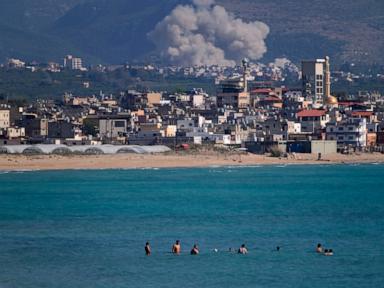
War doesn't respect cultural sanctuaries. It never has. If you want proof, look at the coastal gridlock snaking away from the historic old quarter of Tyre right now.
Vehicles crammed with rolled carpets, mattresses, and plastic furniture are moving at a crawl along the Mediterranean highway toward Sidon. The latest evacuation order from the Israeli military didn't just target standard militant strongholds. It directly hit Tyre's ancient Christian district, a historic enclave that had stayed largely safe from the intense aerial bombardment tearing through the rest of southern Lebanon.
This isn't just another displacement story in a conflict that has already forced over 1.2 million people from their homes. It is a dangerous flashing light for the delicate sectarian balance of the entire country. When the Israeli Defense Forces (IDF) expand their sights to target a prominent Christian neighborhood, the narrative of a localized war on Hezbollah cracks wide open.
The Threat to Tyre Old Quarter
On Tuesday, the reality of the war crashed into the ancient, narrow alleys of Tyre's seaside Christian quarter. The IDF issued an absolute evacuation warning covering the entire port city, explicitly naming the Christian neighborhood for the first time.
The military justification came via an Arabic-language statement on X by IDF spokesperson Col. Avichay Adraee. The army alleged that Hezbollah operatives were using civilian buildings within the Christian district to conduct hidden operations. The warning was explicit: leave now, because any building used for military purposes will be targeted.
The response from local religious leadership was swift, desperate, and joint. Three prominent figures broke through the chaos to issue a rare, unified plea to the international community and Lebanese state officials:
- George Iskandar, Metropolitan Archbishop of Tyre for the Melkite Greek Catholic Church
- Elias Kfoury, Greek Orthodox Metropolitan of Tyre, Sidon, and Dependencies
- Charbel Abdullah, Archeparch of the Maronite Catholic Archeparchy of Tyre
They aren't just worried about brick and mortar. They are fighting to prevent a historic catastrophe. The old city of Tyre is a UNESCO World Heritage Site, packed with centuries of shared cultural, religious, and human history. If these ancient structures are leveled, an irreplaceable piece of global heritage vanishes forever.
The Misconception About Safe Zones
Let's look at what actually triggered this crisis. It is a harsh reality that many commentators are completely missing.
Over the past few weeks, as Israeli airstrikes flattened parts of southern Lebanon, the Christian quarter of Tyre remained untouched. Because it was safe, hundreds of displaced Lebanese Shiite Muslim families fled there to find refuge. The Christian residents opened their doors, sharing spaces and resources in a rare display of cross-sectarian solidarity during a brutal national crisis.
But hiding or helping? That is where the narratives clash completely.
Israel claims that Hezbollah operatives used this human migration as a shield, embedding themselves inside the Christian neighborhood to escape the bombs. The Christian leadership and local municipal officials deny this vehemently. They argue that welcoming displaced civilians isn't the same as hosting armed militants.
To prove there was no armed presence, the Lebanese army actually deployed patrols straight into the Christian district last week. It was a clear attempt to signal that the neighborhood was clean of weapons. But in modern warfare, a state military's presence rarely overrides an adversary's intelligence reports. The IDF maintained its stance, and the evacuation order followed anyway.
What This Means for Lebanon's Sectarian Balance
You can't understand Lebanon without understanding its sectarian makeup. Power is meticulously divided among Christians, Shiite Muslims, Sunni Muslims, and Druze. It's a fragile ecosystem. When one piece fractures, the whole house shakes.
Metropolitan Elias Kfoury didn't mince words after the evacuation notice hit. He pointed out that this ongoing conflict isn't just a surgical strike on a single militia. "The war is against all of Lebanon, not just one particular group," Kfoury warned.
When Christian areas get dragged into the line of fire, it fuels a dangerous internal anxiety. If Christian enclaves can no longer offer safety to displaced Shiites without becoming targets themselves, internal friction grows. Landlords get terrified of renting to displaced families. Neighborhoods start setting up unauthorized checkpoints. The social fabric that keeps Lebanon together during crisis starts to fray at the edges.
The Human and Cultural Cost
An Israeli airstrike in a neighboring Tyre district killed eight people and wounded 32 others on the very same day the evacuation order was issued. The threat isn't theoretical. It's immediate, violent, and loud.
While hundreds packed their cars to join the gridlock toward Sidon, some older residents couldn't leave on their own. Civil Defense teams had to manually move the elderly out of the old quarter.
But fleeing is a luxury of the resourceful. For people like Ali Bahar, a father of three who packed his family into a car with no destination in mind, the future is completely blank. "Where should we go? There is nowhere to go. We will end up in the streets," he said.
If you look back at the history of the region, church leaders in southern villages like Rmeish have openly stated why some residents choose to ignore evacuation orders entirely: they are terrified that if they leave their ancestral lands, they will never be allowed to return. It's a deep-seated fear born from decades of regional displacement.
Immediate Steps for Regional Observers
The situation in Tyre is fluid, but the broader implications are already set in stone. If you are tracking the geopolitical realities of this conflict, here is what you need to watch next:
- Monitor Internal Displacement Friction: Track how cities further north, like Sidon and Beirut, manage the influx of residents fleeing the Christian quarters. Look for signs of rising sectarian tension over housing and security.
- Watch the Lebanese Army's Role: See if the Lebanese military increases its footprint in remaining neutral or minority enclaves to preemptively debunk Israeli claims of militant activity.
- Press for Cultural Property Protection: Watch whether international bodies like UNESCO or Western diplomatic missions use direct channels to secure explicit guarantees for Tyre’s historic old city.
The battle for Tyre isn't just about territorial control or eliminating rocket launchpads. It's a test case for whether any part of Lebanon's multi-faith reality can survive a total war.



:max_bytes(150000):strip_icc():focal(665x0:667x2)/gettyimages-50733149-2000-8b129a2475974982a915418ce92a73d8.jpg)