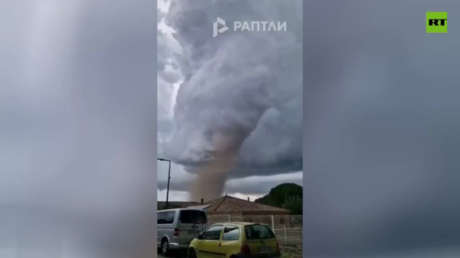
Southern France just got hit by a rare tornado, and the media response is predictably lazy. Headlines scream about climate anomaly, freak weather, and unprecedented destruction. Panic sells. Nuance does not.
Every single mainstream report treats this event as a freak statistical outlier. They frame it as a rogue meteorological accident that dropped out of a clear blue sky to terrorize vineyards and sleepy villages. That narrative is comforting. It lets municipal planners pretend their building codes are fine and lets insurers write off the damage as an act of God. It is also completely wrong.
I have spent years analyzing severe convective storms across the Mediterranean basin. I have watched billions of euros in infrastructure projects get approved in high-risk corridors while local authorities rely on outdated hazard maps. The danger is not that tornadoes are suddenly appearing in France. The danger is that we refuse to build for the weather we already have, hiding behind the excuse that these events are too rare to matter.
The Myth of the French Anomaly
Look at the data from the European Severe Weather Database. Tornadoes in France are not rare. They happen every single year, often multiple times a year, particularly along the Mediterranean coast and the plains of the north. Calling a southern French tornado rare is shorthand for saying we ignored the historical record because it does not fit our mental model of European climate.
The lazy consensus says Mediterranean weather equals gentle breezes, olive trees, and predictable mistral winds. Meteorologists who know the actual dynamics of the Gulf of Lion understand a different reality. When cold air aloft slams into the warm, moisture-laden surface waters of the Mediterranean, the thermodynamic profile mirrors parts of the American Midwest.
Yet, local construction standards treat wind resistance like an optional luxury. Traditional stone and mortar homes look charming on postcards, but they disintegrate the moment a high-end-EF0 or low-EF1 vortex touches down.
Imagine a scenario where a modern housing development is engineered to withstand straight-line gales of 120 kilometers per hour, but receives zero reinforcement against rotational shear forces. That is not bad luck. That is structural negligence.
Why the Standard Disaster Playbook Fails
When a twister tears through a French commune, the standard playbook kicks into gear.
- Politicians show up in hard hats to express deep solidarity.
- Emergency funds are promised.
- Insurance companies dispatch adjusters to argue about whether the roof blew off due to wind or rain.
Nothing changes. The rebuilt structures use the exact same techniques that failed the first time. We treat acute atmospheric violence as a chronic insurance problem rather than an engineering failure.
The real issue is land-use planning. Municipalities expand commercial zones and residential subdivisions into known wind corridors without mandating continuous load paths in construction. A continuous load path means steel straps and heavy-duty anchors tie the roof to the walls, and the walls to the foundation. Without this, even a minor vortex will peel a roof away like the lid off a sardine tin.
European building codes obsess over seismic activity in the south, which makes sense given historical fault lines. But they treat wind loads as a secondary concern, assuming thunderstorms only drop rain. That assumption is lethal.
The Brutal Economics of Pretending It Is Rare
Insurance executives love the word unprecedented. It is their favorite excuse for hiking premiums while denying payouts. If an event is unprecedented, actuarial tables do not apply, and risk cannot be priced normally.
This is a scam.
Meteorologists have the radar data. Climatologists have the shear vectors. The physical conditions that generated the recent French tornado are well-documented. What is missing is the political will to admit that southern Europe's climate vulnerability is evolving.
If you own property in Provence, Languedoc, or along the Côte d'Azur, stop listening to headlines that call these storms flukes. Treat your roof, your windows, and your outbuildings as if a convective vortex could target your specific postal code tomorrow. Because statistically, eventually, it will.
Stop waiting for the government to mandate common sense. Bolt your roof down yourself.


