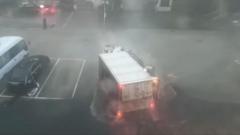
When a massive typhoon makes landfall, most people head indoors. They stock up on water, tape their windows, and wait out the storm. But freight keeps moving. Supply chains don't just pause because nature throws a tantrum. That economic reality forces heavy vehicle operators onto highways while wind speeds reach destructive levels.
A heavy goods vehicle turning over on a highway during a tropical cyclone isn't just an accident. It's a textbook physics failure caused by wind shear, high-profile surfaces, and low friction. Driving a massive cargo truck during a severe typhoon requires a terrifying calculus of momentum, weight distribution, and sheer survival.
Let's look at why these rigs flip so easily when heavy weather hits.
The Physics Behind a Truck Flip
Wind is invisible, but during a major typhoon, it behaves like a solid wall. Semi-trailers act as massive sails. When high-speed gusts hit the side of an empty or lightly loaded box trailer, the center of gravity shifts instantly.
Think about it. A standard semi-trailer has a massive surface area. Wind hitting a twenty-foot-high trailer at fifty miles per hour creates lateral force that tires simply cannot grip against, especially on wet pavement.
Hydroplaning makes it worse. Water pooling on highway surfaces creates a slick barrier. Once a tire loses contact with the asphalt, the truck turns into a heavy, unguided missile.
Operators face an impossible choice. Slow down too much and you risk getting rear-ended by other traffic. Keep going and a sudden gust will lift the trailer right off its wheels.
Why Freight Keeps Rolling During Weather Warnings
People always ask why trucks are even on the road during extreme weather alerts. The answer comes down to logistics contracts and tight delivery windows.
Modern supply chains operate on exact schedules. Distribution centers penalize carriers heavily for late deliveries. Dispatchers sitting miles away in dry offices often misjudge local conditions. They see a weather report on a screen and assume drivers can push through.
Drivers take the brunt of the risk. Independent owner-operators lose money every hour their rig sits parked. That financial pressure pushes many to take risks they know are dangerous.
Governments try to enforce highway closures, but these bans often happen too late. By the time authorities restrict high-profile vehicles, the storm is already hammering the region, trapping drivers on exposed bridges and elevated expressways where wind speeds are highest.
Real Dangers on Coastal Highways
Coastal routes and bridge networks are death traps during typhoons. Open water on both sides accelerates wind speeds, turning a steady gale into violent, unpredictable microbursts.
When a lorry turns over, it triggers massive chain reactions. A flipped rig blocks multiple lanes instantly. Behind it, passenger cars struggle to brake on slick asphalt.
Emergency responders face massive hurdles reaching these crash sites. High winds make it dangerous for crane operators to lift heavy vehicles. Debris cleanup gets delayed, freezing regional transport networks for hours or even days.
How to Protect Drivers and Transport Networks
Logistics companies need to change how they handle severe weather alerts. Waiting for official government bans isn't enough. Fleet managers must empower drivers to park immediately without financial penalty when conditions deteriorate.
Better telematics systems can track real-time wind speeds along specific highway corridors. If a route hits critical wind thresholds, automated software should reroute or ground high-profile vehicles before they enter danger zones.
Shippers must build weather buffers into their delivery timelines. Expecting on-time performance during a natural disaster is unrealistic and dangerous.
When extreme weather hits, the goal shouldn't be keeping goods moving at all costs. The priority has to be keeping the people behind the wheel alive. Stop treating transport workers like collateral damage in the race for next-day delivery.
:max_bytes(150000):strip_icc()/ar-American-Cheese-taste-test-horizon-4x3-54cc339550cd44b9a818c17bdfd5428d.jpg)