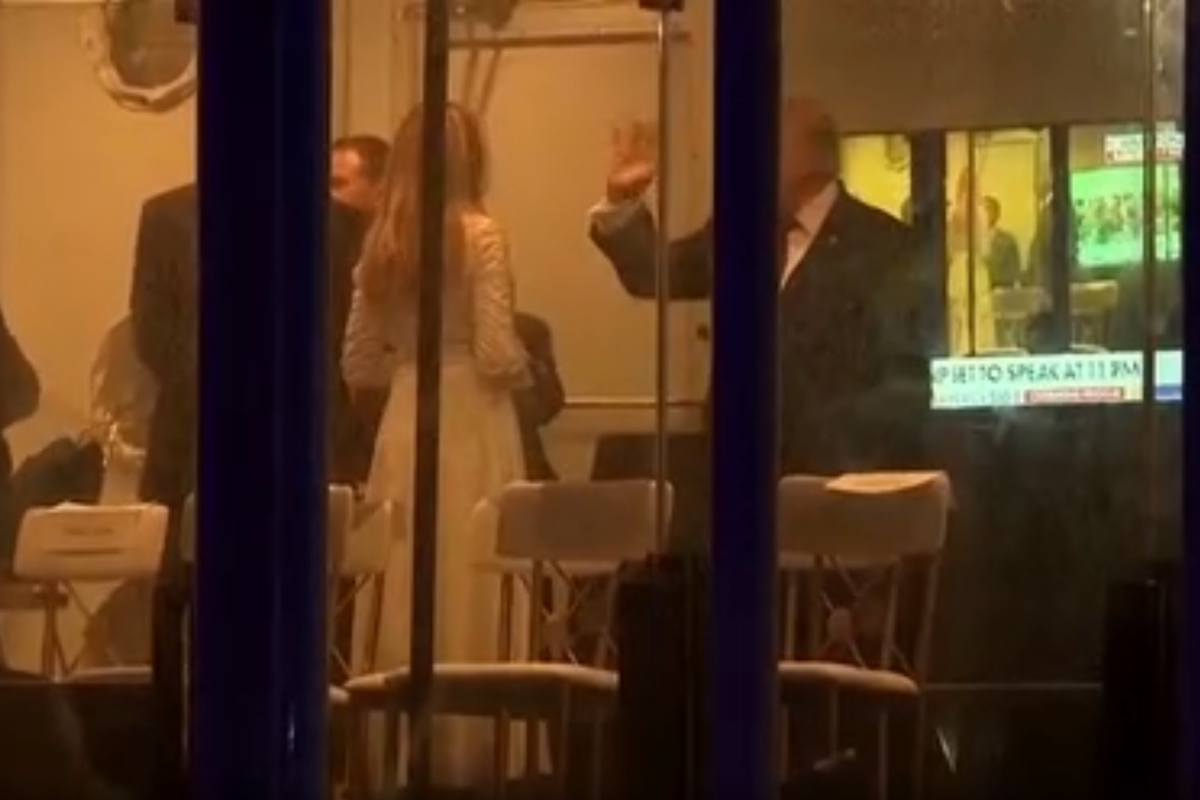
The image of Donald Trump watching a live broadcast of himself while standing on camera is not just another social media punchline. It is a perfect distillation of a closed-loop media ecosystem that has fundamentally altered how political figures interact with reality. When Fox News aired footage that inadvertently captured Trump tracking his own televised presence in real-time, the internet reacted with predictable mockery. Critics weaponized the moment as proof of vanity. That interpretation, however, misses the far more sophisticated, systemic reality of modern political staging.
This is not a story about personal ego. It is a story about a highly calculated, multi-layered feedback loop where the line between the observer and the observed has been entirely erased.
The Closed Circuit of Modern Political Staging
For decades, politicians used television as a megaphone to broadcast a message to a distant audience. The relationship was linear. In the current media ecosystem, that relationship is cyclical and immediate. When a political figure stands before cameras and simultaneously monitors the live feed of those same cameras, they are engaged in real-time performance calibration.
They are adjusting their posture, their expressions, and their physical cues based on the immediate visual data being fed back to them. The television monitor functions as a digital mirror, allowing for instantaneous course corrections during a live event.
This creates a self-referential cycle. The media outlet broadcasts the politician, the politician reacts to the broadcast, and the outlet then broadcasts the reaction. For an audience habituated to standard political coverage, witnessing the mechanics of this loop breaks the fourth wall. It reveals the machinery behind the imagery, exposing the fact that the public square is no longer an environment where spontaneous events occur, but rather a studio where reality is produced and consumed simultaneously by the performer.
Why the Echo Chamber Demands Constant Monitoring
To understand why this happens, one must look at the structural relationship between specific political entities and partisan networks. This is not a passive alliance. It is an interdependent ecosystem where both sides rely on the other for content, validation, and narrative momentum.
- Audience Retention: Partisan networks require a steady stream of highly predictable, reinforcing imagery to maintain viewership numbers.
- Narrative Control: By monitoring live feeds, political operations can ensure that the visual presentation aligns perfectly with their internal messaging goals.
- Instant Optimization: Seeing how a gesture or a background element translates on screen allows production teams—and the principals themselves—to make micro-adjustments on the fly.
This level of synchronization creates a highly insulated information environment. The danger is not merely that it looks unusual when caught on camera; the danger is that it alters the decision-making process. When leaders consume their own media coverage as their primary source of feedback, external reality becomes secondary to televised reality. Policy and rhetoric are no longer judged by their real-world outcomes, but by how effectively they play within the confines of the studio monitor.
The Evolution of the Televised Politician
The intersection of statecraft and television has always been fraught with theatricality. John F. Kennedy understood the power of the lens during his debates with Richard Nixon. Ronald Reagan brought Hollywood timing to the White House. What we are witnessing today, however, is a quantitative and qualitative departure from those early iterations of media savvy.
Previously, the performance was prepared in advance, executed for the cameras, and analyzed after the fact. Today, the analysis, execution, and consumption happen at the exact same moment.
[Politician Performs] ---> [Network Broadcasts] ---> [Politician Observes Live Feed]
         ^                                                          |
         |_______________________(Micro-Adjustments)________________|
This structural shift transforms political figures into active editors of their own live events. They are no longer just delivering a speech; they are auditing the broadcast quality, the lower-third graphics, and the framing while speaking. When the curtain slips and the public sees a politician caught in this loop, the initial reaction is often laughter. But beneath the mockery lies a profound discomfort with the realization that the political process has become entirely internalized, feeding on its own reflection to the exclusion of everything else.
The reliance on this immediate feedback loop creates a fragile political style. It operates brilliantly within the controlled parameters of a sympathetic studio or a highly managed rally environment. Yet, when confronted with unscripted crises or adversarial environments where the mirror is removed, the performance often falters. The modern political apparatus has built an incredibly sophisticated mechanism for talking to itself, leaving the rest of the world to watch the broadcast of a broadcast.