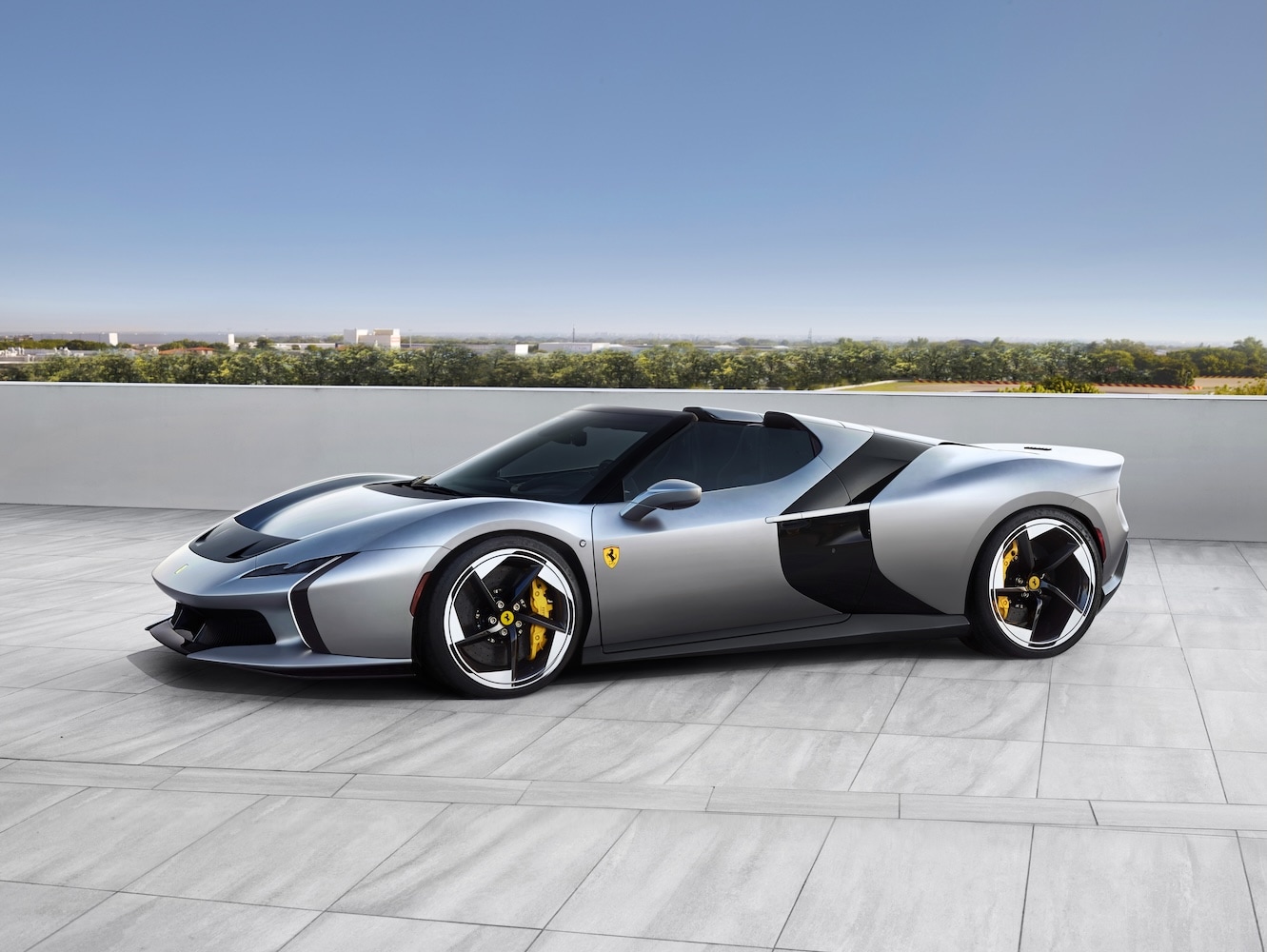
Maranello just dropped another ultra-exclusive bomb on the automotive world. It is called the Ferrari HC25. If you haven't heard of it yet, that is because only one person on earth owns it. Built through the legendary Special Projects program, this machine takes the bones of an F8 Spider and turns them into something entirely unique.
Most people look at one-off supercars and see rich toys. They are wrong. These cars are a window into how top-tier manufacturers test the limits of design without corporate red tape. The Ferrari HC25 isn't just a re-skinned convertible. It is a masterclass in aerodynamics, visual drama, and mechanical restraint. It runs a 3.9-liter twin-turbo V8, hits a top speed of 340kph, and throws out the entire design language of the standard production car.
Let's look at what this machine actually represents and why it matters to anyone who loves high-performance engineering.
Mechanical DNA Wrapped in Bespoke Carbon Fiber
Underneath that completely custom body sits the platform of the Ferrari F8 Spider. That means you get a mid-rear mounted V8 pumping out 710 horsepower. Power goes straight to the rear wheels through a seven-speed dual-clutch transmission. It sprints from 0 to 100kph in just 2.9 seconds.
But you don't commission a Special Projects car just for the numbers. You buy it for the execution.
The client wanted something that felt more aggressive than the F8 but maintained its road compliance. Every single body panel on the Ferrari HC25 is new. The front nose is sharper, cutting lower into the asphalt. Designers reworked the S-Duct system entirely. This isn't just for looks. It alters how air flows over the front axle, increasing high-speed stability when you approach that 340kph limit.
The rear deck is where things get truly wild. The standard F8 Spider uses a traditional twin-buttress design to house the folding hardtop. The HC25 discards this entirely. Instead, it introduces a sweeping, single-piece carbon fiber engine cover with integrated cooling vents. It looks less like a modern road car and more like a dedicated endurance racer from the late 1990s.
The Reality of Maranello Special Projects
Getting Ferrari to build you a custom car isn't just about having a fat bank account. Money gets you in the door. Loyalty keeps you in the room.
The Special Projects division only takes on a handful of clients each year. The waitlist stretches out for more than five years. To even qualify for a project like the Ferrari HC25, you need a massive collection of historic and modern Prancing Horses. You need a verified relationship with the factory.
Once you get greenlit, the process takes roughly two to three years. You sit down with Chief Design Officer Flavio Manzoni and his team. You sketch. You debate. You argue over millimeter-wide changes in the fender flares.
- Phase 1: The Brief. The client outlines a vision. This usually references a historic model or a specific design philosophy.
- Phase 2: Digital Modeling. The design team creates full-scale 3D renders to test aerodynamics virtually.
- Phase 3: The Clay Model. A physical prototype is built. The client travels to Maranello to inspect the proportions under natural light.
- Phase 4: Production. Engineering creates the bespoke carbon panels and integrates them with the donor chassis.
It is a grueling process. It requires immense patience. If you want instant gratification, you buy an Assetto Fiorano package off the lot. If you want a legacy piece, you wait for an HC25.
Why 340kph is a Modern Engineering Line in the Sand
We live in a world where electric hypercars claim top speeds north of 400kph. Against those digital numbers, 340kph might sound almost normal. Honestly, it isn't.
Pushing an open-top supercar to 340kph requires managing violent air currents. Without a fixed roof, cabin turbulence can become destructive. The engineers behind the Ferrari HC25 spent hundreds of hours in the wind tunnel modifying the windscreen rake and rear lip spoiler. They created an aerodynamic bubble around the cockpit. This ensures that even at extreme velocities, the driver isn't fighting the air coming off the front hood.
The car uses specific Michelin Pilot Sport Cup 2 R tires. These compounds are sticky. They handle massive thermal loads. When you are running a twin-turbo V8 at full tilt, heat management is your biggest enemy. The side air intakes on the HC25 were widened by twelve percent compared to the stock F8 Spider. This feeds more cool air into the intercoolers, keeping power delivery consistent even during prolonged high-speed runs.
The Inside Look at Custom Cabin Curation
Step inside the Ferrari HC25 and the changes are immediately obvious. The standard F8 interior is functional but somewhat clinical. The owner of this one-off machine wanted a minimalist, driver-focused cockpit that felt completely different.
The dashboard is stripped of bright aluminum accents. Instead, matte carbon fiber dominates the console. The seats are custom-molded carbon shells wrapped in a specific Navy blue Alcantara with contrasting hand-stitched silver patterns. Even the digital displays feature custom graphics unique to this chassis number.
There is no massive central infotainment screen. It is distracting. The focus stays entirely on the yellow tachometer sitting right in front of the driver's face.
How the Ferrari HC25 Shifts the Collector Market
One-off cars used to be styling exercises shown at Pebble Beach or Villa d'Este, then hidden away in climate-controlled vaults. That trend is dying. Modern collectors want cars they can actually drive.
The Ferrari HC25 was built to be used. Its suspension geometry incorporates a front-axle lift system to handle real-world speed bumps and driveway inclines. The carbon-ceramic brakes are tuned for immediate bite even when cold. It is a usable piece of rolling art.
When this car eventually hits the secondary market decades from now, its value won't be tied to production numbers. There are no production numbers. It stands alone. Historically, Special Projects cars like the SP12 EC or the P80/C command massive premiums because they represent a specific moment in Ferrari's design timeline. They are immune to typical depreciation curves.
If you are looking to understand where supercar design goes next, stop looking at concept cars on convention floors. Look at the one-offs. The sharp lines, the aggressive S-Duct modifications, and the radical rear deck of the HC25 are clues. Expect to see hints of this design language filter down into the next generation of series-production mid-engine cars from Maranello.
To track how these design cues evolve, pay close attention to the upcoming twin-turbo replacement models over the next twenty-four months. Look for the way front splitters integrate into the bumper and how active aero elements are hidden within the bodywork. The future of the brand is already driving around on public roads in the form of this single, brilliant machine.