The mud in the Donbas region does not just stick to your boots. It gets into your thoughts. It is a thick, gray paste that smells of sulfur, rotted roots, and burnt diesel. When you are crouching in a trench that looks like a jagged wound in the earth, the horizon shrinks to a few feet of frozen dirt. You stop looking at the horizon anyway.
You look up. If you liked this article, you should read: this related article.
For the past few years, the sky has been the most dangerous place on earth. The sound of a buzzing engine—resembling a bloated, angry hornet—can mean you have roughly twelve seconds to find cover before a first-person-view (FPV) drone carrying a taped-on grenade dives into your dugout. Infantrymen call it the "drone paranoia." It is a constant, exhausting twitch. Every bird is a threat. Every gust of wind makes you flinch.
But the nature of this terror is shifting again, hiding inside a plastic frame that costs less than a decent pair of combat boots. For another look on this development, refer to the recent coverage from Ars Technica.
The Handheld Predator
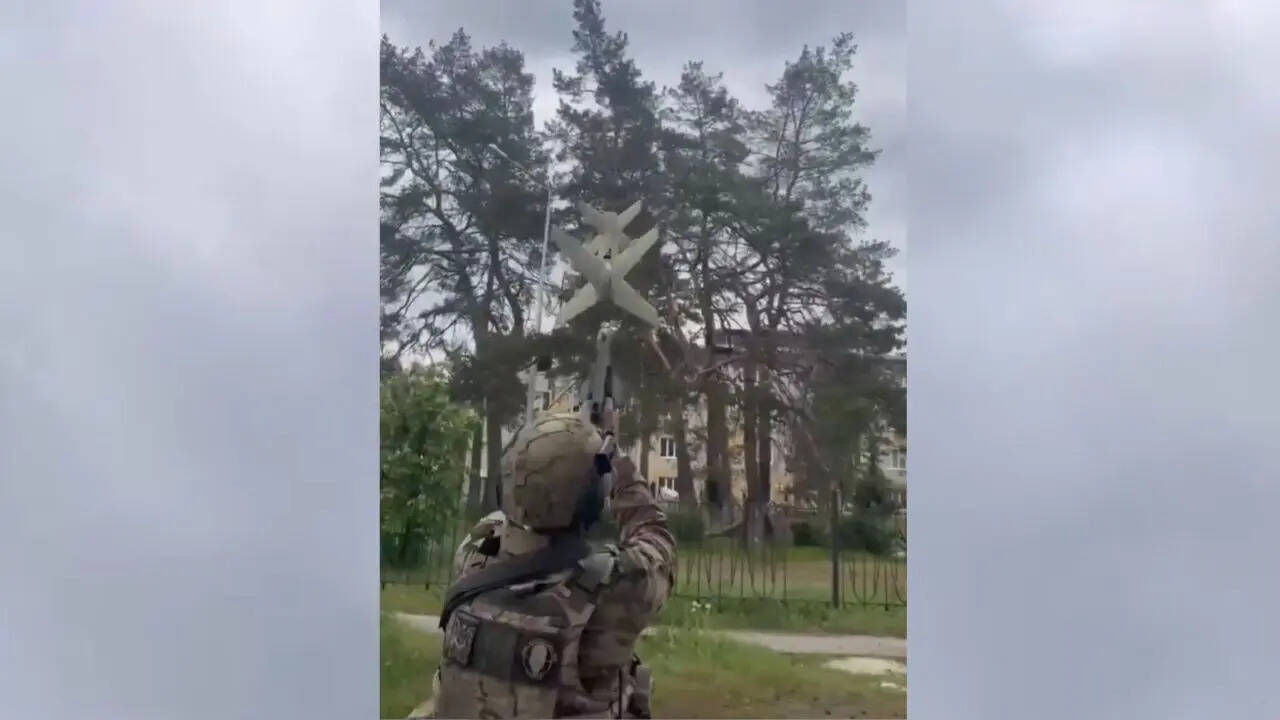
Imagine a soldier named Alexei. He is not a tech genius or a cyber warfare specialist. He is twenty-four, his knuckles are split from the cold, and he hasn't slept a full six hours in three months. In his right hand, he holds something that looks like a toy. It weighs less than a loaf of bread. It fits neatly into his palm.
This is the Yolka. In Russian, the name means "spruce tree," a domestic, almost cozy moniker for a weapon designed to hunt and kill other machines.
The drone costs around $500 to manufacture. In the grand ledger of modern warfare, where a single Patriot missile battery costs over a billion dollars and a traditional fighter jet can run past $100 million, $500 is pocket change. It is rounding error territory. Yet, this cheap assembly of carbon fiber, microchips, and rotors is designed to do something that multi-million-dollar air defense systems often struggle to achieve: swatting low-flying reconnaissance and kamikaze drones out of the air.
The technology relies on a principle known as "fire-and-forget." To understand why this matters, you have to understand how difficult it is to fly a standard drone under the stress of combat.
Up until now, intercepting an enemy drone required a human pilot with thousands of hours of flight-simulator experience. The pilot had to wear heavy goggles, wrestle with dual-joystick controllers, and manually track a target moving at sixty miles per hour through a video feed that was constantly cutting out due to electronic jamming. If the radio signal dropped for even a second, the interceptor drone simply tumbled into the mud.
The Yolka changes the math. Alexei does not need to be an expert pilot. He does not need to guide the machine through a grainy monitor while artillery shells shake the dirt around him. He points it toward the sound of the buzzing sky, launches it, and lets the onboard artificial intelligence take the wheel.
The machine sees the target. It locks on. It finishes the job by itself.
The Microchip in the Mud
The magic—and the horror—of this shift lies in the democratization of autonomous tracking.
For decades, true "fire-and-forget" technology was the exclusive domain of wealthy nation-states. It required the thermal imaging seekers of a Javelin anti-tank missile or the radar guidance of an AIM-120 AMRAAM. These systems require clean labs, specialized defense contractors, and decades of development.
The Yolka, however, represents the militarization of consumer tech. The internal architecture relies on low-cost optical sensors and compact processing units similar to those found in smart home security cameras or self-stabilizing action cameras used by skateboarders and snowboarders.
Once the soldier identifies a threat in the sky through a basic sight or a companion tablet, the drone's internal software takes over. It utilizes computer vision algorithms to differentiate between a bird, a cloud, and an enemy quadcopter. Even if the electronic warfare units down in the trenches blast the area with radio-jamming frequencies designed to sever the link between pilot and aircraft, the Yolka remains unaffected.
It does not need a pilot anymore. The link is broken, but the machine's intent remains absolute. It tracks the visual silhouette of its prey, adjusting its rotors in microsecond intervals, closing the gap until impact.
Consider what happens next to the economics of attrition.
War is ultimately a grueling exercise in bookkeeping. If an adversary spends $2,000 on a commercial reconnaissance drone that can spot troop movements and direct accurate artillery fire, using a $100,000 Western-supplied missile to shoot it down is a losing proposition. You will run out of money and missiles long before they run out of plastic drones.
But a $500 interceptor? That flips the ledger. It turns air defense into an asymmetric advantage that can be deployed at the squad level. Every single infantryman becomes an independent air-defense hub.
The Automated Horizon
There is a profound temptation to view this as a clean solution to a dirty problem. We love stories about elegant engineering saving lives on the front line. But the reality in the trenches is rarely clean, and it is never elegant.
The introduction of fully autonomous tracking at this price point removes the final human buffer in local airspace. When Alexei releases that tiny frame from his hand, he is ceding control to a line of code written in a lab hundreds of miles away. The machine cannot question its parameters. It cannot see the fear in the eyes of the person operating the opposing drone, nor can it evaluate the larger moral weight of the conflict. It simply executes a mathematical function: reduce the distance between Object A and Object B to zero.
The psychological weight of this automation presses heavily on the people below. Soldiers on both sides of the conflict talk about the eerie quiet that settles over a position when the drones take over. The sky is no longer just an open expanse of weather; it is a dense, invisible web of automated search grids.
This is not the future of warfare. It is the current state of it. The separation between science fiction and the grim reality of a muddy ditch in Eastern Europe has vanished entirely.
As the sun sets over the treeline, casting long, skeletal shadows across the cratered fields, Alexei packs the small plastic frame back into his kit. The wind picks up, carrying the distant thud of heavy mortar fire. He checks the battery level on the device one last time. The small green LED light glows steadily against the darkening sky, a tiny, unblinking eye waiting for the next mechanical hum to rise from the horizon.


