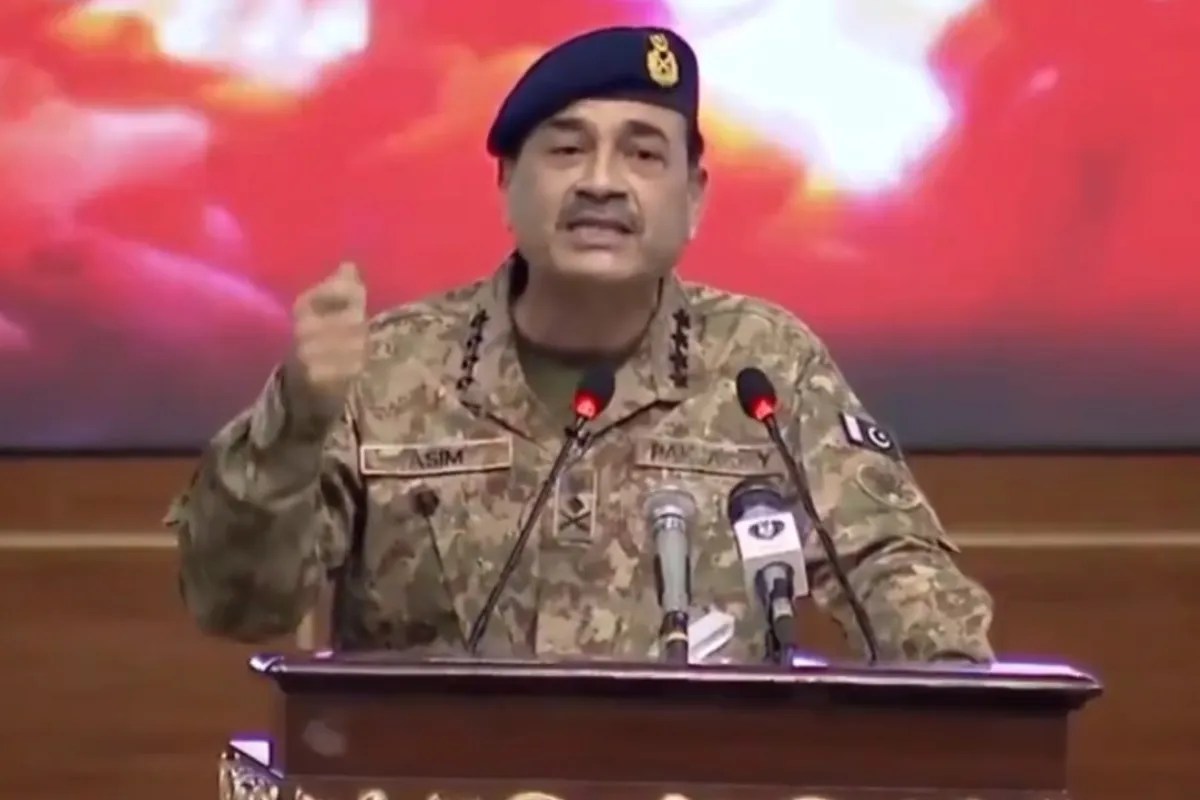
General Asim Munir assumed the role of Pakistan’s Chief of Army Staff with a mandate to stabilize a nation teetering on the edge of a sovereign default. His strategy was straightforward: consolidate power, bypass the traditional bureaucratic gridlock, and position the military as the ultimate guarantor of economic recovery. However, this aggressive centralization of authority has created a systemic trap for the Pakistani state. By making the military the sole architect of both national security and economic policy, Munir has linked the army’s institutional prestige to volatile market forces and a restless, impoverished population.
The core of this strategy rests on the Special Investment Facilitation Council (SIFC). While framed as a "single-window" portal to attract Gulf capital, the SIFC represents the formalization of "Pakistan Inc." It is a structure where the uniformed brass, rather than elected ministers or civil servants, makes the final call on mining, agriculture, and information technology projects. This isn't just a policy shift. It is a fundamental rewriting of the Pakistani social contract that has left the GHQ in Rawalpindi with no one left to blame if the promised "green gold" of foreign investment fails to materialize.
The Debt Trap and the Army’s Balance Sheet
The primary crisis facing Munir is not merely political dissent but a mathematical reality. Pakistan’s debt-to-GDP ratio and its relentless interest payment obligations have reached a point where the military’s own financial interests are at risk. For decades, the Pakistani military functioned as an independent economic actor, managing vast business empires from cereal production to cement. Now, the stakes are higher. The state's inability to service its debt directly threatens the military’s budget and its ability to maintain conventional parity with India.
Munir’s announcement to lead the economic charge was a gamble designed to project "certainty" to investors in Riyadh and Abu Dhabi. These monarchs prefer dealing with generals over the chaotic, revolving door of Pakistani civilian prime ministers. But this certainty is an illusion. When the military guarantees a return on investment, it is effectively putting the nation’s remaining assets up as collateral. If these projects do not yield immediate results, the blowback will not hit a disposable political party. It will hit the military's reputation as the only functional institution in the country.
The Breakdown of the Hybrid Model
The current governance model is often called "Hybrid Plus." In previous iterations, the military stayed behind a "thin civilian veil," allowing politicians to take the heat for unpopular decisions like raising electricity tariffs or cutting fuel subsidies. Under General Munir, that veil has become transparent. The crackdown on the Pakistan Tehreek-e-Insaaf (PTI) and the subsequent management of the February 2024 elections have stripped away the military’s claim of being an "apolitical" referee.
This visibility is a liability. When a shopkeeper in Lahore or a laborer in Karachi sees their electricity bill double, they no longer look to the Prime Minister’s House for answers. They look toward Rawalpindi. By taking credit for "stopping the rot," Munir has inadvertently accepted responsibility for the hunger and inflation that follow IMF-mandated austerity. This is a dangerous position for an army that relies on a populist image for its domestic legitimacy.
The SIFC and the Myth of Foreign Salvation
The SIFC is touted as the miracle cure. The plan involves leasing millions of acres of state land to corporate farming ventures and selling stakes in Reko Diq, one of the world's largest untapped copper and gold deposits. On paper, the numbers are staggering—projections of $100 billion in investment over the next decade.
In reality, the capital has been slow to arrive. Sovereign wealth funds from the Middle East are no longer interested in "brotherly" bailouts. They want a Return on Investment (ROI). They look at Pakistan’s crumbling infrastructure, its erratic legal system, and the simmering insurgency in Balochistan and Khyber Pakhtunkhwa. They see a country where the military can guarantee a contract today, but cannot guarantee social stability tomorrow.
Furthermore, the focus on large-scale, military-managed projects ignores the fundamental rot in the Pakistani economy: a lack of manufacturing base and a pathetic tax-to-GDP ratio. You cannot mine your way out of a structural deficit if the elite, including the military’s own retired officers, remain outside the tax net.
The Internal Friction and the Border Problem
While Munir focuses on the economy, Pakistan’s borders are more volatile than they have been in twenty years. The relationship with the Taliban government in Kabul has soured into open hostility. The Tehrik-i-Taliban Pakistan (TTP) is emboldened, launching sophisticated attacks on security forces with increasing frequency.
This creates a tactical dilemma. An army focused on running the economy and managing domestic political dissent is an army distracted from its core competency: counter-insurgency. The resources required to secure the CPEC corridors and the new SIFC mining sites are immense. Every soldier diverted to guard a corporate farm is a soldier not patrolling the Durand Line.
To make matters worse, the heavy-handed approach to dissent in Balochistan—the very region where most of the SIFC's "wealth" is located—is fueling a new generation of militants. These insurgents view the military’s economic initiatives not as development, but as the final "loot and pillage" of their resources. You cannot run a successful gold mine in the middle of a war zone without bleeding the state dry through security costs.
The Inevitable Collision with Reality
The IMF is the other player in this high-stakes game. The Fund’s demands are clinical: end the state's role in the economy, privatize loss-making enterprises, and float the currency. These demands are diametrically opposed to the military’s "Pakistan Inc." model, which relies on state-directed capitalism and protectionism.
Munir is attempting to walk a tightrope between IMF discipline and military-led expansion. It is a path that has no historical precedent for success in a country with Pakistan’s demographic pressures. With a population of 240 million and a median age of 20, the country needs millions of jobs that a few high-tech mines and corporate farms simply cannot provide.
The frustration is boiling over. We are seeing the rise of localized, non-partisan protest movements that ignore the traditional political parties. These groups are protesting basic survival issues—water, power, and food. When the military is the one making the economic decisions, these protests inevitably become anti-military.
The Strategic Miscalculation of Silence
The military's response to criticism has been a digital iron curtain. Frequent internet shutdowns, the banning of social media platforms like X, and the pursuit of "digital terrorists" are attempts to control a narrative that has already escaped the barracks. In the age of decentralized information, a heavy-handed information policy only creates a vacuum filled by more radical voices.
General Munir’s "declaration" of economic leadership was intended to be a show of strength. Instead, it revealed a systemic weakness. The army has become the "everything department" of Pakistan. It is the judge, the jury, the central banker, and the landlord. In this environment, there is no shock absorber. There is no civilian buffer to take the impact when the next economic crisis hits.
The military has painted itself into a corner where its institutional survival is now tied to the price of a bag of flour and the global price of copper. If the SIFC fails to bring the promised billions—and if the TTP continues to bleed the frontier—the military will face a crisis of confidence not just from the public, but from within its own ranks. The junior officers and soldiers are not immune to the inflation affecting their families.
The current trajectory suggests that the military's attempt to "save" the economy may ultimately be the factor that destabilizes its own grip on the country. Success requires more than just issuing orders; it requires a level of transparency and civilian buy-in that the current leadership seems unwilling to permit.
The Balochistan Factor
Any discussion of Munir’s economic roadmap must center on Balochistan. This is where the minerals are. This is also where the state is most absent and most hated. The military’s strategy here has been purely kinetic—suppress the insurgency first, extract the minerals second. This "security-first" development model has failed globally, from the Congo to Myanmar.
Without a political settlement that gives the local population a genuine stake in the revenue, the SIFC’s projects will remain "fortress investments." These are high-cost, high-risk assets that require constant military protection, effectively eating up the profits they are supposed to generate. The international mining giants the General is courting are acutely aware of ESG (Environmental, Social, and Governance) standards. They are hesitant to sign deals that are seen as exploitative by the local population, fearing future litigation or sabotage.
The End of the Old Guard
The veteran analysts who have watched Pakistan for forty years see a pattern breaking. Usually, the army waits for the civilians to fail, steps in to "clean up," and then retreats once the pressure builds. This time, there is no retreat. The military is too deeply embedded in the day-to-day management of the economy to simply hand back the keys.
The "announcement" that Pakistan’s neck is now in the noose of these military-led decisions is not an exaggeration. It is a cold assessment of a country that has run out of options and a military that has run out of excuses. The coming months will determine if Munir’s gamble can produce a miracle or if it will lead to a total institutional collapse.
The primary task for the Pakistani leadership now is to realize that economic stability cannot be manufactured in a garrison. It requires a functional legal system, a predictable tax regime, and, most importantly, the consent of the governed. Without these, the military's economic roadmap is merely a blueprint for a more organized form of national decline.
Audit the books of the state-owned enterprises currently being prepared for "facilitation" under the SIFC to see exactly how much debt the taxpayer is expected to absorb before these assets are handed over.