The White House policy option to directly purchase the Chagos Archipelago from Mauritius reveals a profound misalignment between United States strategic logic and United Kingdom diplomatic policy. The United Kingdom framework, initiated by Prime Minister Keir Starmer, attempted to settle a long-standing post-colonial sovereignty dispute with Mauritius by transferring nominal ownership of the islands while securing a 99-year lease back for the joint military installation on Diego Garcia. This structure introduced severe long-term security externalities. By exploring a direct sovereign acquisition of the archipelago, initiated by Treasury Secretary Scott Bessent, the Trump administration is attempting to replace a fragile, multi-layered leasehold agreement with permanent territorial control, eliminating regional surveillance risks and securing long-range power projection vectors across West Asia and the Indo-Pacific.
Evaluating this shift requires an understanding of the operational value of Diego Garcia, the geopolitical vulnerabilities introduced by the proposed United Kingdom-Mauritius treaty, and the legal and structural mechanisms required for a direct transnational purchase.
The Strategic Premium Quantification of Diego Garcia
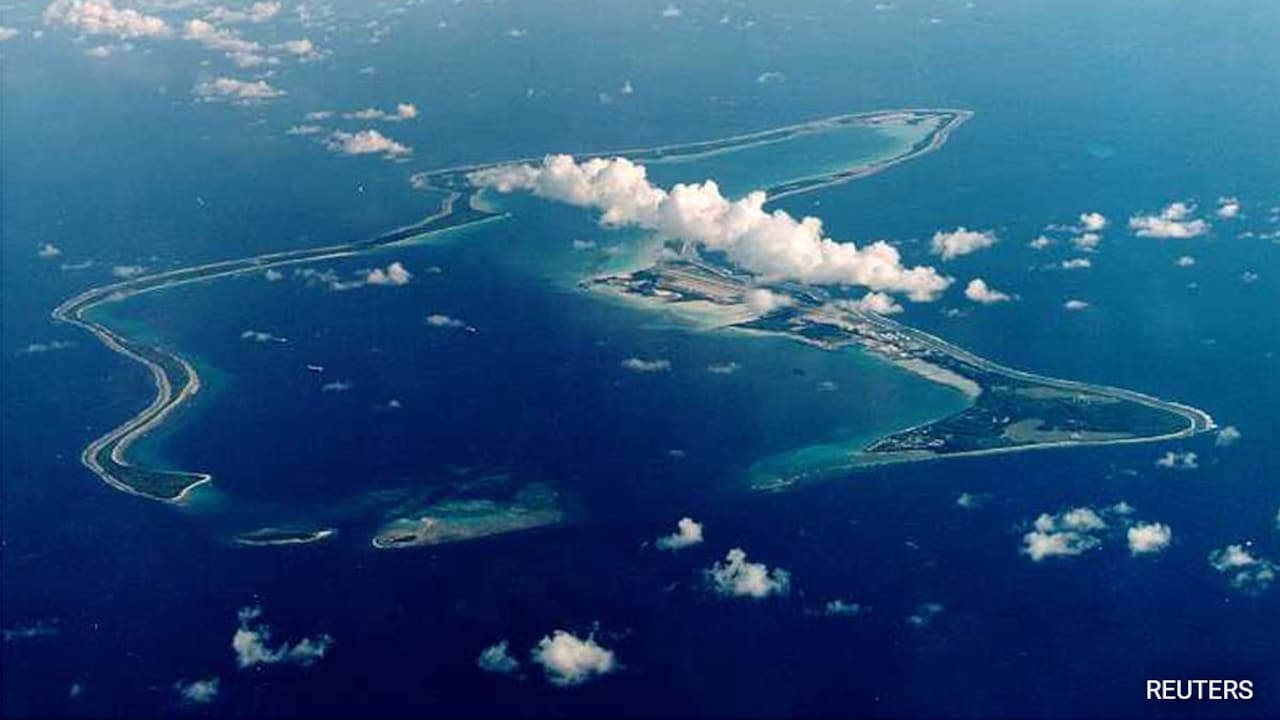
Diego Garcia operates as a critical military asset for the United States, serving as an un-interceptable launch pad and logistical center in the central Indian Ocean. The island’s utility is calculated through three distinct structural pillars.
Geodetic Insulation and Range Vectors
The atoll sits approximately 2,360 miles (3,800 kilometers) from Iran, placing it outside the effective theater-ballistic missile range of mid-tier regional adversaries while remaining well within the operational radius of United States long-range strategic bombers, such as the B-2 Spirit and B-52 Stratofortress. This geographic positioning allows for unrefueled, heavy-payload strike sorties across both the Middle East and the South China Sea.
Deep-Water Port Capacity
The lagoon at Diego Garcia is uniquely configured to accommodate carrier strike groups and submarine tenders. It serves as a forward-deployed maritime pre-positioning squadron station, holding heavy equipment, armor, and munitions sufficient to sustain a marine expeditionary brigade for 30 days without domestic replenishment.
Electromagnetic and Intelligence Dominance
The isolation of the Chagos Archipelago minimizes electronic noise, optimizing the site for global space surveillance networks, satellite tracking installations, and signals intelligence interception across critical sea lines of communication.
The core vulnerability of this footprint does not stem from its hardware, but from its legal foundations. The United States occupies Diego Garcia via a 1966 exchange of notes with the United Kingdom, a derivative agreement anchored to British sovereignty. If the underlying sovereignty shifts or becomes legally compromised, the entire security infrastructure faces operational risk.
The Sovereignty Transfer Failure Mechanism
The United Kingdom strategy sought to resolve international legal friction. The International Court of Justice and United Nations resolutions have consistently characterized the 1965 detachment of the Chagos Archipelago from Mauritius as an unlawful decolonization process. London’s proposed treaty aimed to exchange nominal sovereignty for legal certainty through a 99-year lease.
This model introduces a structural breakdown when viewed through the lens of risk management. The fatal flaw of the United Kingdom-Mauritius arrangement lies in the creation of an adversarial surveillance vector.
[Mauritian Sovereign Control] ---> [Diplomatic/Economic Alignments with China/Iran]
                                       |
                                       v
[Diego Garcia Perimeter] <------- [Host-Nation Espionage & Signals Vulnerability]
Mauritius maintains deeply integrated economic and diplomatic ties with external powers, specifically China and Iran. Transferring the sovereign rights of the surrounding archipelago to Mauritius gives Port Louis the authority to manage the exclusive economic zone, airspace, and neighboring islands. This creates a clear avenue for counter-intelligence risks:
- Signals Intelligence Satellites and Stations: Under Mauritian sovereignty, adjacent islands within the Chagos group could host commercial deep-water ports or fisheries facilities funded by foreign capital. These installations can serve as cover for signals intelligence listening posts or underwater acoustic arrays designed to track United States nuclear submarine movements leaving Diego Garcia.
- Airspace and Maritime Interdiction: A sovereign Mauritius retains the legal right to grant overflight or landing rights to foreign state aircraft on adjacent islands, compromising the operational security of sensitive United States deployments.
- Host-Nation Dependency: The lease structure converts the United States military presence into a tenant activity, subject to the long-term political stability and shifting foreign policy alignments of Mauritius. If an adversary offers superior financial terms or exerts economic leverage over Port Louis, the lease terms could face arbitrary renegotiation or unilateral termination.
This security liability caused the United States to withdraw its support for the United Kingdom legislation, forcing Downing Street to shelve the ratification process indefinitely. The United Kingdom cannot proceed with the transfer without United States approval, creating a geopolitical stalemate that the White House is now attempting to break via an outright acquisition strategy.
The Transactional Architecture of Territorial Acquisition
The proposal to purchase the Chagos Archipelago directly from Mauritius bypasses the United Kingdom lease model entirely, substituting a property rights framework for an administrative leasehold. This strategy relies on specific legal and financial maneuvers.
Step 1: Theoretical British Title Realization
The United States cannot purchase the territory directly from Mauritius while the United Kingdom retains administrative control as the British Indian Ocean Territory. The first stage requires London to formally cede its title to Mauritius under a pre-negotiated three-party framework. The United Kingdom would act as a structural intermediary, liquidating its colonial claim in exchange for United States security guarantees elsewhere or financial offsets.
Step 2: Direct Bilateral Capital Injection
Once sovereignty is unified under Mauritius, the United States Treasury would execute a direct state-to-state acquisition agreement. The purchase price would be structured to exceed the net present value of the projected 99-year lease payments from the United Kingdom, combined with a premium designed to offset Mauritius's economic reliance on foreign infrastructure investments.
Step 3: Incorporation under United States Territorial Law
The archipelago would be integrated into the United States legal framework, likely as an unorganized, unincorporated territory similar to Guam or Wake Island. This shifts the legal foundation of Diego Garcia from an international executive agreement to domestic federal domain, granting the Pentagon absolute statutory control over access, security perimeters, and airspace management.
Technical Limitations of the Purchase Model
| Risk Vector | Description | Strategic Mitigation |
|---|---|---|
| International Legal Precedent | The UN General Assembly and international bodies may view an outright sale as a continuation of imperial territorial trafficking, refusing to recognize the shift in domestic jurisdiction. | Rely on the bilateral treaty power of sovereign states; use a UN Security Council veto to neutralize hostile resolutions. |
| Chagossian Displacement Claims | The indigenous Chagossian population, forcibly evicted between 1965 and 1973, maintains active legal claims for the right of return, which could create a domestic civil rights liability within the United States court system. | Restrict the application of the United States Constitution through the Insular Cases framework, limiting judicial standing for non-citizen residents of unincorporated territories. |
| Geopolitical Precedent Inflation | Pursuing a transactional purchase approach could validate claims by other nations looking to acquire territory through financial leverage, altering maritime borders elsewhere. | Classify the Chagos acquisition as a unique, non-replicable rectification of a pre-existing bilateral defense agreement. |
The Strategic Path Forward
The United States must reject any trilateral compromise that leaves the underlying sovereignty of the Chagos Archipelago in the hands of a third-party nation vulnerable to external economic pressure. The active conflict with Iran highlights the danger of relying on host-nation permissions for long-range defense operations. The United Kingdom’s attempt to preserve its base access via a 99-year lease with Mauritius introduces structural intelligence and security risks that cannot be mitigated by treaty text alone.
The optimal strategy requires the White House to execute a coordinated diplomatic and financial play. The United States must maintain its veto over the current United Kingdom-Mauritius transfer treaty, keeping the legislation shelved in London. Concurrently, the United States Treasury and Department of State must present a joint package to Port Louis. This proposal should offer immediate capital injection and long-term infrastructure funding in direct exchange for a complete sovereign transfer of the archipelago to the United States.
If Mauritius rejects the purchase offer due to geopolitical ties with competing nations, the fallback option is to sustain the current status quo indefinitely. The United States must compel the United Kingdom to maintain its colonial administration over the British Indian Ocean Territory by tying British cooperation on Diego Garcia directly to intelligence-sharing privileges and nuclear weapons modernization support. Permanent leasehold frustration is preferable to a flawed sovereignty transfer that places an adversarial surveillance asset within the defensive perimeter of the primary power projection platform in the Indian Ocean.