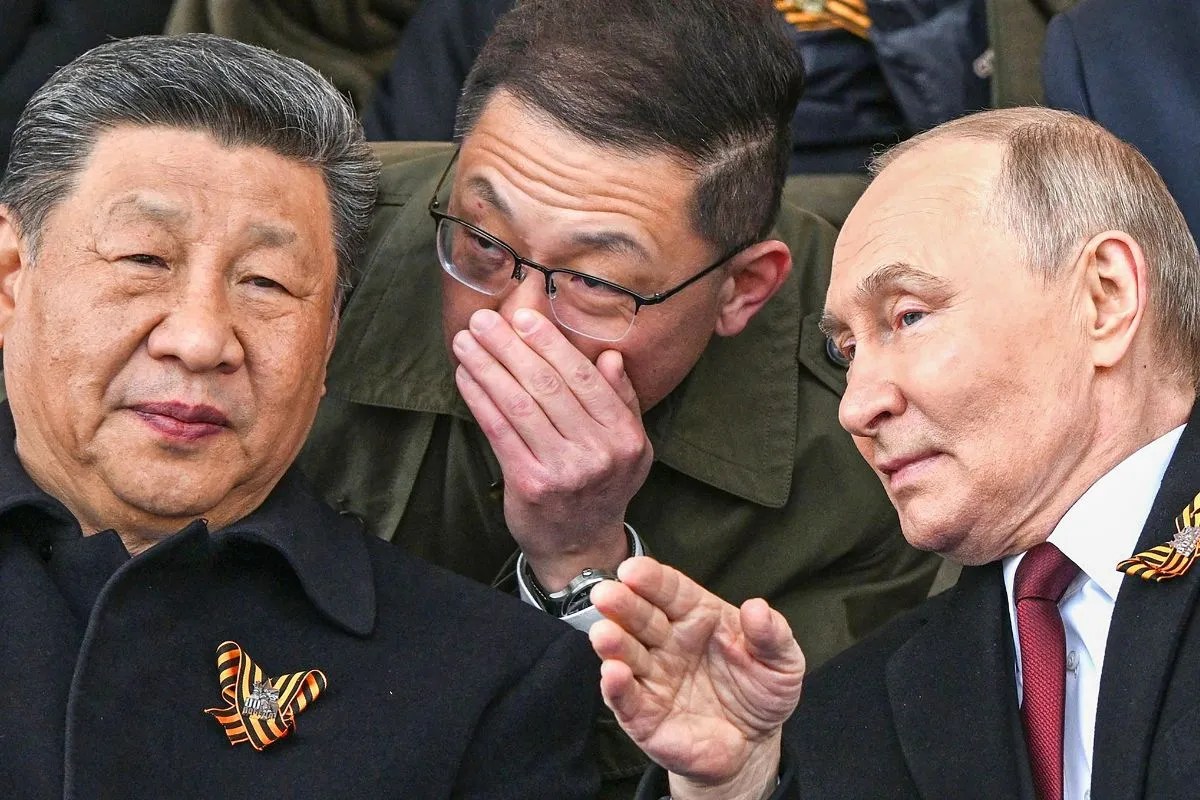
The strategic alignment between Russia and China operates not on ideological affinity, but on a calculus of asymmetric interdependence and shared systemic pressures. Vladimir Putin’s state visit to Beijing following Donald Trump's return to the US presidency highlights a structural pivot in global trade and security. While surface-level analysis views this relationship through the lens of a generic "no limits" partnership, a rigorous deconstruction reveals a complex matrix of economic necessity, military-technical exchange, and institutional hedging against Western economic containment.
The architecture of this bilateral relationship can be broken down into three core operational vectors: energy arbitrage, financial systemic decoupling, and localized geopolitical leverage.
The Asymmetric Energy Arbitrage: Discounted Supply Meeting Monopsony Demand
The economic foundation of the Moscow-Beijing axis rests heavily on the reallocation of hydrocarbon flows away from European markets toward Asia. This transaction is governed by a strict cost function that favors Beijing, creating a distinct buyer-monopsony dynamic.
[Russia: Hydrocarbon Exporter] ---> (Siberia-to-China Pipelines) ---> [China: Industrial Monopsony]
                                                                            |
                                                                  (Deep Price Discounts)
The Hydrocarbon Re-Routing Mechanism
Prior to 2022, Europe absorbed over 60% of Russian crude oil exports and roughly 40% of its natural gas. The enforcement of Western sanctions, price caps, and the sabotage of the Nord Stream pipelines forced an immediate structural pivot. Russia redirected this volume toward China and India. However, infrastructure constraints dictate the efficiency of this redirection:
- Pipeline Bottlenecks: The Power of Siberia 1 pipeline operates under fixed capacity limits, unable to instantly absorb the volume previously sent via the massive European pipeline network. The proposed Power of Siberia 2 remains a point of intense negotiation, as Beijing uses its leverage to demand price parity with domestic Chinese subsidized rates.
- Maritime Logistics and Insuring Risks: Seaborne crude relies on a "shadow fleet" of tankers operating outside Western insurance matrices. This introduces a structural transaction cost, reducing the net margin per barrel that Moscow recaptures.
The Pricing Discount Matrix
China does not import Russian energy out of altruism. Beijing secures Russian ESPO (Eastern Siberia Pacific Ocean) and Urals crude at a persistent discount relative to Brent benchmarks. This discount functions as a risk premium for defying secondary Western sanctions.
The economic benefit to China is twofold: it lowers the input cost for its massive industrial manufacturing sector and fills its strategic petroleum reserves at a lower capital expenditure than its regional competitors, such as Japan or South Korea. For Russia, this creates a structural vulnerability: its state budget becomes highly sensitive to Beijing’s internal demand cycles and pricing dictates.
Financial Architecture and Sanction-Insulation Frameworks
A critical vulnerability for both nations is exposure to the US Dollar-dominated SWIFT clearing system. The transformation of their bilateral financial architecture focuses strictly on reducing this attack surface through two primary mechanisms: local currency settlement and alternative financial messaging infrastructure.
The Renminbi Clearing Pipeline
Bilateral trade settlement has shifted systematically away from the USD and Euro toward the Renminbi (RMB) and the Ruble. Currently, over 90% of Russia-China trade is invoiced in local currencies. Russia has become one of the largest offshore users of RMB.
This shift introduces structural inefficiencies that both states must actively manage:
- The Ruble-RMB Liquidity Trap: Russian exporters accumulate massive RMB reserves in Chinese banks. However, capital controls enforced by the People's Bank of China (PBOC) restrict the free repatriation and conversion of these assets. Russia cannot easily use these RMB reserves to settle accounts with third-party nations in South America or the Middle East without clearing through mainland systems.
- Secondary Sanctions Bottlenecks: Major Chinese state-owned commercial banks regularly halt or delay payments from Russian entities to avoid losing access to the clearing mechanisms of the US Federal Reserve. This has forced trade settlement into smaller, regional Chinese banks located along the border, which have zero exposure to the US financial system but possess limited liquidity and slower processing times.
Institutional Alternative Systems
To mitigate the threat of total disconnection from global financial architecture, Russia’s System for Transfer of Financial Messages (SPFS) has been integrated with China’s Cross-Border Interbank Payment System (CIPS). While CIPS provides a technical alternative to SWIFT, it still relies on SWIFT for a portion of its international messaging, meaning the insulation from Western regulatory penalties is incomplete.
Military-Technical Cooperation and Dual-Use Supply Chains
The strategic defense relationship between Moscow and Beijing has evolved from direct arms sales to a sophisticated ecosystem of dual-use technology transfers and joint structural defense exercises. This cooperation avoids explicit military alliances while achieving operational synchronization.
The Dual-Use Supply Chain Matrix
China avoids sending lethal, finished weapon systems to Russia to prevent triggering sweeping Western secondary sanctions that would jeopardize its export access to North American and European markets. Instead, the supply chain prioritizes high-value components that sit in the regulatory gray zone of "dual-use" goods:
- Advanced Machine Tools: Chinese CNC (Computer Numerical Control) machines have largely replaced European imports in Russian defense industrial plants, providing the precision manufacturing necessary for missile and armored vehicle production.
- Semiconductors and Microelectronics: While China does not produce the highest-end sub-5nm chips, it provides massive volumes of legacy-node semiconductors (28nm and above) essential for the guidance systems of drones, cruise missiles, and loitering munitions.
- Nitrocellulose and Optoelectronic Components: Basic chemical precursors for propellants and optical sensors for night-vision and targeting systems flow through logistics hubs in Xinjiang and Central Asia into the Russian defense sector.
Geopolitical Force Multiplication
Beyond material trade, the military relationship manifests in geographic coordination designed to stretch Western strategic resources across two distinct theaters: the North Atlantic/Arctic and the Indo-Pacific.
Joint naval maneuvers in the East China Sea, the Sea of Japan, and increasingly in the Bering Sea force the United States and its regional allies to allocate intelligence, surveillance, and reconnaissance (ISR) assets across multiple vectors simultaneously. This creates a strategic feedback loop: heightened tension in the Taiwan Strait or South China Sea reduces the diplomatic and material capital Washington can deploy toward the European theater, and vice versa.
Tactical Friction Points and Structural Limitations
The Moscow-Beijing axis is not a monolith; it is constrained by historic mistrust, asymmetric power dynamics, and competing regional ambitions. Understanding these friction points is essential for predicting the longevity of the alignment.
Central Asian Geopolitical Competition
The post-Soviet space of Central Asia (Kazakhstan, Uzbekistan, Turkmenistan, Kyrgyzstan, and Tajikistan) represents a theater of soft competition between Russia and China.
- Security vs. Economics: Historically, Russia acted as the primary security guarantor for these nations via the Collective Security Treaty Organization (CSTO), while China functioned as the primary economic investor through the Belt and Road Initiative (BRI).
- The Balance Shift: Russia’s military preoccupation in Europe has allowed China to deepen its security footings in Central Asia, establishing direct anti-terrorism coordination centers and expanding security equipment transfers to local regimes, slowly displacing historic Russian dominance in its own backyard.
The Demographics of the Russian Far East
A long-term structural anxiety within Moscow's planning circles is the demographic imbalance along the 4,200-kilometer shared border. The Russian Far East is sparsely populated, economically underdeveloped, and resource-rich, directly adjacent to China’s densely populated northeastern industrial provinces. While officially dismissed, Russian strategic planners remain cautious about over-reliance on Chinese capital to develop eastern infrastructure, fearing a de facto economic colonization of the region.
Strategic Playbook: The Near-Term Realignment under US Pressure
The return of Donald Trump to the White House alters the variable inputs for both Moscow and Beijing. The proposed US tariff regime—targeting a universal baseline tariff alongside specific 60% tariffs on Chinese imports—forces a calculated response from both powers.
[US Tariff/Sanction Pressure]
       |
       +---> (To China): Forces expansion of alternative export markets & secure raw materials.
       |
       +---> (To Russia): Enforces strict reliance on Chinese industrial inputs.
China will counter US tariff pressure by aggressively securing its raw material supply chains, viewing Russia as a sanction-proof backyard for agricultural products, base metals, and energy. Concurrently, Beijing will seek to expand its market share for consumer goods, automotive products, and industrial machinery within Russia, filling the void left by Western brands.
Russia will attempt to leverage Western fears of a permanent, unassailable Eurasian bloc to extract diplomatic concessions regarding its western borders. Moscow will position itself as a critical player in any potential US-led attempt to decouple from China, though its deep economic dependence on Beijing makes a genuine "reverse-Nixon" maneuver—where Washington splits Moscow away from Beijing—highly improbable under current structural conditions.
The optimal strategic play for both actors is the preservation of the status quo: avoiding a formal military treaty that would mandate mutual defense commitments, while continuously refining their parallel financial, logistical, and industrial infrastructure to withstand persistent economic warfare from the West.