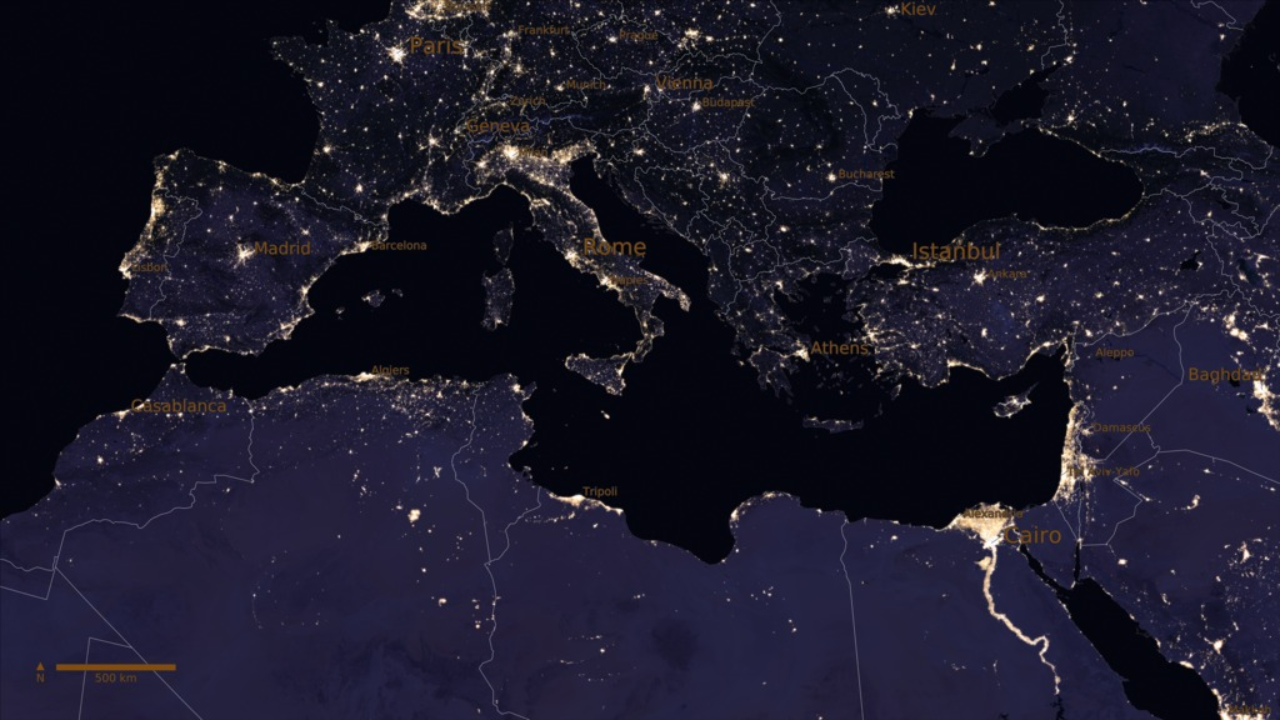
The global increase in nocturnal radiance, primarily concentrated in sub-Saharan Africa and Southeast Asia, functions as a high-fidelity proxy for unspoken economic activity and infrastructure density. Traditional GDP metrics often fail to capture the informal economies and rapid rural-to-urban migrations characteristic of these regions. Satellite-derived radiance data—specifically from the Visible Infrared Imaging Radiometer Suite (VIIRS)—provides a non-biased, empirical layer to verify reported growth rates. This analysis deconstructs the mechanics of "Night Light Expansion" (NLE) through the lens of photon emission as a function of capital investment and energy distribution.
The Mechanics of Radiance as an Economic Indicator
Measuring economic health via satellite imagery relies on the correlation between artificial light and electricity consumption. In developing markets, this correlation is tighter than in post-industrial societies where light efficiency and "dark sky" policies decouple luminosity from productivity. The expansion of the luminous footprint in sub-Saharan Africa and Southeast Asia represents a shift from subsistence-based living to integrated, energy-dependent manufacturing and service clusters.
We must categorize this growth into three distinct structural drivers:
- Industrial Agglomeration: The development of Special Economic Zones (SEZs) and export processing centers which operate on 24-hour cycles.
- Infrastructural Interconnectivity: The literal electrification of transit corridors, which bridges the gap between urban hubs and rural resource pools.
- Urban Sprawl and Densification: The transition of informal settlements into permanent, electrified residential zones.
The surge in brightness is not merely a byproduct of "development" but a specific signal of Fixed Capital Formation. When a region glows brighter, it indicates that the physical environment has been modified with permanent electrical infrastructure—a prerequisite for long-term industrial scaling.
Structural Drivers of Growth in Southeast Asia and Africa
The divergence in NLE patterns between these two regions reveals different underlying economic strategies. Southeast Asia’s luminosity is driven by high-density manufacturing clusters, while sub-Saharan Africa’s growth is characterized by point-source expansion, primarily around resource extraction sites and administrative capitals.
The Southeast Asian Manufacturing Belt
In nations like Vietnam and Thailand, the increase in night lights follows a linear path along major logistics arteries. The light is not diffused; it is concentrated in ribbons. This signifies a "Hub and Spoke" infrastructure model. The energy consumption here is high-intensity, reflecting a move toward heavy machinery and automated production lines.
The African Urban Transition
In contrast, sub-Saharan Africa’s luminosity is often characterized by "leapfrogging." Because traditional grid infrastructure is expensive to deploy across vast distances, many new light sources are the result of decentralized solar-plus-storage systems. This creates a fragmented light map. The brightness here is less a signal of heavy industry and more a marker of Basic Utility Access and the emergence of a consumer middle class.
The Technical Bottleneck of VIIRS and OLS Data
To accurately interpret these satellite revelations, we must account for the sensor limitations that often lead to data misinterpretation. Historically, the Defense Meteorological Satellite Program (DMSP) used Operational Linescan System (OLS) sensors, which suffered from "pixel saturation" in bright urban centers and poor spatial resolution. The transition to VIIRS Day/Night Band (DNB) data improved sensitivity but introduced new variables:
- Atmospheric Backscatter: Humidity and aerosol density in tropical regions can reflect light, making a region appear brighter than its actual energy output warrants.
- The Albedo Effect: Variations in ground surface materials (e.g., concrete vs. soil) change how much light is reflected back to the sensor.
- Luminance Directionality: Modern LED lighting is often highly directional (pointing downward). If a region upgrades from old high-pressure sodium lamps to LEDs, the satellite may actually detect a decrease in light even though the area is more developed, due to reduced "sky glow."
This creates a Measurement Paradox: A city could be modernizing its infrastructure and increasing its economic output while appearing darker to a satellite, simply because it has become more efficient at directing light toward the ground.
Quantifying the Urban-Rural Luminosity Gap
The disparity between urban core brightness and rural dimness provides a metric for regional inequality. In high-growth regions of Africa, we observe a "Primate City" effect, where the capital city accounts for over 80% of the nation’s total detected photons.
The strategy for bridging this gap involves the Decentralization of Light. When luminosity begins to bleed out from the capital into secondary and tertiary cities, it signals that the economy is no longer purely extractive or administrative. It indicates the birth of internal trade networks. The velocity of this "light bleed" is a more accurate predictor of future GDP growth than reported government figures, which are often subject to political manipulation or statistical lag.
The Ecological Cost of Artificial Brightness
While economists view night lights as a sign of progress, environmental data points to a massive disruption in local biomes. The "brighter night" phenomenon in Southeast Asia, particularly in coastal regions, disrupts the migratory patterns of marine life and the pollination cycles of local flora.
The biological impact functions as a Negative Externality of NLE. The challenge for developing nations is the "Luminosity Efficiency Frontier": maximizing the economic utility of light while minimizing its environmental footprint. This requires a shift from broad-spectrum lighting to narrow-spectrum, shielded illumination—a transition that is rarely prioritized during the initial stages of rapid capital expansion.
Predictive Modeling and Resource Allocation
For global investors and policy planners, NLE data acts as a "Heat Map for Opportunity." By identifying areas where the light footprint is expanding faster than the official population growth, analysts can pinpoint emerging consumer markets before they are saturated.
The logic follows a three-step validation process:
- Detection: Identifying a persistent 5% year-over-year increase in radiance in a previously dark pixel.
- Categorization: Using spectral analysis to determine if the light is industrial (high-intensity, stable) or residential (lower-intensity, variable).
- Correlation: Cross-referencing the light data with mobile phone penetration and port throughput data to verify economic movement.
Strategic Realignment for Infrastructure Investment
The data confirms that the center of gravity for global energy demand is shifting. Sub-Saharan Africa and Southeast Asia are not just "getting brighter"; they are building the foundational layers of 24-hour economic systems.
The critical play for energy providers and infrastructure developers is to pivot away from centralized "mega-grid" projects in these regions. The fragmented, decentralized nature of the light expansion in Africa suggests that the highest returns will be found in Distributed Energy Resources (DERs). In Southeast Asia, the linear, corridor-based growth dictates a need for high-density, grid-tied industrial parks.
Failure to align investment with these specific radiance patterns results in stranded assets—massive power plants with no transmission lines to reach the new, shifting clusters of light. The map is literally glowing with the coordinates of the next decade's industrial winners; the only requirement is the technical precision to read the signal through the atmospheric noise.