Silence.
In the Demilitarized Zone that splits the Korean Peninsula like a jagged scar, silence is never actually empty; it is a heavy, vibrating thing woven from the rustle of unharvested reeds, the distant hum of high-voltage fences, and the slow, suffocating weight of seventy years of unresolved grief.
When a metal box buried six inches beneath the damp earth snaps shut, the sound does not stay in the valley. It travels. It ricochets off the concrete walls of diplomatic chambers in New York, echoes through the briefing rooms of Seoul, and hardens into ink on official stationery in Pyongyang.
In August 2015, two South Korean soldiers—Staff Sergeant Ha Jae-heon and Staff Sergeant Kim Jung-won—stepped onto a patrol path near Paju, just south of the Military Demarcation Line. Within seconds, two wooden-box mines detonated. Ha lost both legs. Kim lost his right ankle. Seoul immediately pointed north, citing an investigation led by the South Korean military and the United Nations Command that concluded North Korean troops had covertly crossed the border to plant the devices.
Then came the counter-narrative. Days later, North Korea’s National Defence Commission issued a sweeping denial, later amplified in formal communications to the United Nations Security Council: the entire incident, Pyongyang declared, had been fabricated by the South.
To read a standard news wire about this diplomatic collision is to encounter a sterile exchange of accusations. One side alleges provocation; the other alleges a smear campaign. Yet beneath the bureaucratic prose lies a profoundly human and terrifying reality about how modern conflicts are fought—not merely with steel and explosives, but with competing versions of truth itself.
The Architecture of a Hidden Trap
To understand why a dispute over a wooden box can push two nuclear-armed spheres to the brink of artillery fire, one must first understand the geography of fear along the 38th parallel.
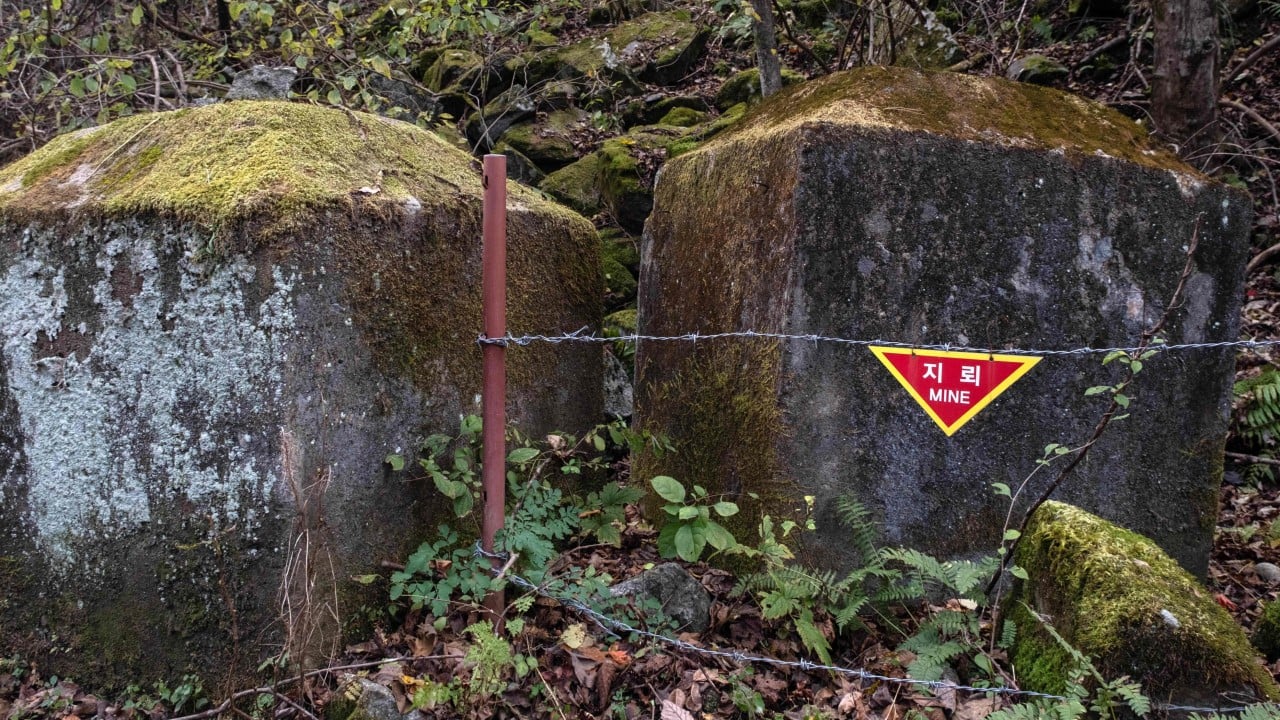
Picture a strip of land roughly 155 miles long and 2.5 miles wide. Nature has reclaimed it. Rare cranes nest in flooded rice paddies, and wild boars roam through rusted barbed wire. Beneath that lush canopy, however, lies one of the densest concentrations of unexploded ordnance on Earth. Historians and military engineers estimate that well over a million landmines—some laid during the 1950–1953 Korean War, others washed down from mountain ridges during summer monsoons—remain buried in the soil.
Consider a hypothetical patrol moving through this terrain at dawn, meant here as an illustration of the daily reality faced by young conscripts on both sides of the line. Imagine a twenty-one-year-old soldier walking single-file behind his squad leader. His boots sink into thick, rain-soaked clay. Every step is a negotiation between routine and dread. He is looking for tripwires, disturbed earth, or the faint metallic glint of a casing pushed upward by frost heave.
What he is not expecting—according to the findings presented by the South Korean Ministry of National Defense and the United Nations Command—is a freshly planted Soviet-style PMD-57 wooden-box mine placed deliberately along a well-trodden access gate. Because the casing is made of pine rather than steel, standard handheld metal detectors struggle to register it. It is an invisible weapon designed specifically to maim rather than kill, forcing an enemy unit to slow down, tend to its wounded, and bleed morale.
When South Korean investigators examined the blast craters in August 2015, they reported finding fragments of wood, firing pins, and springs consistent with North Korean inventory, alongside evidence that the mines had not been washed there by seasonal rains, as the terrain sloped away from northern hillsides.
Yet in Pyongyang, the story looked entirely different.
The Battle for the Narrative at the United Nations
When North Korea’s mission to the United Nations transmitted its rebuttal to the Security Council, it did not merely say "we didn't do it." It constructed an alternate reality, challenging the physical evidence and questioning Seoul’s motives.
According to statements from North Korea’s National Defence Commission and its UN envoy, the claim that northern soldiers crept undetected across one of the most heavily surveilled borders on the planet was logistically absurd. Pyongyang argued that if South Korea possessed video footage or thermal imaging of the alleged infiltration—as Seoul claimed to have—it should produce it openly rather than rely on closed-door military briefings. In the North’s framing, the blast was either an accidental detonation of South Korea’s own decades-old mines or a staged pretext engineered by Seoul and Washington to justify upcoming joint military exercises, known as Ulchi-Freedom Guardian.
Pause and sit with that ambiguity for a moment.
If you have ever stood near a border where history is weaponized, you know how disorienting this fog becomes. Most of us live in worlds where facts have receipts: a timestamped video, an independent autopsy, an impartial police report. Along the DMZ, however, there is no neutral beat cop. The United Nations Command, which oversees the 1953 Armistice Agreement, is viewed by Seoul and Washington as an international peacekeeper, while Pyongyang has long denounced it as an American-led instrument of hostility.
Think of the dispute like two neighbors separated by a high, opaque wall, each holding a different half of a torn photograph. One neighbor points to scorch marks on the grass and says, You threw a match over the fence. The other points to the height of the wall and says, Nobody could throw a match that far—you burned your own lawn to frame me. Without an arbiter both sides trust, the physical evidence becomes secondary to the story each side needs to tell its own people.
Why Fabrication Claims Carry Explosive Weight
Why does North Korea insist on calling the blast a fabrication rather than simply remaining silent? And why does South Korea invest so heavily in proving North Korean culpability before the UN?
The answer lies in the delicate, unforgiving math of deterrence.
In 1953, the Korean War did not end with a peace treaty; it ended with an armistice—a temporary ceasefire that has stretched across seven decades. Under international law and the terms of that armistice, planting mines across the Military Demarcation Line is not a minor border infraction. It is an act of war.
For South Korea, establishing beyond doubt that Pyongyang ordered the mining was essential to justify its response: resuming cross-border propaganda broadcasts via massive banks of loudspeakers for the first time in eleven years. Those broadcasts—blaring weather reports, K-pop, and critiques of the North Korean leadership across the valley—struck at the regime’s most sensitive nerve: information control.
For North Korea, admitting responsibility would mean conceding a violation of the armistice and inviting tighter international sanctions at the UN Security Council. By branding the blast a South Korean fabrication, Pyongyang sought to flip the moral ledger, casting itself as the victim of a manufactured crisis and warning that any retaliation would be met with all-out military force.
Within days of the UN exchanges, artillery shells were fired across the western border. Evacuation orders went out to South Korean border villages. North Korean frontline units entered a "quasi-state of war." Submarines disappeared from radar. For seventy-two tense hours in late August 2015, millions of families in Seoul and Pyongyang went to sleep wondering if morning would bring sirens.
The Human Toll Beneath the Rhetoric
Diplomats speak in terms of "provocations," "countermeasures," and "sovereignty." Soldiers and villagers speak in terms of blood, dust, and hospital corridors.
In the aftermath of the Paju blast, television cameras captured the human cost that no UN resolution could undo. Staff Sergeant Kim Jung-won, waking from surgery after losing part of his leg, reportedly expressed concern not for himself, but for his fellow soldiers still patrolling the fence line. Meanwhile, in the civilian border villages of Yeoncheon and Paju, elderly farmers who had spent their lives planting ginseng in the shadow of artillery batteries packed single suitcases and descended into damp concrete bomb shelters, listening to the rumble of military convoys passing overhead.
I think often about the sheer exhaustion of living inside a permanent cliffhanger. It is easy, from thousands of miles away, to treat diplomatic cables at the United Nations as moves on a chessboard. It is much harder when you realize that every pawn on that board is a nineteen- or twenty-year-old kid—northern or southern—whose mother wakes up every morning checking the news before she checks the weather.
History Repeats in the Mud
The 2015 mine dispute was neither the first nor the last time truth became a casualty along the 38th parallel.
Look back at the sinking of the South Korean corvette Cheonan in March 2010, which killed forty-six sailors. A multinational investigation led by South Korea concluded that a North Korean miniature submarine had fired a homing torpedo into the ship’s hull. North Korea rejected the findings entirely, calling the investigation a "charade" fabricated by Seoul and Washington, and demanded to send its own inspection team—a request South Korea refused.
Look back further, to the 1976 axe murder incident at Panmunjom, or the 1968 Blue House raid, or the countless tunnel discoveries beneath the DMZ that Pyongyang initially dismissed as South Korean coal mines. Across every decade, the pattern holds steady: an acute physical shock on the ground, followed immediately by an asymmetric war over credibility in international forums.
And the danger has only grown more complex. In recent years, as North Korea has physically severed inter-Korean roads and railways, planted thousands of new anti-personnel mines along its side of the border, and formally abandoned the goal of peaceful unification, the margin for miscalculation has narrowed to a razor’s edge. When two heavily armed militaries operate within shouting distance without functioning hotlines or shared investigative mechanisms, any explosion—whether triggered by a deliberate infiltrator, a shifting monsoon landslide, or a decaying relic from 1952—can spiral out of control before a single diplomat reaches the podium in New York.
What Remains After the Smoke Clears
The crisis of August 2015 eventually de-escalated through marathon, late-night negotiations at the truce village of Panmunjom. North Korea expressed "regret" over the injuries sustained by the South Korean soldiers—a carefully calibrated word that stopped short of an explicit admission of guilt—while South Korea agreed to turn off its border loudspeakers.
On paper, peace held. The diplomatic files at the United Nations were archived. The news cycle moved on to other capitals, other borders, other emergencies.
Yet out in the tall grass of the DMZ, nothing truly vanished. Heavy rains still wash the topsoil down the ridges every July. Somewhere beneath the roots of wild persimmon trees and tangled concertina wire, small wooden boxes filled with TNT still sit in the dark, waiting patiently for weight, pressure, and the next contested story.