The sea does not care about flags. At night, the Persian Gulf strips away political maps, leaving only a vast, ink-dark expanse where the hum of a diesel engine carries for miles and salt eats relentlessly at steel. Out there, on the water, you learn to read the silhouettes. You know the blunt, heavy shoulder of a merchant tanker. You know the lean, aggressive rake of a patrol boat.
And then, sometimes, you see something that belongs to neither world.
It floats low to the surface, a pale, unblinking eye staring out from a steel hull, tethered to nothing visible, drifting through international shipping lanes like a ghost ship stripped of its crew. To a sailor on a bridge wing, half-blinded by fatigue and the glare of radar screens, it looks like a piece of drift log until the binoculars bring it into sharp focus. A sleek hull. A cluster of high-definition lenses. A brain made of silicon and algorithms, quietly recording the secret choreography of passing warships.
It is a surface drone. A mechanical spy. And on one particular night in the waters between Bahrain and the Strait of Hormuz, someone tried to steal it.
The Anatomy of an Invisible War
To understand what happened when the United States Navy caught an Iranian support ship towing one of its unmanned surface vessels, you have to look past the dry language of military press releases. You have to look at the geometry of modern paranoia.
For years, the conflict between Washington and Tehran has played out in headlines about nuclear enrichment, sanctions, and fiery speeches at the United Nations. But away from the podiums, the real friction happens in the gray zone—that uncomfortable space just short of open war where intelligence is harvested byte by byte, and every piece of floating hardware is both a tool and a target.
The United States Fifth Fleet operates thousands of square miles of ocean with a relatively small number of crewed ships. To bridge that gap, the Navy turned to robotics. They deployed Saildrone Explorers—autonomous, wind- and solar-powered vessels packed with sensors, cameras, and navigation equipment. To the casual observer, they look like glorified surfboards with vertical wings. To naval intelligence, they are persistent, tireless sentinels that can watch a choke point for months without a single sailor needing a cup of coffee.
But autonomy has a dark side. A machine with no crew has no guns. It cannot maneuver to defend itself. It cannot fire a warning shot or lock a targeting radar. It is entirely, defenshetically naked.
When the Iranian support ship Shahid Dazhooi hoisted a U.S. Navy Saildrone Explorer out of the water and lashed it to its deck in late August, it wasn't just an act of maritime piracy. It was a calculated stress test. It was an adversary reaching out a gloved hand to see how soft the shell was, and how fast the turtle would bite.
The Long Watch
I remember the hum of the combat information center on a guided-missile destroyer. The air is always conditioned down to a shivering chill, smelling faintly of stale coffee, ozone, and hot electronics. The lighting is low—red-tinted bulbs to preserve night vision for the bridge teams upstairs.
In that room, the world is reduced to green phosphor glows and glowing vector lines. Every blip on the tactical display represents a choice, a potential crisis, a calculus of seconds. When an unmanned surface vehicle goes dark or stops transmitting its telemetry, the silence in that room changes. It’s not the quiet of peace; it’s the quiet before a switch is thrown.
Imagine sitting at that console, thousands of miles from home, watching a little white icon on a screen suddenly begin to drift off its programmed patrol box. Imagine zooming in on the camera feed. You see the deck of a foreign vessel. You see your own equipment—hardware paid for by taxpayers, designed to keep shipping lanes open—slung over the side of a ship that views you as an existential threat.
The calculus is brutal. If you send a warship racing in with guns manned, you risk escalating a minor theft into a shooting war. If you do nothing, you invite every regional adversary to treat your technological edge as a floating supply depot.
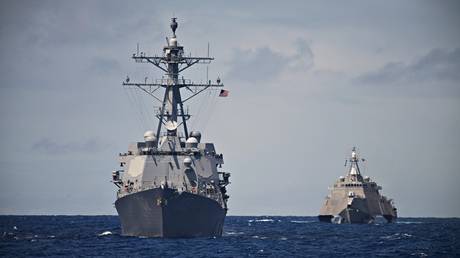
The U.S. Navy chose a middle path that night, relying on a combination of speed, communication, and sheer psychological pressure. The patrol coastal ship USS Thunderbolt was dispatched immediately. A maritime patrol helicopter was scrambled, its turbine engines screaming out of the night sky, rotor wash churning the dark water into white foam as it illuminated the Iranian ship with a blinding searchlight.
Picture the scene on the deck of the Shahid Dazhooi. One moment, the sailors are securing their prize, thinking they’ve grabbed an easy piece of foreign technology to reverse-engineer in a dry dock. The next moment, the sky above them turns into a roaring tempest of wind and light. A multi-million-dollar American helicopter hovers just feet overhead, its spotlight pinning them to their own deck like insects under a microscope, while a grey warship closes the distance with its guns trained directly on their bridge.
It is a dance of hyper-compressed tension. Nobody wants to be the spark that lights the powder keg. But everybody is acutely aware that a single twitch on a trigger could rewrite the history of the Middle East.
Why the Drone Matters
Why risk an international incident over a fiberglass surfboard with a camera?
Because the future of naval warfare is not about massive aircraft carriers slugging it out across horizons. It is about data dominance. The waters of the Persian Gulf are among the most congested and strategically vital waterways on Earth. A massive percentage of the global oil supply squeezes through the narrow throat of the Strait of Hormuz every single day.
Whoever sees the water first, wins.
A human crewed ship gets tired. A sailor on watch misses a radar return because he blinked, or because he’s been awake for eighteen hours dodging small craft. A machine doesn't blink. It records every sonar ping, every radar signature of a passing fast-attack craft, every thermal plume from a submarine periscope.
For Iran, capturing a Saildrone meant more than just acquiring a piece of high-tech gear. It was an opportunity to crack open the brain of American maritime surveillance. What frequencies do they use? How do they encrypt their data link? Can we blind them when we need to move our own assets?
For the United States, allowing that drone to disappear into an Iranian naval base would have signaled weakness. It would have told regional actors that the gray zone is a free-for-all where unmanned assets can be picked off like fruit from a tree.
That is why the recovery was swift. Faced with the unmistakable reality of the USS Thunderbolt bearing down and the heavy gray shape of a Seahawk helicopter hovering in the dark, the Iranian crew cut the tow line. The drone splashed back into the water, battered but intact. The American warship scooped it up, checked its systems, and sent it back out into the dark.
The Horizon We Can’t See
The incident lasted only a few hours. The headlines faded within days, replaced by newer crises, flashier political scandals, and the endless churn of the 24-hour news cycle.
Yet, out on the Gulf, nothing has truly returned to normal.
The water is busier now. The machines are more numerous. On both sides of the political divide, engineers are designing smarter, faster, stealthier drones that can operate without GPS, that can talk to each other through encrypted acoustic pulses underwater, that can hide in plain sight among the endless swarm of commercial fishing boats and oil tankers.
We are building a mirror world beneath the waves and across the surface—a world of algorithms watching algorithms, where humans are increasingly relegated to the role of supervisors, sitting in air-conditioned rooms thousands of miles away, watching green lights blink on a screen.
It is a quiet war, fought by ghosts in green waters.
And the next time someone tries to pull one of those ghosts from the sea, there might not be a helicopter fast enough, or a crew cool-headed enough, to make them let go.
The water rolls on, dark and indifferent, hiding what lies beneath.