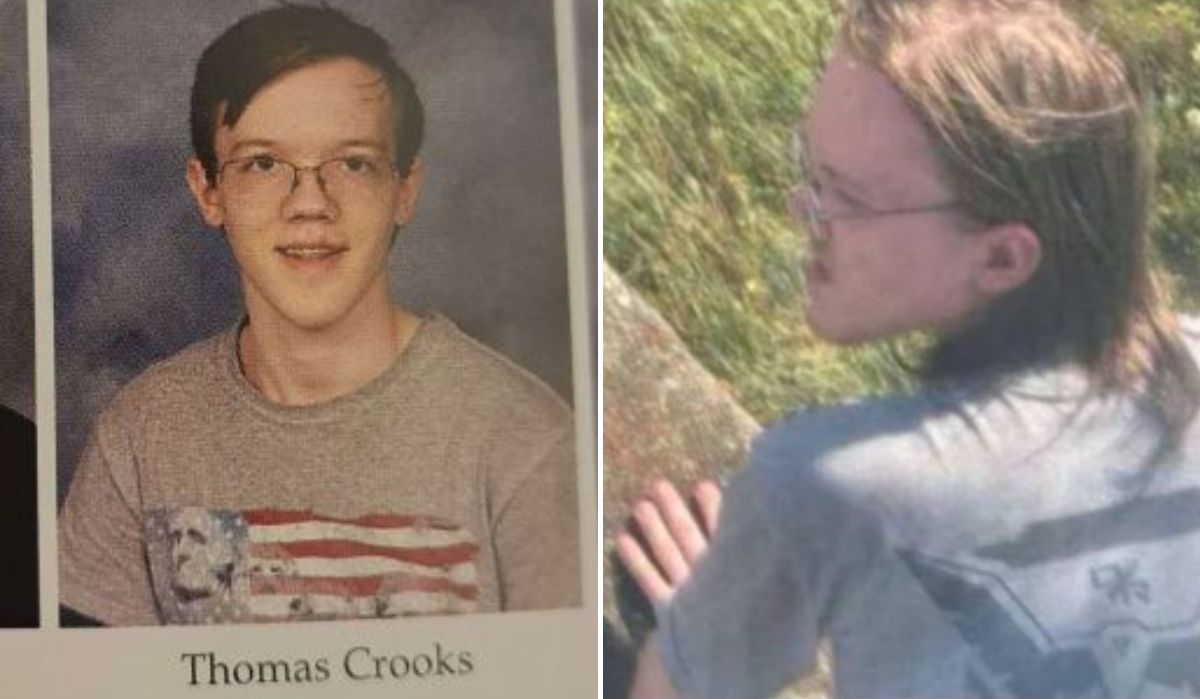
The house on Meridian Road looked like a quiet promise kept. A lawn trimmed to a neat, suburban green. A driveway where a family sedan sat parked with predictable regularity. Inside, the walls held the ordinary echoes of American life: the hum of a refrigerator, the murmur of the evening news, the quiet friction of parents and a son trying to figure out how to coexist in the same breathing space.
Nothing looked broken. In related updates, take a look at: Inside the Pentagon Posture Crisis Nobody is Talking About.
That is the terrifying part of how catastrophe arrives. It does not crash through the front window with sirens blaring. It gathers in the silence. It builds in the spaces between words, in the rooms where nobody is asking the right questions because nobody suspects there is an answer worth looking for.
When the smoke cleared in Butler, Pennsylvania, and the terrifying flash of a sniper's bullet rewrote a July afternoon, the world scrambled for a monster. We wanted horns, or a manifesto dripping in operatic malice, or a history of howling cruelty. Instead, the father sat down with investigators and handed over a description that was far more chilling for its absolute, hollow normality. NPR has analyzed this critical issue in great detail.
He didn't describe a firebrand. He described a vacuum.
His son, the young man who had somehow slipped through the cracks of a middle-class upbringing into the crosshairs of history, had been a ghost long before he ever picked up a rifle. The father remembered a child who never wept. Not when he skinned a knee. Not when he faced disappointment. Not when the world pressed down with the heavy, unavoidable griefs of growing up. He rarely laughed, either. His expressions were flat lines drawn across a canvas of indifference.
To a parent, that kind of quiet can easily be misread. You tell yourself they are introverted. You tell yourself they are deep thinkers, old souls, kids who march to the beat of an internal drum that adults simply cannot hear. We live in a culture that worships the stoic. We reward the quiet kid in the back of the classroom who keeps his head down and causes no trouble. We mistake absence for peace. We mistake emotional starvation for self-sufficiency.
Consider what happens when a mind grows up in total isolation, not from the physical world, but from human resonance.
You can feed a child three meals a day. You can pay for his schooling, buy him clothes that fit, and drive him to the local range. You can check every logistical box of parenthood. But if you never truly touch the interior landscape of his thoughts—if you never force him to look you in the eye and explain what hurts, what angers, or what brings him joy—you are merely managing a tenancy, not raising a human being.
The boy grew up in a digital ecosystem where empathy is ironized and connection is measured in clicks, views, and anonymous forums. In that space, a person can starve to death while sitting right in the middle of a crowded room. The father's memories of an emotionless son are not just an anecdote about one troubled household. They are a mirror held up to a society that has perfected the art of standing shoulder-to-shoulder while remaining entirely invisible to one another.
We want to believe that evil is loud. We want it to wear a neon sign so we can point at it, isolate it, and destroy it before it strikes. But the modern tragedy often wears the hoodie of the boy next door. It looks like someone who sits at the kitchen table, eats his dinner, and says nothing of consequence because the machinery inside his head has already decoupled from the human race.
There is a profound, aching grief in realizing how little you actually know about the people sleeping down the hall.
When the investigators left, the father was left alone with the silence of a house that would never be quiet in the same way again. He had to reconcile the ordinary memories—the sound of footsteps on the stairs, the closed bedroom door, the flicker of a computer screen late at night—with the sudden, irreversible horror of what those quiet hours had produced. The boy who never cried had saved all his tears for a single, cataclysmic explosion of violence that shook a nation.
We spend billions of dollars on security apparatuses, on threat assessments, on predictive policing and digital surveillance. Yet we remain entirely unequipped to measure the weight of an unexpressed emotion. We have no radar for the slow, silent calcification of a human heart.
The door remains half-open down the hall. The light is still on. And somewhere in the dark, another quiet mind is deciding what to do with the silence.


