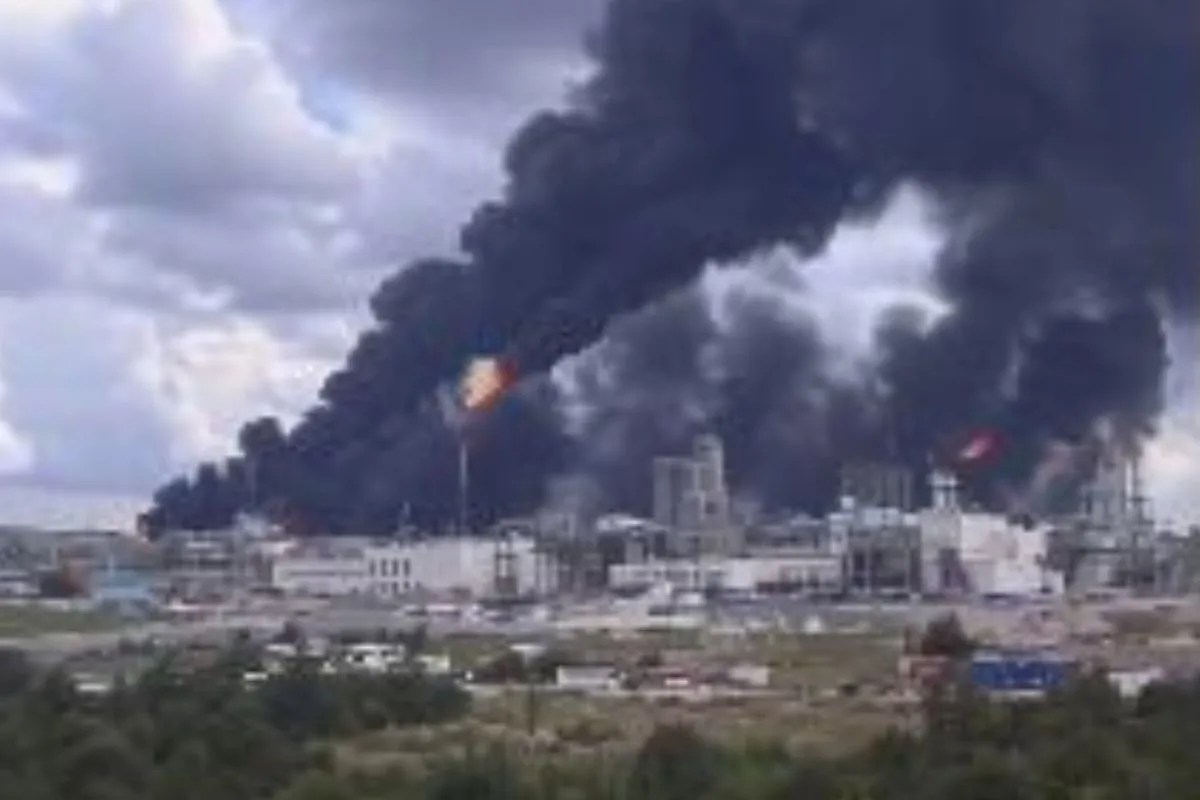
The air in the Amur region does not merely cold; it bites. It presses against the lungs with an icy weight that makes every breath a conscious act.
On that shift, the steel behemoth of the Amur Gas Chemical Plant stretched across the horizon like a metallic city under construction. Pipes thick enough to swallow a car wound through the freezing landscape. Flares burned orange against the twilight.
Then came the rupture.
Silence first. The sudden, unnatural dropping of pressure in the veins of the facility. Then, a roar that tore the frozen night apart, followed by a wall of searing heat that turned the sub-zero wind into a blowtorch.
Seven human beings did not make it home.
Among them, six were citizens of China—engineers, welders, specialists who had traveled thousands of miles across borders, leaving behind quiet kitchens and waiting families, only to find their final moments trapped inside a roaring crucible of petrochemical fire. Thirty-six others woke up in hospital beds, wrapped in gauze, breathing through oxygen tubes, their bodies carrying the permanent signatures of an industrial catastrophe.
We talk about infrastructure as if it were made only of concrete and balance sheets. We look at massive multi-billion-dollar joint ventures between energy giants as abstract triumphs of international engineering.
We forget the flesh.
Consider what happens next in a hospital room hundreds of miles from the blast site, where a survivor stares at a sterile white ceiling. The burns sting, but the silence stings worse. The project timelines, the economic metrics, the raw export capacities—all of those metrics evaporate the moment a human life is snuffed out by a sudden failure of containment.
Industrial progress has a shadow. We rarely look at it until the dark catches up to us.
The Amur Gas Chemical Plant was designed to be a monument of modern processing, a vital artery feeding natural gas derivatives across continents. It is a mega-project of staggering scale, intended to process billions of cubic meters of hydrocarbons annually. But scale breeds vulnerability. When you handle volatile compounds at cryogenic or hyper-heated states, a single microscopic flaw in a valve or a gasket ceases to be a technical error. It becomes an explosive hazard.
I have walked industrial sites enough to know the quiet dread that lingers after a disaster. You smell the scorched insulation days later. You see the eyes of the remaining workers—men and women who walk past the same pipes every morning, wondering silently if their shift will be the one that turns.
Trust is fragile. It shatters much faster than steel.
When the smoke cleared over the Amur site, the investigators stepped in. They sifted through twisted girders and blackened control panels. Reports began to trickle outward—leaks, ignition sources, protocol reviews, safety audits requested too late. Bureaucrats use words like incident and casualty to flatten the jagged edges of tragedy into manageable statistics.
Let us refuse to let those lives be flattened.
Six families in China received news that no phone call should ever deliver. One family in Russia wept for a local worker who also vanished into the flames. Thirty-six households woke up to a changed reality, where rehabilitation will be long, painful, and entirely unglamorous.
No corporate press release can restore a father, a son, a colleague. No insurance payout can rewrite the physics of an explosion that tore through a night shift without warning.
The frost has already returned to the Amur region. The snow falls softly over the charred scaffolding, dusting the twisted metal in white, trying desperately to cover what the fire exposed. But the memory of that heat remains locked in the steel, waiting to see if we have finally learned how to value human life above the relentless drive of the machine.