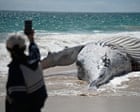
The Indian Ocean breeze usually carries the sharp, clean scent of salt and sun-bleached weed along the Perth coastline. On that particular morning, the air turned heavy, thick with something ancient and decomposing. It was a smell that made people stop fifty yards away, hands flying to their faces, eyes watering against the invisible wall of rot.
A humpback whale, immense and motionless, lay stranded on the shore.
To look at a creature of that magnitude up close is to confront an alien world. In life, they belong to the blue abyss, moving through crushing pressures with effortless grace. In death, stranded on the shallow slope of a public beach, the animal looked impossibly out of place, like a fallen cathedral pillar carved from slate and blubber. The skin, slick and scarred with barnacles and cookie-cutter shark bites, absorbed the morning sunlight rather than reflecting it.
Before the municipal barricades could go up, the crowd gathered.
Human nature splits cleanly in two when faced with a spectacle so morbid and magnificent. Ten feet from the giant tail fluke, a teenager adjusts her posture. She holds her smartphone at arm's length, tilts her chin, and smiles. The whale fills the background, a mountain of dark flesh against the turquoise froth of the surf. Click. A second later, the image is compressed, filtered, and beamed into the digital ether, separated entirely from the reality of what it represents.
A few yards back, an older man stands with his collar pulled up over his nose, shaking his head. He remembers when these waters felt vast and untamed. For him, the stench is not just an unpleasant odor; it is a profound disruption, a reminder of ecological fragility draped across the sand in plain sight. He does not pull out a phone. He simply watches, silent and heavy-hearted, as the flies begin to cloud the air.
This divide tells a quiet story about modern life. We live in an era where tragedy and wonder are mediated through glass screens. When an apex mammal dies and drifts onto a populated shore, it ceases to be solely a biological event. It becomes a photo opportunity, an impromptu tourist attraction, a momentary break from the monotony of the daily commute.
Beneath the spectacle, the physics of decay wait for no one. Marine biologists and local council workers arrive in high-visibility vests, carrying heavy equipment and measuring tapes. They know what the onlookers do not. As internal organs break down under the relentless heat, gases accumulate inside the carcass. A stranded whale is a pressurized system, ticking quietly under the midday sun. The air around the head of the leviathan is shimmering with heat and the unmistakable tang of ammonia.
Crowds push closer. Curiosity always wins over caution until someone notices the skin beginning to stretch taut across the ribcage.
In the water just beyond the breakers, a dorsal fin breaks the surface. Another shadow moves silently through the shallows, drawn by the scent drifting outward on the tide. Nature remains entirely indifferent to the cameras, the murmurs of the crowd, or the municipal workers discussing logistics. The ocean reclaims what belongs to it, one wave at a time, indifferent to whether we are watching through a lens or holding our breath against the wind.