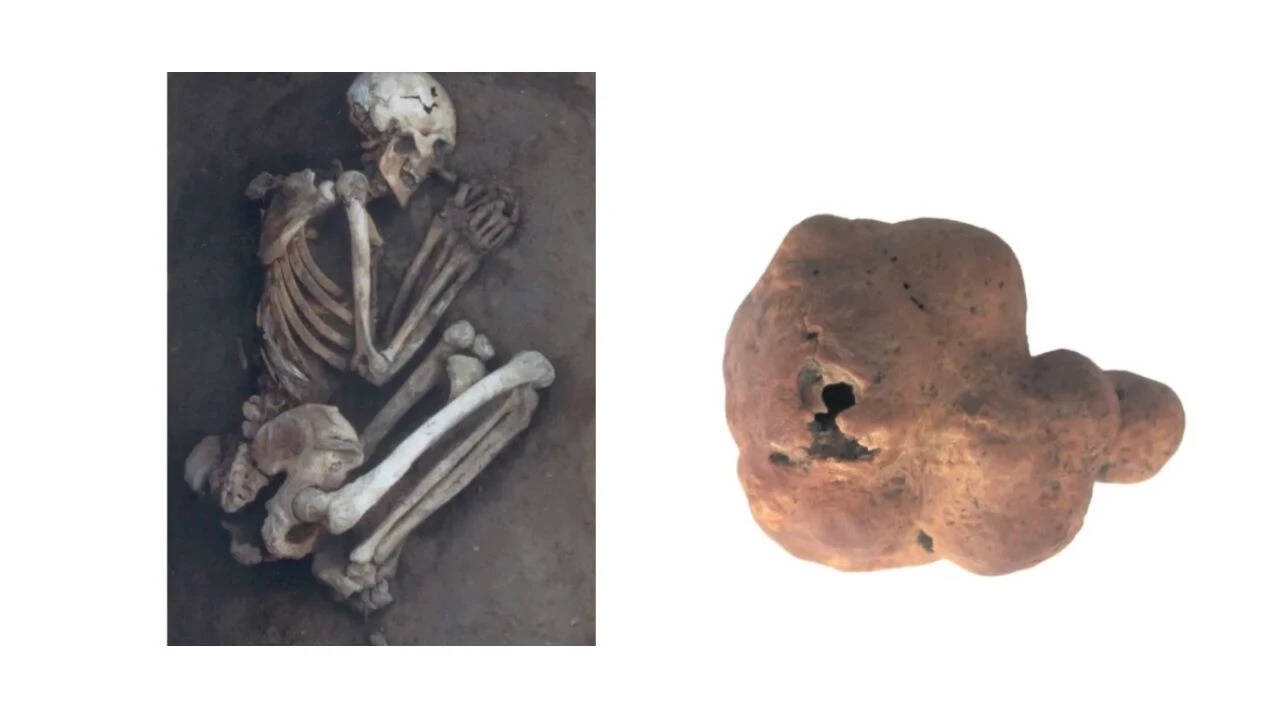
Bones tell stories. They whisper tales of hard labor, healed breaks, and bodies pushed past their absolute limits. But some forms of suffering leave no mark on the skeleton at all. Imagine living five millennia ago with an invisible agony that tortured you every single day, only for modern science to uncover the culprit locked inside your grave.
That is precisely what happened when researchers analyzed the remains of a Bronze Age man buried in a monumental earthen mound, or kurgan, dating back about 5,300 years. Unearthed at the Ipatovo-5 site on the Stavropol Upland in southern Russia near the Black Sea, this individual belonged to the Steppe Maikop horizon of the fourth millennium BC. When anthropologists first looked at his skeleton, they saw a man in his forties who had endured a brutally demanding physical existence. His bones bore the unmistakable scars of heavy pastoral labor, including healed fractures and severe joint wear likely caused by managing livestock and hauling cargo across the unforgiving Eurasian steppe.
Yet the most striking discovery wasn't found on his skeleton. It turned up during meticulous laboratory examinations when scientists noticed a peculiar brownish, knobbly object resting among the bones of his hands.
Measuring roughly 2.1 centimeters across, the object looked uncannily like a dried grape. It had a crystalline interior and multiple small bumps protruding from its surface. At first glance, you might wonder if it was just an accidental pebble swept into the burial chamber by shifting soils. But a team led by Natalia Berezina, an anthropologist at Lomonosov Moscow State University, suspected something far more biological. They published their findings in the journal Archaeological and Anthropological Sciences, detailing an analytical battery that transformed how we view prehistoric health.
What Modern Science Revealed Inside the Ancient Grave
To figure out what the mysterious object actually was, the research team subjected it to seven distinct analytical techniques, including electron microscopy, high-resolution CT scanning, and X-ray diffraction. They weren't guessing. They wanted hard chemical proof.
The scans revealed a complex internal architecture. Crystals had grown outward from multiple distinct centers before fusing into a single solid mass, layer by accumulating mineral layer. When scientists examined the chemical composition, the truth came into sharp focus. The stone was composed primarily of carbapatite, also known as hydroxyapatite, along with whitlockite—a rare calcium phosphate mineral closely tied to bacterial activity.
Crucially, the mineral makeup completely lacked calcium oxalate and uric acid, which are the typical building blocks of stones formed by diet or metabolic issues. Instead, the presence of whitlockite served as a smoking gun. It pointed directly to a chronic, long-standing bacterial infection. This man didn't develop his stone because he ate the wrong foods or drank poor water. He suffered because bacteria colonized his upper urinary tract or prostate, triggering a slow, agonizing accumulation of mineral deposits over years.
Chronic Agony in the Bronze Age
You have to put yourself in his shoes. In an era devoid of antibiotics, surgical interventions, or pain relief, a 2.1-centimeter stone lodged in the urinary tract meant a life sentence of relentless pain. Every movement on horseback or heavy wagon trip across the dusty plains would have jarred his body, exacerbating an infection that likely caused recurrent blockages. If the stone eventually obstructed his ureter completely, it could have triggered severe kidney swelling or lethal sepsis. We don't know the exact moment he died, but we know his final years were defined by profound physical misery.
Soft tissue pathologies like kidney or prostate stones rarely survive the archaeological record. Organic materials and delicate mineral formations usually disintegrate in acidic soils, or they get mistaken for ordinary pebbles and discarded during rough excavations. When ancient stones do survive, they offer rare windows into a world of disease that skeletal analyses completely miss.
Why Soft Tissue Secrets Rarely Survive
This find is not an isolated medical oddity in the grand sweep of archaeology. Researchers previously documented an 8,500-year-old bladder stone inside the remains of a woman buried in Sicily's Uzzo Cave, alongside ancient prostate stones discovered in Sudan dating back roughly 12,000 years. Each discovery chips away at the romanticized myth that ancient humans lived pure, disease-free lives before modern lifestyle factors corrupted our biology. Prehistoric populations battled chronic bacterial infections, metabolic distress, and grinding organ pain just like we do today.
Rethinking Prehistoric Health and Hardship
The real value of discoveries like the Ipatovo kurgan stone lies in how they humanize the past. It is easy to look at ancient history as a procession of cultures, pottery shards, and bronze weapons. We categorize people by their burial rites and economic output. But beneath those cultural labels were flesh-and-blood individuals dealing with mundane, excruciating human problems.
This unnamed herder walked the steppe with a body breaking down under the weight of manual labor and an unyielding infection. He didn't write a diary. He left no written complaints about his failing health. Yet chemistry preserved his agony for over five millennia, turning a tiny mineral deposit into a profound testament to endurance. Next time you complain about a minor ache, remember the man from the southern Russian steppe who carried a grape-sized stone across a lifetime of open plains.