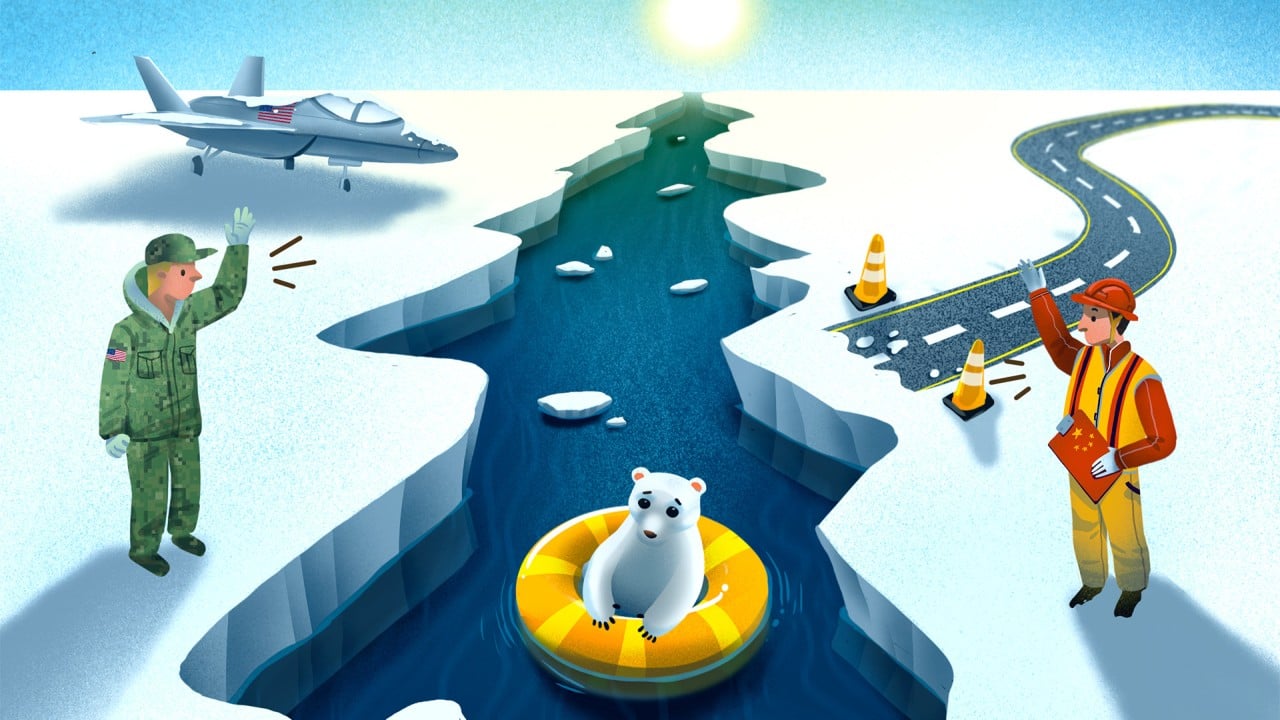
The Arctic is melting twice as fast as the rest of the planet and that's not just an environmental disaster. It's a geopolitical powder keg. If you think the South China Sea is tense, wait until you see what happens when the ice disappears in the Far North. Washington and Beijing are currently on a collision course over a region that used to be a frozen afterthought.
Climate change is literally carving out new shipping lanes and exposing trillions of dollars in untapped minerals. For the United States, the Arctic is a backyard that needs guarding. For China, it’s the "Polar Silk Road," a shortcut to European markets that bypasses the messy bottlenecks of the Malacca Strait. But here’s the problem. China isn't even an Arctic nation. It’s a "near-Arctic state," a self-appointed title that makes officials in D.C. and Ottawa roll their eyes.
This friction isn't just about ice. It’s about who owns the future of global trade. Whether these two superpowers can actually sit at the same table to manage this melting frontier remains the biggest question of the decade. Right now, it looks like they're choosing a cold shoulder over cold-weather cooperation.
Why China is Obsessed with the High North
China doesn't have a single inch of Arctic coastline. That hasn't stopped them from pouring billions into icebreakers and research stations. You’ve got to understand the motivation here. It’s about energy security and speed.
The Northern Sea Route along Russia’s coast can shave weeks off a trip from Shanghai to Rotterdam. In a world where supply chains are fragile, that time is literal gold. Beijing’s 2018 White Paper on Arctic Policy made their intentions clear. They want a seat at the table where the rules are made.
They’re playing the long game. By investing in Russian liquified natural gas projects like Yamal LNG, China is securing its energy future while the West tries to freeze Russia out. This creates a weird dynamic. Russia needs Chinese cash to develop its northern frontier, and China needs Russian permission to use the waters. The U.S. sees this "no-limits" partnership as a direct threat to the established order of the Arctic Council.
The American Pivot to the Ice
For years, the U.S. basically ignored the Arctic. We had one or two working icebreakers while Russia had dozens. That’s changing fast. The Pentagon's updated Arctic Strategy focuses on "integrated deterrence." Basically, that’s military-speak for "we’re watching you."
We’re seeing more joint exercises in Alaska and Norway. The U.S. is worried that Chinese "scientific research" is actually a cover for underwater surveillance. If Beijing maps the Arctic floor, their submarines can hide better. It’s a classic security dilemma. Every time the U.S. moves a destroyer north, China and Russia call it provocation. Every time China builds a new heavy icebreaker, the U.S. sees a future warship.
The tension isn't just military. It's about the rules of the sea. The U.S. insists the Northwest Passage and the Northern Sea Route are international waters. Canada and Russia disagree. China is watching this closely. If they can set the precedent in the Arctic that "international" means "open to us," they can apply that same logic elsewhere.
Science as the Last Remaining Bridge
Is there any hope for cooperation? Maybe. The Arctic Council used to be the gold standard for "Arctic Exceptionalism," the idea that this region was too harsh and too important for petty politics. That fell apart when Russia invaded Ukraine. The Council hit a massive speed bump, and while it's moving again, things aren't the same.
Scientific data is the one thing everyone needs. You can't predict global sea-level rise without knowing what's happening to the Greenland ice sheet. You can't manage fish stocks that are moving north as the water warms without shared data.
- Climate Monitoring: Both nations have top-tier satellite programs.
- Emergency Response: If a massive cruise ship or tanker sinks in the Arctic, nobody has the resources to handle it alone.
- Black Carbon: Reducing soot that melts ice is a win-win for everyone’s climate goals.
But even here, trust is bottoming out. When the U.S. bans Chinese tech in its research infrastructure, the data sharing stops. When China refuses to be transparent about its dual-use technology, the collaboration dies. It’s a cycle that’s hard to break.
The Resource Trap and Indigenous Rights
We often talk about these countries like they’re the only ones that matter. They aren't. There are four million people living in the Arctic, including many Indigenous communities. These people are on the front lines. Their permafrost is melting under their houses.
China’s hunger for minerals like nickel, copper, and rare earths drives them to seek mining deals in places like Greenland. To some locals, Chinese investment looks like a way to gain economic independence from colonial powers. To the U.S., it looks like a debt trap that could lead to a Chinese military base on Greenland's soil.
Remember the 2019 drama when the U.S. offered to buy Greenland? It sounded like a joke, but the intent was serious. Washington wants to keep Beijing’s checkbook away from the North American Arctic at any cost. This puts smaller Arctic players in a tough spot. They need the money, but they don't want to become pawns in a new Cold War.
Environmental Collapse vs Economic Opportunity
The irony is thick here. The very thing that's making the Arctic profitable—the melting of the ice—is a signal of global catastrophe. We're arguing over who gets to drill for the oil that caused the melting in the first place.
If the U.S. and China can’t agree on basic environmental standards for the Arctic, the damage will be permanent. Black carbon emissions from increased shipping will accelerate the melt. Unregulated fishing will wipe out stocks before we even know they’re there.
There’s a small window where "Arctic Exceptionalism" could return. It would require the U.S. to accept China as a legitimate stakeholder in specific scientific and environmental areas. It would require China to stop its aggressive "near-Arctic" posturing and respect the sovereignty of the actual Arctic states. Honestly, neither side seems ready to blink.
How to Track the Cooling Relations
You shouldn't just take my word for it. Watch the specific markers of tension. If you want to know which way the wind is blowing, look at these three things.
First, keep an eye on the Icebreaker Gap. If the U.S. Congress continues to stall on funding the Polar Security Cutter program while China launches its third or fourth vessel, the power dynamic shifts. China will have the physical capability to dictate terms in the ice.
Second, watch Greenland's elections. Any shift toward pro-investment parties usually means a backdoor for Chinese infrastructure. The U.S. response to those deals will tell you exactly how high the "Red Line" is drawn in the North.
Third, look at the satellite imagery of the Svalbard archipelago. It’s a demilitarized zone under the Svalbard Treaty, but it’s a hotbed for "research" that looks a lot like signal intelligence.
The Arctic isn't a vacuum. It’s a mirror. Whatever is happening in the South China Sea or over Taiwan eventually shows up in the ice. If we can't find a way to cooperate on a melting planet, we’re not just looking at a chill in diplomacy. We’re looking at a permanent freeze.
Start paying attention to the Bering Strait. It's the narrow neck of water between Alaska and Russia. It’s becoming the new frontier of global surveillance. If you're invested in global shipping or energy, you need to track the Arctic Council’s meeting notes. They’re usually dry, but that’s where the real boundaries are being drawn. If the U.S. and China can’t even agree on a joint search-and-rescue protocol, then you know the relationship is truly under the ice.