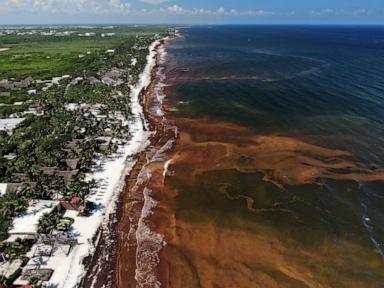
Record levels of sargassum seaweed are choking Caribbean and Gulf of Mexico beaches, turning once-pristine turquoise coastlines into rotting, sulfur-smelling brown barriers that threaten local tourism economies and coastal ecosystems. Walk down any stretch of sand from Cancun to Barbados during peak arrival season, and you will not find the postcard-perfect shores promised by travel brochures. You will find mounds of golden-brown macroalgae piled meters high, decomposing under a merciless tropical sun, emitting hydrogen sulfide gas, and driving away the very visitors who sustain the regional economy.
This is not a seasonal nuisance that can be swept away by morning clean-up crews with rakes. This is a massive, permanent ecological shift driven by changing ocean currents, nutrient runoff, and rising sea temperatures. The Great Atlantic Sargassum Belt now stretches thousands of miles across the ocean, acting as a floating rainforest of seaweed that refuses to die quietly.
The Anatomy of a Floating Crisis
To understand why the shores of the Caribbean and the Gulf of Mexico are drowning in vegetation, look far out into the open Atlantic. Historically, sargassum lived a relatively quiet life trapped within the swirling gyre of the Sargasso Sea. Unlike most other seaweeds, sargassum is entirely pelagic. It never touches the ocean floor. It reproduces vegetatively, doubling its biomass every eleven to eighteen days under the right conditions, floating freely on the surface buoyed by small, gas-filled bladders.
Around 2011, something shifted fundamentally in the oceanographic machinery. Massive plumes of sargassum began breaking away from their traditional confines, catching equatorial currents, and proliferating explosively across the Central Atlantic.
Scientists point to a lethal combination of factors fueling this expansion. Agricultural runoff laden with nitrogen and phosphorus pours down the Amazon and Mississippi rivers into the ocean, acting as a massive aquatic fertilizer. Upwelling events bring deep, nutrient-rich water to the surface. Pair these nutrient injections with warming ocean temperatures caused by climate change, and you have an incubator operating at maximum capacity.
The seaweed feeds on chaos. Every tropical storm churns the water, mixing nutrients and spreading fragments. Every hectare of deforested land in the Amazon basin that washes downriver feeds the next coastal wave hitting the beaches of Tulum, Playa del Carmen, and Punta Cana.
The Economic Shocks on Tourism
Hotels and resort operators face an existential financial drain. When millions of tons of sargassum wash ashore, the economic ripple effects hit instantly. Tourists cancel reservations. Review sites fill up with photographs of brown sludge and complaints about the toxic rotten-egg smell of hydrogen sulfide.
Local governments spend tens of millions of dollars annually scraping beaches with heavy machinery. Tractors scoop up the sand along with the seaweed, eroding the beaches further and destroying the nesting habitats of endangered sea turtles. The physical removal process is expensive, inefficient, and often counterproductive.
Workers wearing respirators clear the shoreline at dawn, only for a fresh tide of seaweed to roll in by noon. The cost of labor, specialized marine harvest vessels, and offshore barrier nets cuts straight into profit margins. Smaller boutique hotels lacking corporate financial backing face bankruptcy. The tourism model upon which entire island nations depend is cracking under the weight of an unwelcome pelagic tide.
Marine Life Caught in the Trap
While the focus remains heavily on the visual and olfactory assault on the beaches, the marine ecosystem suffers far worse out at sea.
As vast mats of sargassum drift toward the coast, they block sunlight from reaching coral reefs below. Smothered corals bleach and die. Turtle hatchlings attempting to crawl out to sea become entangled in the dense vegetative mesh and perish.
Paradoxically, sargassum out in the open ocean serves a vital ecological purpose. It provides a crucial habitat, feeding ground, and nursery for juvenile fish, crabs, sea turtles, and eels. The problem arises when these massive rafts encounter shallow coastal waters. Trapped against the shore, the dense mats deplete the water of oxygen as they decompose, creating suffocating dead zones where fish wash up by the thousands.
When the algae rots on the beach, it leaches heavy metals—including arsenic and cadmium absorbed from polluted waters—into the sand and coastal water table. This introduces severe public health concerns that go far beyond a ruined beach vacation.
Why Conventional Solutions Are Failing
Governments and resort conglomerates have thrown capital at the problem with little strategic coordination.
Nearshore barrier nets deployed to divert the seaweed often fail during high-energy wave events or trap marine wildlife. Offshore harvesting ships are expensive to operate, burn massive amounts of fossil fuel, and can only capture a fraction of the incoming biomass. Burying the seaweed on inland land sites risks contaminating groundwater with salt and heavy metals. Composting is complicated by the high salt content of the algae, which stunts plant growth unless the material is thoroughly washed.
Entrepreneurs attempt to convert the crisis into a commodity. Small enterprises harvest sargassum to produce organic fertilizers, livestock feed, bricks, and paper products. While these initiatives showcase ingenuity, they barely scratch the surface of the problem. When millions of tons of biomass arrive daily, processing a few truckloads amounts to emptying an ocean with a teaspoon.
The Trajectory Ahead
The sargassum surge is not a temporary anomaly or a bad weather year. It represents the new baseline for tropical coastlines across the Western Hemisphere.
Ignoring the root causes while treating the symptoms on the beach is a losing game. True mitigation requires international cooperation upstream, tackling agricultural runoff at the continental scale, and implementing aggressive carbon reduction strategies to cool ocean temperatures. Until international bodies treat pelagic macroalgae blooms as a major transboundary environmental disaster rather than a localized hospitality inconvenience, the Caribbean and Gulf of Mexico will remain at the mercy of the tide.
The next wave is already forming off the coast of West Africa, drifting slowly across the Atlantic on a collision course with the shore.