Ice is quiet until it breaks.
Up in the high north, where the thermometer drops deep into regions of existential silence, the permanent white is turning to water. For generations, the Arctic was locked behind a frozen vault door. It was nature's ultimate barrier, a hostile, jagged expanse of multi-year pack ice that kept armies, oil rigs, and container ships at a respectful distance. Nothing lived there easily. Nothing passed through it quickly.
That vault is swinging open.
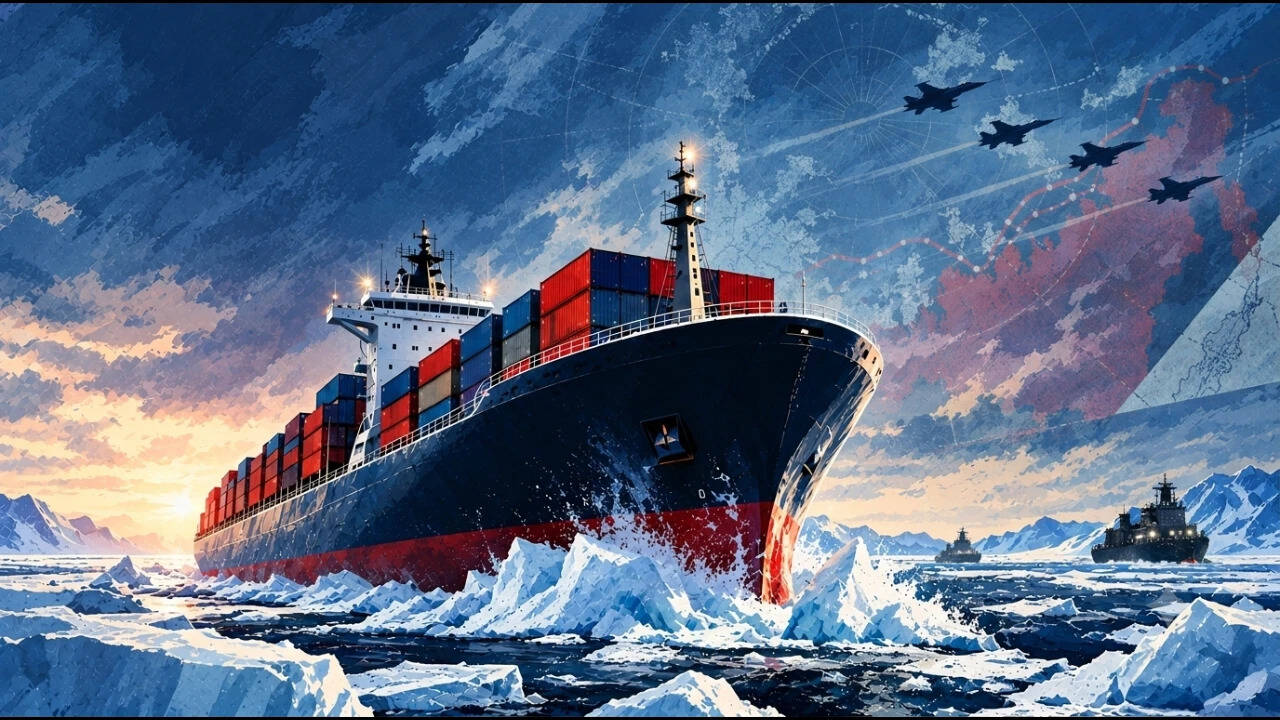
Consider what happens next: a shortcut forms. What used to take a grueling thirty-day detour around the Suez Canal—burning thousands of tons of heavy bunker fuel while dodging the geopolitical flashpoints of the Middle East—now cuts straight across the roof of the world. The Northern Sea Route. It sounds like a ghost story whispered by old whalers, but it is fast becoming the maritime highway of the twenty-first century.
And at the edge of this newly liquid world sits Russia.
For centuries, Moscow has looked at its northern coastline not as a frontier, but as an iron wall. It was frozen solid for most of the year, useless for trade, impossible to patrol. Today, that freezing wasteland is transforming into a maritime balcony overlooking the Atlantic and the Pacific. Underneath those receding sheets of ice lie colossal, untouched treasuries of natural gas, crude oil, and rare earth minerals. Trillions of dollars in raw wealth, locked in the dark for millennia, are slipping out of the deep freeze.
To understand what this means, imagine a Siberian port city like Murmansk. Winter air here does not just bite; it burns. A local fisherman looking out over the Barents Sea sees a horizon that is changing faster than human memory can track. The ice edge retreats a little further north every single season. The winter ice pack is thinner. The storms are stranger, wetter, and more volatile.
The Russian state sees opportunity in that chaos. Moscow has spent billions pouring concrete into the Arctic permafrost, building deep-water ports, and assembling the world's only fleet of nuclear-powered icebreakers. These massive floating monoliths plow through frozen seas like iron battering rams, carving lanes through solid ice so that liquefied natural gas tankers can glide unbothered from Yamal toward the eager ports of Asia.
Wealth flows north. Power follows wealth.
Yet geography is a cruel master. You cannot open a new door without letting the neighbors look inside.
As the ice vanishes, the strategic isolation that protected Russia’s northern flank for hundreds of years vanishes with it. For the Kremlin, the melting Arctic is a double-edged sword dripping with irony. The very warming that enriches the treasury also dissolves the natural moat that kept foreign navies away.
Enter the North Atlantic Treaty Organization.
For decades, NATO’s northern gaze was fixed on specific bottlenecks and conventional flashpoints. Now, the alliance is waking up to a stark reality. The roof of the world is no longer a no-man's-land. It is a strategic high ground.
Look north toward the Scandinavian peninsula. Look at Finland and Sweden, nations that hugged neutrality for generations like a warm wool coat until the shifting tectonic plates of global security forced them to rip it off. They joined the alliance. Suddenly, the Baltic Sea is practically a NATO lake. More importantly, the geopolitical architecture of the Arctic has been redrawn overnight.
Norway, sitting on the roof of Europe, watches Russian strategic submarines slip out of their bastions in the Kola Peninsula into the open waters of the Norwegian Sea. Every movement is tracked. Every patrol is met with a quiet, tense shadow.
When a superpower gains access to unprecedented shipping lanes and energy deposits, it feels compelled to defend them. And when that superpower is Russia, militarization follows the shipping lanes as surely as smoke follows fire. Moscow is reopening Soviet-era Arctic bases, stringing together a necklace of radar installations, surface-to-air missile batteries, and specialized Arctic infantry brigades along its northern littoral.
NATO cannot ignore this buildup. To do so would be to cede control of the globe's shortest maritime transit corridor and a massive chunk of its future energy supply.
So the alliance is stepping closer.
Patrol aircraft hum through the freezing stratosphere off the coast of Iceland. Nuclear submarines play high-stakes games of hide-and-seek beneath the polar ice cap, navigating complex thermal layers where sonar bounces off melting freshwater plumes. Exercises involving tens of thousands of troops take place in the snow-choked valleys of northern Norway, teaching soldiers how to keep rifle mechanisms from freezing solid at minus forty degrees.
The friction is subtle, but it is constant. A radar ping here. An intercepted bomber there. A diplomatic protest filed in the quiet corridors of Geneva or Brussels.
We are watching the rewriting of global trade and global defense play out in real time across a canvas of white and blue. The climate crisis is often discussed in terms of ecological tragedy—and rightly so, as coastal cities flood and ancient ecosystems unravel. But in the boardrooms of Moscow, Washington, and Beijing, it is also calculated as a brutal exercise in realpolitik.
The ice was a great equalizer. It kept the Arctic quiet.
Now, the silence is breaking. The tankers are moving. The missiles are being positioned. And the northernmost frontier of human civilization is becoming the most dangerous chessboard on Earth.