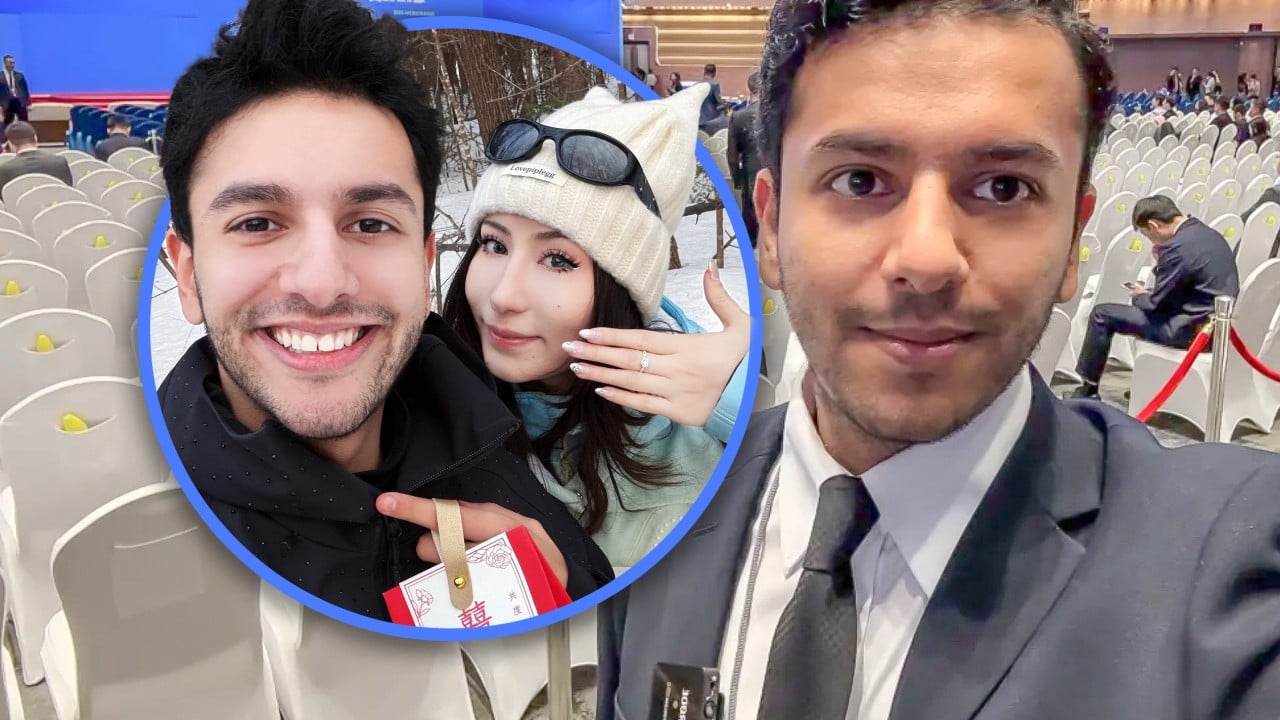
When Ameer Al-Mousawi, an Iraqi journalist who spent his formative years in China, announced his engagement to a woman from Xinjiang, the internet did what it usually does with cross-cultural romance. It turned it into a spectacle. The viral footage of Ameer dancing, a blend of Middle Eastern rhythm and Chinese cultural fluency, served as the perfect visual hook for a story that, on the surface, looks like a simple modern fairy tale. But look closer. This isn't just about a wedding. This is a case study in a new kind of demographic and cultural integration that is reshaping how the world views the volatile intersections of the Arab world and Western China.
Ameer represents a specific, growing class of "global citizens" who are not Western-educated. He is a product of the Chinese education system, a man who speaks Mandarin with the cadence of a local and understands the nuances of the Chinese social contract better than most foreign diplomats. When he chose to marry a woman from the Xinjiang Uyghur Autonomous Region, he didn't just pick a partner. He inadvertently stepped into the center of a massive, state-backed narrative about ethnic unity and the success of the "Silk Road" project.
The engagement is a masterclass in organic soft power. While governments spend billions on PR campaigns to convince the world that their regions are stable and welcoming, a single video of a popular Iraqi figure embracing Xinjiang traditions does more heavy lifting than a thousand white papers. It presents a lived reality that contradicts the stark, often grim headlines found in international geopolitical reporting.
The Baghdad to Beijing Pipeline
To understand why this engagement matters, you have to understand the journey of the man behind it. Ameer Al-Mousawi moved to China as a child. He grew up in the 1990s and 2000s, a period when China was transitioning from a manufacturing hub into a global superpower. For an Iraqi family, China offered something the post-2003 Middle East could not: predictable stability and an upwardly mobile future.
Ameer’s fluency in the language and culture allowed him to bridge a gap that few can. He became a bridge-builder, not through formal policy, but through media. By the time he became a journalist, he was already a recognizable face. His viral "dance" wasn't a calculated move; it was the natural expression of a man who exists in two worlds at once. When he performs, you see the Iraqi soul expressed through a Chinese lens. This is the "why" that most superficial reports miss. It isn't just a dance. It is a physical manifestation of a successful cultural transplant.
For the Chinese audience, Ameer is the "ideal" foreigner. He is someone who has "eaten the bitterness" of learning the culture and has come out the other side as a champion of it. His engagement to a Xinjiang woman provides a neat, emotional coda to that journey. It signals to the public that the integration is complete. He isn't just visiting; he is staying. He is building a family. He is investing his genetic and emotional future into the soil.
Xinjiang as the New Frontier of Lifestyle
The choice of a bride from Xinjiang is particularly loaded with meaning. For years, the region has been viewed through a strictly political lens. Whether it is human rights discussions in the UN or infrastructure debates regarding the Belt and Road Initiative, Xinjiang is rarely discussed as a place where people simply fall in love and get married.
By centering a high-profile engagement in this region, the narrative shifts from politics to lifestyle. It humanizes a territory that has been abstracted by global conflict. The imagery of the engagement—the traditional dress, the specific customs of the region, the festive atmosphere—serves to normalize Xinjiang as a destination of beauty and tradition.
This isn't to say the political tensions don't exist, but for the average viewer in Cairo, Dubai, or Shanghai, those tensions are secondary to the visual of a happy couple. The "how" of this story is found in the algorithm. Short-video platforms like Douyin and TikTok have a ravenous appetite for "wholesome" cross-cultural content. When an Iraqi man dances in Xinjiang, the algorithm pushes it to millions because it hits every high-engagement note: exoticism, romance, talent, and a "feel-good" resolution.
The Economics of the Influencer Marriage
In the modern media economy, a marriage is also a business merger. Ameer is a journalist and an influencer. His new partner, by association, becomes a part of that brand. Together, they represent a demographic that advertisers are desperate to reach: the young, mobile, culturally fluid population of the "Global South."
Consider the trade routes. Iraq is a massive market for Chinese goods and infrastructure. Xinjiang is the gateway to the West. A couple that embodies the union of these two points is a walking billboard for the Silk Road. They represent the human side of trade deals. They make the abstract concept of "Eurasian integration" look like a wedding party.
We are seeing a shift where individual stories are being used to bypass traditional news filters. If a Western outlet publishes a critical report on Xinjiang, the counter-narrative isn't just a government spokesperson anymore. It’s a video of Ameer and his fiancée eating local food, laughing, and showing a version of the region that feels authentic because it is personal. This is far more effective than any official broadcast because it leverages the trust viewers have in personalities they have followed for years.
Cultural Fluency as a Survival Skill
Ameer’s story highlights a harsh truth for those who refuse to adapt: in the coming decades, "cultural fluency" will be the most valuable currency in the world. Being able to speak a language is a basic skill. Being able to inhabit a culture—to dance its dances, understand its humor, and marry into its families—is a power move.
Ameer isn't an outlier; he is a precursor. As China continues to expand its influence through the Middle East and Africa, we will see more "Ameers." We will see more children of the diaspora who return to their ancestral homes or stay in their adopted ones, acting as the connective tissue between civilizations that are often at odds.
The engagement isn't just a win for the couple; it's a win for the idea that people can be more than their passports. It challenges the "clash of civilizations" theory by offering a "fusion of civilizations" alternative. It’s messy, it’s loud, it’s performed for the cameras, but it is undeniably happening.
The Unspoken Friction
Of course, no story is this perfect without some underlying friction. The "viral" nature of their relationship puts an immense amount of pressure on the couple to remain symbols. They are no longer allowed to just be two people. They are "The Iraqi Reporter and the Xinjiang Bride." If the marriage fails, it isn't just a personal tragedy; it's a PR blow to the narrative they have come to represent.
Furthermore, there is the question of authenticity. How much of this is a genuine personal choice, and how much is influenced by the rewards the digital ecosystem offers for this specific type of content? In a world where "intercultural couple" is a profitable niche, the line between private life and public performance becomes dangerously thin.
They are navigating a path where their every move is scrutinized by both supporters of the "One Belt, One Road" ideology and skeptics of the region’s governance. It is a tightrope walk performed in wedding shoes.
Beyond the Viral Dance
The dance that made Ameer famous was a moment of joy, but the engagement is a moment of commitment. It signals a move away from the ephemeral nature of "viral content" toward the permanence of institution-building.
In the grander scheme of geopolitics, this engagement is a footnote. But in the history of how cultures actually interact—on the ground, in the streets, and in the home—it is a significant chapter. It tells us that despite the rhetoric of decoupling and trade wars, the human instinct to connect and integrate remains the most powerful force on the map.
The "New Silk Road" isn't just made of asphalt and fiber-optic cables. It is made of people like Ameer who have decided that the distance between Baghdad and Urumqi is a distance worth closing.
This is the reality of the 21st century. The borders are hardening in some places, but in the hearts of those who have grown up between worlds, the lines have already blurred. The wedding will be a celebration of that blurring. It will be loud, it will be filmed, and it will be shared by millions who want to believe that love can bridge the gaps that politics only widens.
As the cameras flash and the videos upload, the message is clear: the future belongs to those who can dance in both worlds.
Find a way to speak the language of your neighbor, or risk becoming a ghost in a world that is moving on without you.