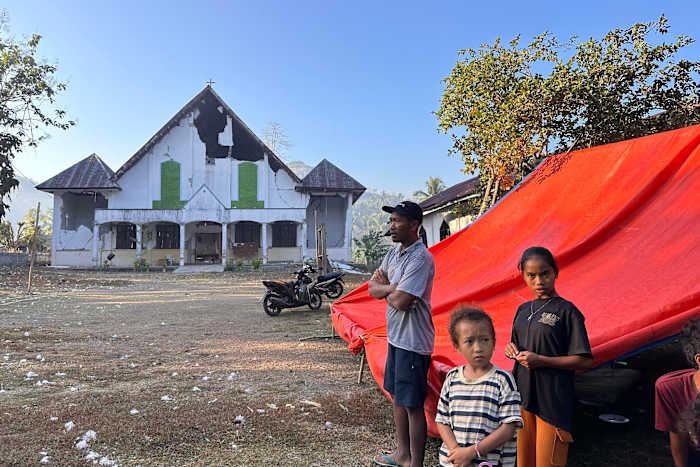
Dawn on the island of Flores usually arrives like a slow wash of gold over the volcanic ridges of East Nusa Tenggara. The air smells of wet earth, woodsmoke, and the heavy, sweet promise of coffee flowers. But on a Saturday morning just before six, the morning did not break. It shattered.
The earth beneath Lamba Leda woke up first, twisting with a violent, predatory roar that ripped through timber beams before families could even rub the sleep from their eyes.
Consider Vincentius Rano. He is a father. When the world began to liquefy beneath his modest wooden home, his instincts bypassed thought entirely. The tremors multiplied in intensity with terrifying speed.
"Suddenly, we felt a tremor that kept getting stronger," Rano would later recount, his voice catching on the memory.
There was no time to run. No open door to freedom. As the roof timbers buckled and groaned overhead, Rano did the only thing a parent can do when physics turns malicious. He arched his own body over his wife and their five-year-old daughter, turning his spine into a shield against a rain of falling lumber. The house collapsed, shattering his shoulder and bruising his back, but his family breathed. They survived the initial blow.
Yet surviving the fall is only the first chapter of a much longer catastrophe.
Across the island of Flores, the mathematics of ruin are staggering, even if numbers alone fail to capture the human cost. According to the National Disaster Management Agency, more than 40,000 people now live beneath blue plastic tarps and inside crowded evacuation camps. At least 70 lives were extinguished in the chaos, while nearly 1,200 others carry injuries ranging from crushed limbs to deep lacerations. Nearly 12,000 homes have been reduced to matchsticks and rubble.
The statistics extend outward like ripples in poisoned water. Across the regencies, 658 schools stand empty and fractured. One hundred and seventy-two health facilities are out of commission. Places of worship, local offices, and community hubs have all been compromised.
Indonesia sits squarely on the Pacific Ring of Fire, an unrelenting tectonic crucible where more than 17,000 islands are constantly jostled by the friction of continental plates. Earthquakes are an inherited reality here. People grow up knowing the ground can turn liquid. They build homes of lighter timber precisely because concrete is a death sentence when the earth shakes.
Even so, habit does not equal immunity.
Shaking stops, but terror lingers. The U.S. Geological Survey logged the main shock at a shallow depth of just 10 kilometers, amplifying its localized fury. In the days that followed, the earth refused to settle. Authorities recorded more than 2,100 aftershocks. Most were microscopic shudders felt only by sensitive seismographs, but at least 70 hit hard enough to rattle teeth and raw nerves.
Every single aftershock acts as an invisible re-trigger.
Imagine sitting in a makeshift tent on a humid afternoon, trying to explain to a foreign journalist what happened to your village. Imagine the earth giving a sudden, sharp jerk beneath your folding chair.
That exact scenario played out for Rano. Mid-sentence, an aftershock cracked through the hills. In less than a millisecond, Rano and his wife dropped, ducking low and locking their hands over their heads in a conditioned reflex of pure survival. Instantly, their little girl began to wail. The physical shaking lasted only a second, but the psychological earthquake re-opened every wound.
This is the hidden crisis unfolding beneath the tarps of East Nusa Tenggara. The physical rebuilding of concrete and timber can be measured in bricks and currency. The invisible fractures inside the minds of children are infinitely harder to mend.
In the camps, thousands of children play quiet games under blue canvas roofs. They stack plastic cups. They flip through donated picture books. They try to look small and invisible. But parents report a chilling behavioral shift: the children refuse to step indoors. Nightfall brings a blanket of dread. When minor tremors ripple through the dark, the children wake up screaming, convinced the sky is falling down again.
To combat this silent epidemic, emergency responders have shifted tactics. Police officers and volunteer mental health workers have traded standard administrative duties for psychological first aid.
Police Chief Yudhi Franata coordinates trauma-healing sessions across the affected regencies. Officers like Mieke Suharni deploy specialized calming methods, such as the Universal Spiritual Emotional Freedom Technique, guiding weeping survivors through patterned breathing and self-soothing touch.
"We are trying to help people manage their fear step by step," Suharni explains, wiping sweat from her brow amidst the din of the camp. "Some survivors continue to experience anxiety and excessive fear. Our goal is to help calm that trauma so they can begin to recover."
You cannot put a cast on a shattered sense of safety. You cannot stitch a nervous system back together with surgical thread.
The children of Flores are learning a bitter lesson too early in life: that the ground beneath our feet, the ultimate symbol of stability and permanence, can betray us without warning.
Out in the hills of Lamba Leda, the wind rustles through toppled trees and twisted sheets of corrugated iron. A group of children sits in a circle on a woven mat, rolling a soccer ball back and forth under the watchful eye of a volunteer. For a few minutes, someone laughs. A small smile breaks through the dust on a little girl's cheek. The ball rolls back. The circle holds. Beneath them, the planet stays quiet, waiting for the next turn of the wheel.