Dirt gets under your fingernails and stays there for days, a permanent crescent of dark soil that refuses to leave no matter how hard you scrub with pumice. That is the first thing they do not tell you. You can wear the thickest leather gloves forged in the fires of industrial catalog warehouses, but the earth finds a way inside. It clings to your cuticles, it settles into the creases of your palms, and long after the sun dips below the horizon and the garden tools are hung back up in the shed, you smell like wet loam and ambition.
Weighing a thousand pounds of orange flesh on a damp morning in Manitoba is an exercise in quiet absurdity.
Imagine standing in a small municipal arena or a crowded fairground parking lot, surrounded by the smell of diesel exhaust, funnel cake, and damp wool. A heavy-duty gantry crane hovers overhead. Steel chains wrap carefully around a spherical mass the size of a small car. The air is thick with anticipation, the kind of breathless silence that usually precedes a penalty kick or a courtroom verdict. Someone coughs. A camera shutter clicks once, twice, a mechanical stutter cutting through the murmur of the crowd.
Then the winch engages.
The cables go taut. A low groan of stressed metal echoes through the morning air. Slowly, almost reluctantly, the earth lets go. The giant pumpkin lifts inches off the flatbed trailer, swinging slightly in the autumn wind, heavy and dense and entirely improbable.
Records fall. Cheers erupt. But nobody talks about the June frost that nearly killed the vine in its infancy. Nobody talks about the cracked stems patched together with surgical tape and prayer.
Growers will tell you it is about genetics, about Atlantic Giant seeds passed down through underground networks like prized velvet currencies. They talk about seed lines out of Nova Scotia or Ohio, lineages tracked with the obsessive detail of thoroughbred racing studs. You buy a seed for twenty dollars, or a hundred, or sometimes trade it for a favor whispered over a fence line. You plant it in soil enriched with aged manure, kelp meal, and microscopic fungi that form symbiotic webs around the taproot.
Yet science is only half the battle. The rest is pure, unadulterated vigilance.
During the peak of the growing season in July and August, an Atlantic Giant vine can drink upwards of four hundred gallons of water a week. It expands so fast you can almost hear the cells tearing open, stretching outward in a desperate race against the frost. A grower’s life shrinks to the perimeter of a patch. You wake up at two in the morning because the humidity dropped and powdery mildew might be creeping onto the leaves. You pull out a flashlight, drop to your knees in the damp grass, and check the underside of a canopy the size of a master bedroom.
There is an intense, singular loneliness to it. While the rest of the world scrolls through news feeds and rushes to morning meetings, you are sitting on a overturned bucket in the middle of a patch, holding a tape measure, tracking a circumference gain of four inches in a single twenty-four-hour window.
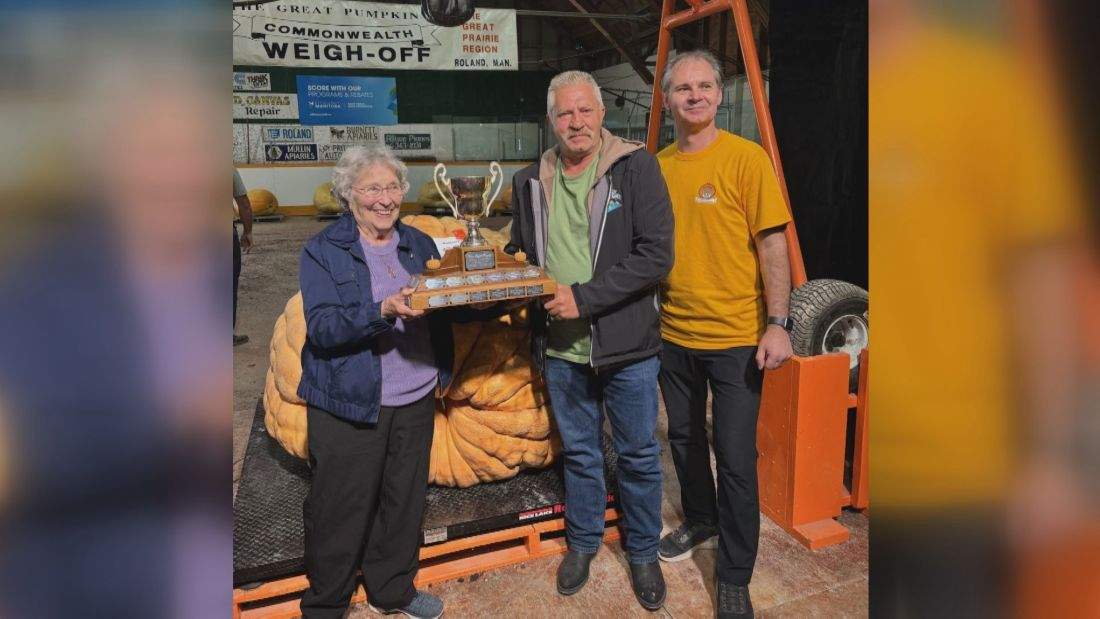
When the news broke at the Manitoba agricultural fair that a new record had been smashed, the headlines in the local paper captured the cold numbers. They listed the weight in pounds, the name of the grower, the town of origin. It read like a municipal shipping manifest. Giant pumpkin squashes competition, sets new record at Manitoba fair.
Numbers are safe. Numbers are clean.
Numbers do not capture the panic of a sudden July hailstorm that punches holes through leaves as wide as trash can lids. They do not capture the heartbreak of walking out one morning to find a split along the rib—a blowout caused by an unexpected surge of water after a dry spell, splitting the skin wide open like a breached dam, instantly disqualifying months of labor.
We look at these gargantuan orange orbs and we laugh. We see them as rural novelties, county fair spectacles engineered by eccentric retirees with too much time on their hands. We treat them like oversized fruit at a county bazaar, good for a photograph with the kids and a local newspaper blurb on page three.
That is a mistake.
To understand the giant pumpkin grower is to understand our deep, ancient impulse to push matter past its natural limits. We are creatures of scale. From the moment we stacked our first stones into arches and cathedrals, we have looked at the boundaries imposed by nature and wondered how far we could stretch them before they snapped. A pumpkin is just a vessel for that ambition. It is a biological canvas where patience, chemistry, and obsession intersect.
Consider the physics of the vine itself. Every ounce of sugar manufactured by those massive, sun-catching leaves is pumped through a singular umbilical cord into one chosen fruit. The grower mercilessly prunes away all the other blossoms, all the other potential contenders, channeling the entire life force of a sprawling, aggressive plant into one single point. It is brutal selection. It is agriculture stripped down to its most ruthless, focused essence.
When that pumpkin swung from the crane in Manitoba, the crowd saw a trophy. The grower saw a survivor.
They saw the night they spent covering the fruit with three layers of heavy blankets because an unseasonal frost threatened to turn the cell walls to slush. They saw the countless hours spent mixing calcium nitrate and seaweed extract, hand-delivering nutrients to a mouthless green giant that could not ask for help. They saw the sweat dripping into the dirt, the aching lower back, the endless cycle of hope and anxiety that repeats itself every single spring from the moment the seed breaks the surface of the soil.
There is a lesson hidden in the loam, if you care to dig for it.
We live in an age of instant gratification, where everything from our news to our relationships is optimized for speed, crispness, and immediate return. We want our results packaged neatly, delivered overnight, frictionless and clean.
The patch teaches the opposite.
It teaches that real magnitude takes time, that growth is often invisible, happening silently beneath a thick blanket of mulch and shadow long before anything breaks the surface. It teaches that beauty and monstrosity often share the exact same root system, fed by the same dark, messy earth.
The fairgrounds are empty now. The cranes have been packed onto flatbed trucks and driven away to other towns, other fields. The crowds have dispersed back to their offices and kitchens, leaving behind flattened grass and a faint scent of autumn decay.
The record-setting pumpkin sits somewhere in a warehouse or on a farm trailer, a monumental orange globe slowly settling into its own immense weight. Eventually, it will be carved or composted, returning its bulk back to the very soil that birthed it, completing a loop as old as agriculture itself.
Next spring, the cycle starts over. The seed goes into the dirt. The hands get dirty. And somewhere out there in the quiet dark of a Manitoba morning, a grower will kneel in the wet grass, turn on a flashlight, and wait for the earth to speak.