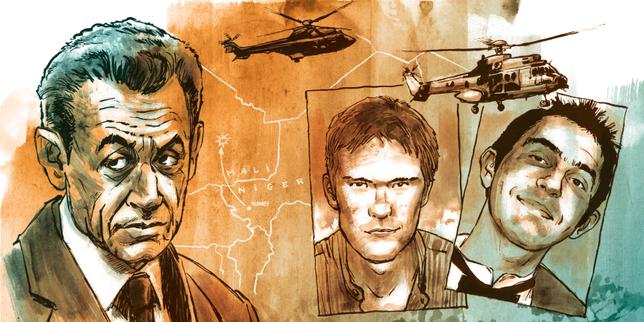
The air in Niamey during the dry season doesn't just hold the heat; it carries a fine, golden dust from the desert that settles on everything. It gets into your clothes, your hair, and the back of your throat. In January, the evening brings a brief, deceptive cool. People gather under the open sky to talk, to drink tea, to escape the heavy stillness of indoor rooms.
On a Friday night in 2011, Antoine de Léocour and Vincent Delory sat at a restaurant table in the capital city of Niger. They were twenty-five. They were childhood friends from Linselles, a quiet town in the north of France, reunited by a celebration. Antoine lived in Niger, working for an aid organization, and was weeks away from marrying a Nigerien woman. Vincent had just stepped off a plane the day before, carrying a suit in his luggage. He was to be the best man.
They were caught in the middle of a laugh when the men with assault rifles walked in.
It took less than two minutes. The gunmen forced the two friends into a pickup truck, alongside a Nigerien driver, and sped toward the northern border. Within hours, the personal tragedy of two families became a geopolitical crisis managed from a brightly lit war room thousands of miles away in Paris.
When a state faces a hostage situation, the public rhetoric is almost always uniform. It is a language of unyielding steel. Governments declare that they will not negotiate, they will not pay ransoms, and they will not bow to terror. This posture is designed to project strength and deter future crimes.
But abstract doctrines look very different when translated into a midnight pursuit across a pitch-black desert.
Consider what happens next when absolute firmness meets the chaotic reality of a rescue operation. The French military, tracking the dust clouds of the fleeing trucks from the sky, launched an interception. French special forces swooped in on helicopters. A fierce firefight erupted in the scrubland near the Malian border.
In the morning, the smoke cleared to reveal a horrific scene. The kidnappers were dead. But so were Antoine and Vincent. Antoine had been executed by his captors at the final moment. Vincent did not die from a terrorist’s bullet; he perished in the intense fire that consumed one of the vehicles during the military assault.
The strategy had been executed perfectly on paper. The line had been held. The state had not blinked. Yet the result was two flag-draped coffins arriving at a military airfield in France, received by weeping parents who had been preparing for a wedding.
This is the agonizing math of statecraft. To the strategists in the capital, a firm stance is an investment in long-term security. They argue that paying a ransom or showing weakness only funds the next attack, endangering thousands of citizens down the road. It is a logical, cold calculation.
But for the families left behind, that logic feels like an abandonment. For years after the tragedy, the relatives of Vincent and Antoine fought for answers, demanding to see the unedited military videos of the clash. They wanted to know why an attack was launched when the risks to the hostages were so absolute. They had to navigate a wall of state secrecy, discovering that the truth is often the first thing hidden when a rescue turns into a disaster.
The policy of refusal is built on a paradox. It requires a government to value the lives of hypothetical future citizens over the breathing, terrified citizens currently held in the back of a truck. It demands that leaders look at a family and say, silently, that their child’s life is a price worth paying for national prestige.
Every time a nation-state declares its absolute refusal to compromise, a clock begins to tick in the dark. The tragedy in the sands of Niger showed that when a message of firmness becomes an inflexible rule, the human beings at the center cease to be people. They become symbols. And symbols, unlike flesh and blood, do not bleed when the crossfire begins.



