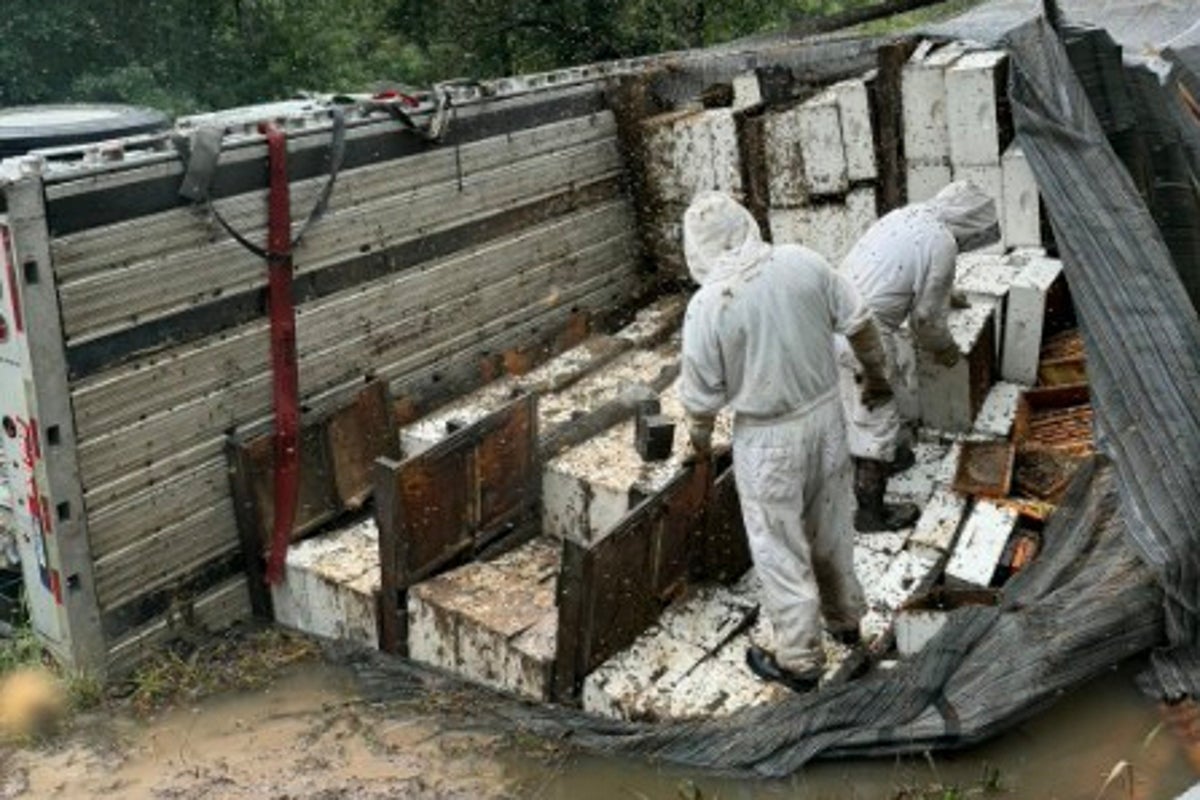
The asphalt on Interstate 35 was still radiating the brutal leftover heat of a Texas afternoon when the air began to vibrate.
To a driver stuck in the sudden, mile-long backup, it initially sounded like a blown tire in the distance—a low, rhythmic droning. Then the wind shifted. The drone sharpened into a high-pitched, furious hum that resonated right through the floorboards of idling sedans.
An overturned semitrailer lay on its side across the lanes, its cargo shattered. But this wasn't a spill of gravel, Amazon boxes, or crude oil. It was a ruptured nerve center of American agriculture. Millions of honeybees, suddenly weaponized by panic and confusion, were pouring out of thousands of broken wooden hives into the blinding southern sun.
Most people see a headline about an overturned bee truck and think of a freak traffic inconvenience, or perhaps a scene from a low-budget horror flick. We laugh at the mental image of state troopers swatting at the air. We roll up our windows, turn up the air conditioning, and complain about the delay.
We miss the real story entirely.
That overturned rig wasn't just carrying insects. It was carrying the invisible infrastructure of our entire food supply, precariously balanced on eighteen wheels and a prayer.
The Midnight Migration
To understand how millions of bees ended up flipping over on a Texas highway, you have to look at the exhausted faces of the migratory beekeepers who live on the road.
Let us call one of these drivers Robert. He is a hypothetical composite of the half-dozen commercial keepers who haul these delicate payloads across state lines every week, but his reality is entirely concrete. Robert hasn’t slept more than four consecutive hours in days. His hands are permanently stained with propolis—the sticky resin bees use to seal their hives—and his truck smells of diesel oil and sweet, warm wax.
The economics of modern farming dictate that Robert must move his livestock under the cover of total darkness.
Bees are fundamentally solar-powered creatures. When the sun goes down, they return to the hive, clustering together for warmth and security. That is the only window a keeper has. You wait until dusk, you load hundreds of heavy, stacked wooden boxes onto a flatbed using a forklift, and you strap them down securely under a specialized net.
Then, you drive. You drive like hell through the night because you are racing the sunrise.
If the sun comes up while the truck is stationary, the bees wake up. They realize they are trapped. The temperature inside those stacked hives begins to climb exponentially, driven by the collective body heat of millions of stressed insects. If a truck gets stuck in a daylight traffic jam without the cooling rush of highway wind blowing through the netting, the hives can literally melt from the inside out, suffocating the colony in its own liquefied honey.
Imagine the pressure of that ticking clock. You are piloting eighty thousand pounds of living, breathing, easily angered cargo down a dark interstate, knowing that a single mechanical failure or a moment of highway hypnosis could destroy your entire livelihood before breakfast.
That is the tension that snapped on the tarmac in Texas. A sudden swerve, a blown tire, a moment of shifting weight—and the fragile illusion of control shattered.
The Chaos on the Tarmac
When the hives broke open, the immediate aftermath was pure survival instinct.
A bee away from its hive is usually docile, merely searching for pollen or water. But a bee whose home has just been dropped from the sky at sixty miles per hour is a creature in the throes of an existential crisis. The air became a thick, living fog of stinging defense mechanisms.
First responders arriving at the scene faced a bizarre tactical nightmare. You cannot put a tourniquet on a swarm. You cannot contain a spill that flies. Firefighters had to don heavy protective gear usually reserved for hazardous chemical spills, their visibility clouded by thousands of insects pelting their helmets like tiny, furious hailstones.
But look past the immediate panic of the scene and look at the financial and ecological ruin bleeding out onto the shoulder of the highway.
Commercial beehives are not cheap. A single healthy colony can cost hundreds of dollars to establish and maintain. When a semi flips, a beekeeper doesn't just lose a truck; they lose millions of highly trained, genetically selected workers. They lose the honey crop. They lose the specialized wooden equipment passed down through generations of family businesses.
More importantly, they lose their contracts.
Those bees were not on a joyride through Texas. They were likely en route to pollinate vast fields of crops—perhaps almonds in California, blueberries in Maine, or pumpkins in Illinois. Our agricultural system is wholly dependent on this nomadic workforce. We have built a system so specialized, so detached from regional ecosystems, that without the constant interstate trucking of billions of bees, our grocery store produce aisles would look like a dust bowl within a single season.
The Invisible Engine of the Supermarket
Consider the breakfast you ate this morning.
If you had a slice of melon, a handful of berries, or a splash of almond milk in your coffee, you were directly consuming the labor of a migratory honeybee. One out of every three bites of food we eat depends entirely on pollinators.
We tend to view agriculture as a mechanical process: tractors tilling soil, automated sprinklers watering fields, chemicals suppressing weeds. We like to believe we have mastered the art of food production through sheer technological might.
It is a comforting lie.
The truth is far more humbling. The entire multi-billion-dollar industrial farming apparatus is utterly beholden to an ancient, delicate biological partnership. If a tiny insect with a brain the size of a sesame seed decides not to crawl inside an almond blossom, the machine grinds to a halt. There is no machine, no artificial intelligence, no drone technology that can replicate the scale and efficiency of what these insects do naturally.
Yet, we treat them as disposable freight.
Every year, commercial beekeepers lose an average of thirty to forty percent of their colonies to a toxic cocktail of pesticides, habitat loss, parasitic mites, and the sheer stress of being trucked thousands of miles across continental highways. The turnover of a semitrailer isn't an isolated accident; it is a violent punctuation mark at the end of a long sentence about how heavily we overtax our natural resources.
It is easy to feel disconnected from this reality when you are walking through a climate-controlled supermarket, staring at pristine rows of plastic-wrapped strawberries. The system is designed to hide the friction. It wants you to believe that food appears by magic. It shields you from the exhaustion of the midnight drivers, the sting of the smoke-filled apiaries, and the fragile vulnerability of the creatures that make it all possible.
What Remains in the Ditches
Hours after the crash, the shattered remnants of the hives were cleared from the Texas interstate. The wrecked semi was towed away. The traffic lanes reopened, and commuter traffic resumed its steady, oblivious roar over the stained asphalt.
But for days afterward, the local environment bore the quiet scars of the disaster.
Thousands of bees that survived the initial impact but were separated from their queens lingered in the nearby brush. They clustered in pathetic, shivering clumps on fence posts and the branches of scrub oaks, waiting for a signal that would never come. Without their hive structure, without their sisters, they were functionally dead already, slowly running out of energy under the vast Texas sky.
The next time you see a brief news blurb about an accident on a distant highway, or when you notice a slight uptick in the price of your favorite fruit, remember the hum.
Remember the frantic, vibrating air on Interstate 35. Remember that our comfort is not guaranteed by the strength of our concrete or the speed of our supply chains, but by the fragile, buzzing lives of a displaced colony, scattered across the breakdown lane.

/https://tf-cmsv2-smithsonianmag-media.s3.amazonaws.com/filer/c6/97/c697b065-e0bd-4970-81ea-819779296b91/u765404inp.jpg)
